
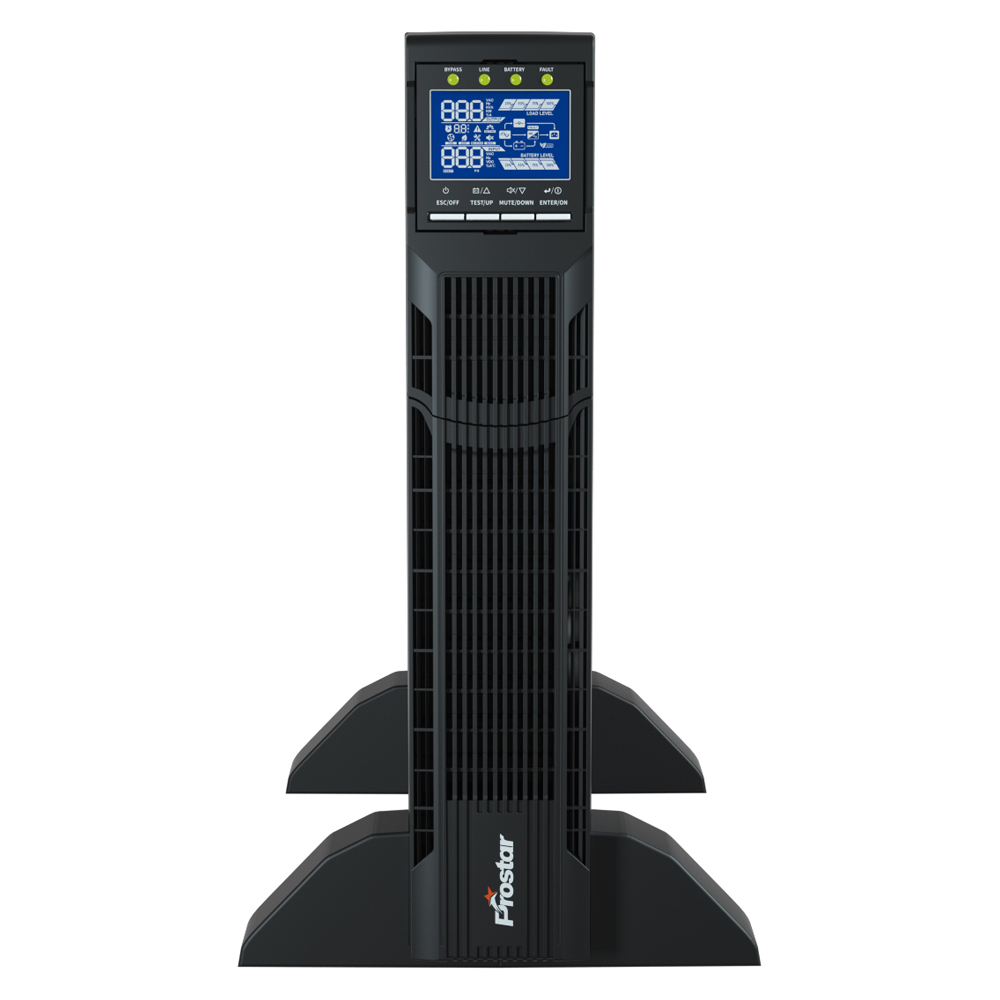
Prostar PER1101+Li is a 1000VA/1000W lithium ion UPS. It has 2U rack-mount form factor, integrated LiFePO4 battery technology, and a 90° rotatable LCD. It installs as a 2U rack mount UPS or a tower UPS. This is suitable for servers, networking equipment, telecom devices, security systems, workstations, and other critical electronic loads.
Why choose this lithium ion UPS?
Compared with lead-acid UPS systems, the PER1101+Li uses LiFePO4 technology. LiFePO4 offers 2,000–5,000 charge cycles, 90–120 Wh/kg energy density, and no routine watering or equalization. The chassis fits rack or tower positions. Its rotatable LCD, compact 2U chassis, and 1000W output make it particularly suitable for space-constrained IT environments.
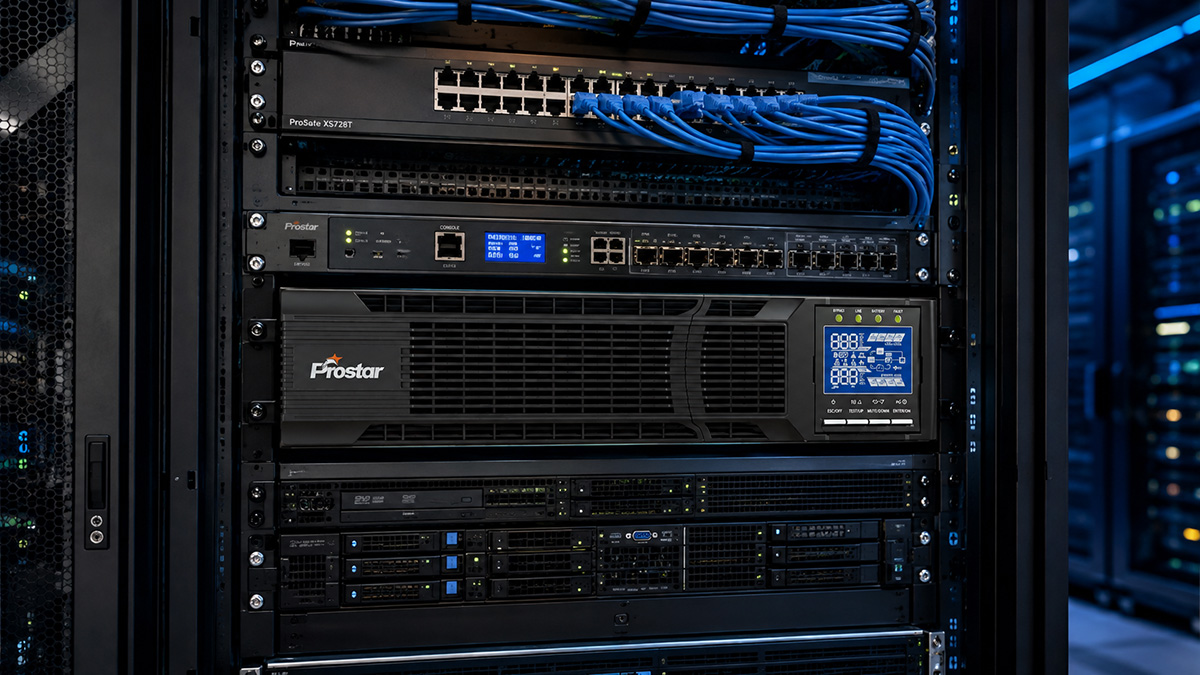

Conventional UPS Designs Lack Installation Options
Modern IT and electronic equipment needs compact, reliable, and low-maintenance backup power. Conventional UPS systems create several problems.
A lead-acid UPS may need battery replacement every 3–5 years. It occupies 3–5 U of rack space or 0.3–0.8 m² of floor area. It weighs 15–25 kg for a 1000VA model. Many UPS systems mount only in racks or only as towers.
This creates a problem for system integrators and IT managers:
- A rack-mounted UPS does not work well outside a rack.
- The tower UPS uses floor space in a server room.
- A fixed LCD becomes unreadable when installed horizontally.
- Lead-acid batteries add 8–12 kg weight and require replacement every 2–4 years.
- Small businesses and distributed IT sites need power protection without large UPS cabinets.
The PER1101+Li 1000VA lithium ion UPS addresses these requirements. It combines LiFePO4 batteries, two installation methods, 1000W output in 2U, and local monitoring via LCD and ports.
1000VA Lithium Ion UPS for Rack and Tower Installation
The PER1101+Li is a 1000VA/1000W lithium ion UPS. It targets applications where space, battery cycle life, installation flexibility, and power protection matter.
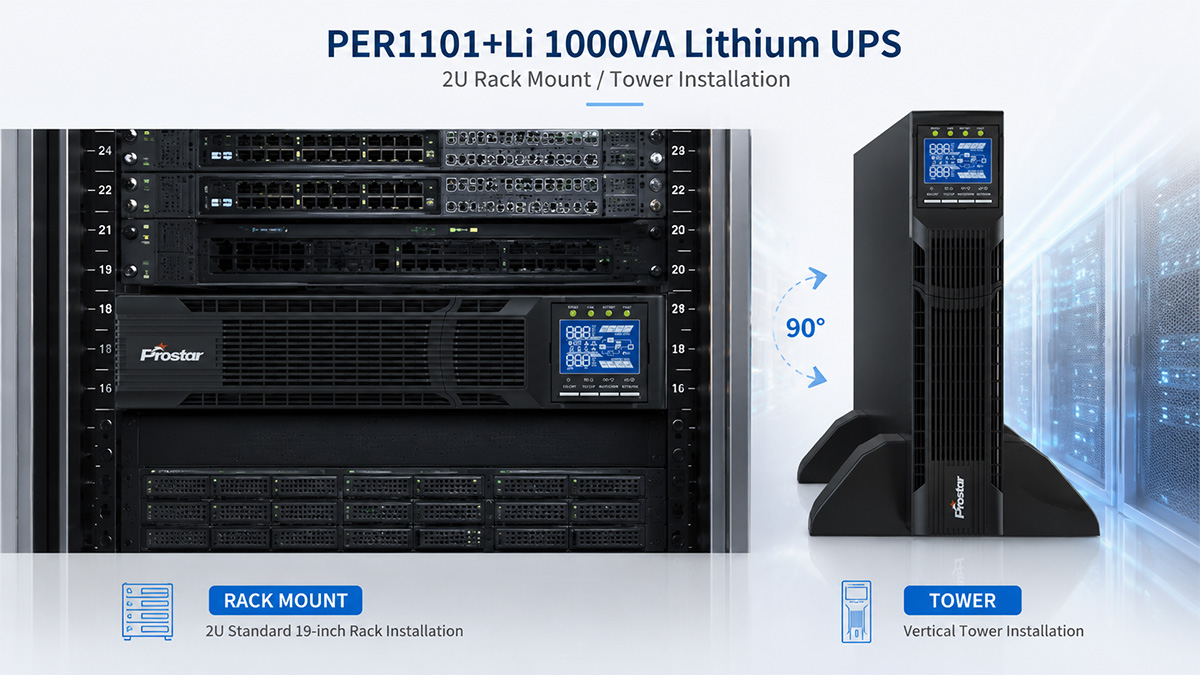
Its mechanical feature is the 2U chassis with a 90° rotatable LCD.
The same UPS configures for:
Rack installation → rotate the LCD → install horizontally in a standard rack
or
Tower installation → rotate the LCD → place the UPS vertically beside the equipment
This produces an adaptable rack mount lithium ion UPS. You do not choose between rack and tower at purchase.
The 90° rotatable LCD improves interface readability according to physical orientation.
| Installation Mode | LCD Orientation | Typical Application |
| Rack Mount | Rotated for horizontal installation | Server racks, network cabinets, telecom racks |
| Tower | Rotated for vertical installation | Offices, security rooms, control rooms |
| Distributed IT | Adjustable according to deployment | Branch offices, retail, small server rooms |
| System Integration | Flexible | OEM/ODM and project applications |
This attracts IT system integrators, UPS distributors, telecom installers, and professional users who need one UPS platform for multiple deployments.
Why It Matters in a Lithium Ion UPS
The battery determines backup runtime and operating cost.
A UPS may have efficient power electronics, but backup performance and total cost depend on battery chemistry.
The PER1101+Li uses a LiFePO4 lithium battery, a lithium-ion chemistry widely selected for applications requiring a combination of safety, cycle life, stability, and compact energy storage.
Compared with conventional VRLA lead-acid batteries, LiFePO4 technology can provide important system-level advantages.
| Factor | LiFePO4 Lithium Ion UPS | Conventional VRLA UPS |
| Battery Chemistry | Lithium Iron Phosphate | Lead Acid |
| Energy Density | Higher | Lower |
| Expected Battery Service Life | Generally longer | Generally shorter |
| Weight | Lower | Higher |
| Maintenance | Lower | Higher |
| Space Efficiency | Excellent | Moderate |
| Cycle Performance | Excellent | Moderate |
| Suitability for Frequent Cycling | Better | More limited |
| Long-Term Replacement Requirement | Reduced | More frequent |
The exact battery life depends on operating temperature, charging conditions, depth of discharge, load profile, battery management, and other environmental factors. Therefore, lithium technology should not be evaluated simply by battery capacity; the complete UPS + battery management + thermal environment + load profile should be considered.
Technical Specifications
General Specifications
| Parameter | Specification |
| Model | PER1101+Li |
| Capacity | 1000VA / 1000W |
| Topology | Online Double Conversion |
| Phase | Single Phase |
| Form Factor | Rack Mounted |
| Dimension (D×W×H) | 440x420x88 mm [2U] |
| Net Weight | 6.5 kg |
Input and Output Performance
| Parameter | Specification |
| Input Voltage Range | Nominal Voltage ±15% |
| Frequency Range | 50Hz: 44-56Hz / 60Hz:54-66Hz |
| Input Power Factor | ≥0.99 |
| Input THDi | <6% |
| Output Voltage | 208/220/230/240VAC Selectable |
| Voltage Regulation | ±1% (Battery Mode) |
| Output Waveform | Pure Sine Wave |
| Transfer Time | 0ms |
| Battery Frequency Accuracy | 50Hz/60Hz ±0.1% |
| Crest Factor | 3:1 |
Battery and Communication
| Parameter | Specification |
| Battery Type | LiFePO4 Lithium / Lead Acid |
| Nominal Battery Voltage | 48VDC (51.2VDC LiFePO4) |
| Charging Current | 5A Default, Adjustable 1-30A |
| Charging Mode | CC/Floating or CC/CV/Floating |
| Battery Protection | Over-charge, Over-discharge, Over-current, Short Circuit, Temperature Protection |
| Communication Ports | USB / RS232 / RS485 |
| Smart Slot | SNMP / Dry Contact Optional |
| BMS Protocol | Pylontech RS485 & CANbus |
Lithium UPS Detail
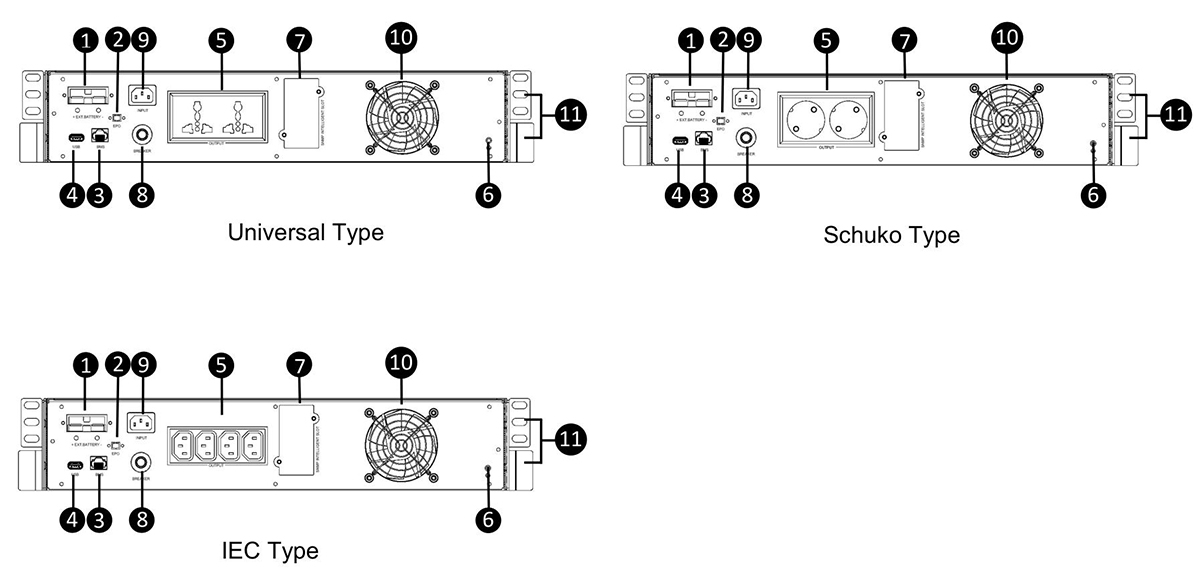

| 1. External Battery Connector | 2. Emergency Power Off(Option) | 3. RS485 Port for BMS |
| 4. USB Port | 5. AC Output Sockets | 6. Grounding |
| 7. Intelligent Slot(for SNMP Card or AS400 Dry Contact) | 8. Input Circuit Breaker | 9. AC Input Terminal |
High Power Density for Critical Loads
The PER1101+Li provides 1000VA / 1000W output capacity.
The 1:1 VA-to-Watt relationship is particularly useful for modern electronic loads because the UPS can deliver its rated apparent power without requiring users to significantly derate the connected load due to a low output power factor.
Typical applications include:
- Network switches
- Routers and firewalls
- Small servers
- NAS systems
- CCTV and security equipment
- Telecom equipment
- Industrial control equipment
- Professional workstations
- POS systems
- Access-control systems
- Communication equipment
For example, a load consisting of a server, network switch, router, and storage device can potentially be consolidated into a compact UPS-protected power architecture, provided the actual total load remains within the UPS’s rated output and transient requirements.
2U Rack Mount Design for Modern IT Infrastructure
Space inside an IT rack is expensive.
A 2U lithium ion UPS allows power protection to be integrated directly into a standard rack architecture without requiring a separate floor-standing UPS cabinet.
This is especially useful for:
Data and Network Rooms
The UPS can be installed together with servers, switches, firewalls, storage devices, and other network infrastructure.
Edge Computing
Distributed computing locations often have limited physical space and require compact backup power.
Telecom Applications
Rack-mounted UPS systems can protect communication and networking equipment while maintaining an organized cabinet layout.
Small and Medium Businesses
A compact rack UPS can provide professional backup power without requiring a dedicated UPS room.
Security Systems
CCTV servers, network video recorders, access-control systems, and communication equipment can benefit from centralized backup power.
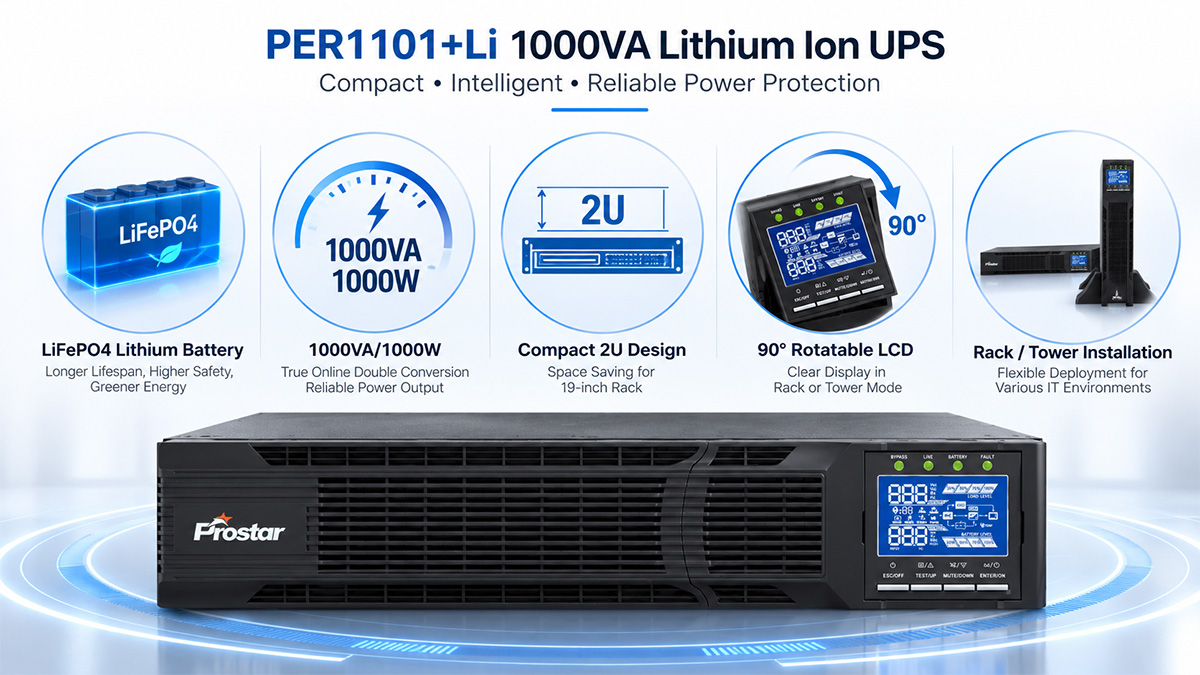
90-Degree Rotatable LCD Screen
One of the strongest differentiators of the PER1101+Li is its rotatable LCD interface.
For a conventional rack UPS, the LCD is normally designed around horizontal rack installation. If the same unit is used as a tower, the display orientation may become inconvenient.
PER1101+Li solves this through a 90-degree rotatable LCD.
Rack Mount Configuration
The UPS is installed horizontally inside the rack. The LCD is rotated so that the interface remains correctly oriented for the operator.
Tower Configuration
The UPS is positioned vertically using the appropriate tower installation arrangement. The LCD can be rotated 90° so the information remains easy to read.
This design provides a practical advantage for distributors and system integrators because the same product can address two installation requirements.
Frequently Asked Questions (FAQ)
The Articles You may Like
- Protect Your Infrastructure: Online UPS Benefits
- Stand-alone power system – Wikipedia
- How to Size Modular UPS for Server Room Without Overspending
- Safeguard Your Electronics with a UPS Backup Power Supply for Home
- How Does Online UPS Protect Home Computers
- 5 Essential Benefits of Uninterruptible Power Supply UPS