
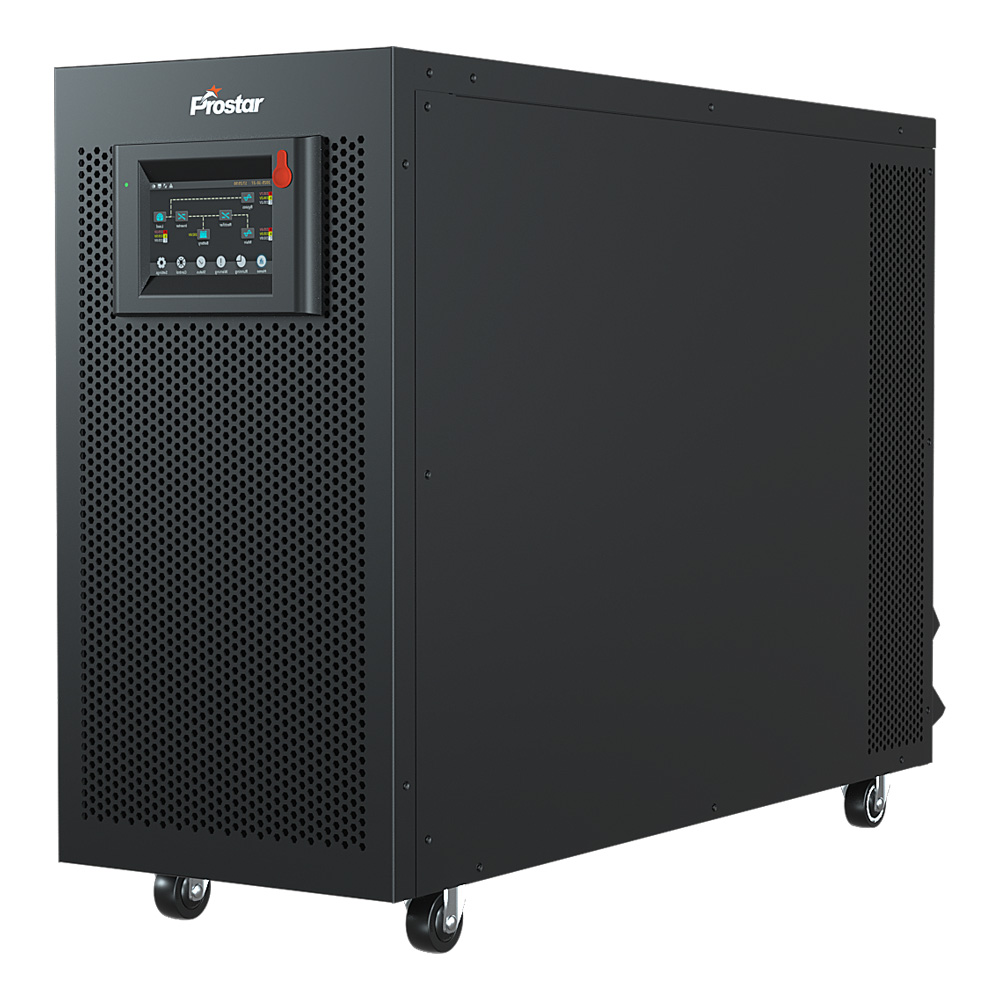
Prostar PET3310 three phase high frequency pure sine wave 10kva ups system provides a clean and stable pure sine wave output. It fully isolates connected equipment from power disturbances. These disturbances include voltage fluctuations, surges, harmonics, and frequency instability.
With a 10kVA capacity and unity output power factor, the 10kva ups system ensures maximum usable power. It also improves energy efficiency. This makes it ideal for modern loads with high power density. Its DSP-based digital control system guarantees fast response, precise regulation, and enhanced system reliability.
The high-frequency transformerless design significantly reduces system size and weight while improving overall efficiency and lowering operating costs. The 10kva ups system supports a wide input voltage range. It operates reliably even in harsh power environments. This minimizes battery discharge to extend battery life.
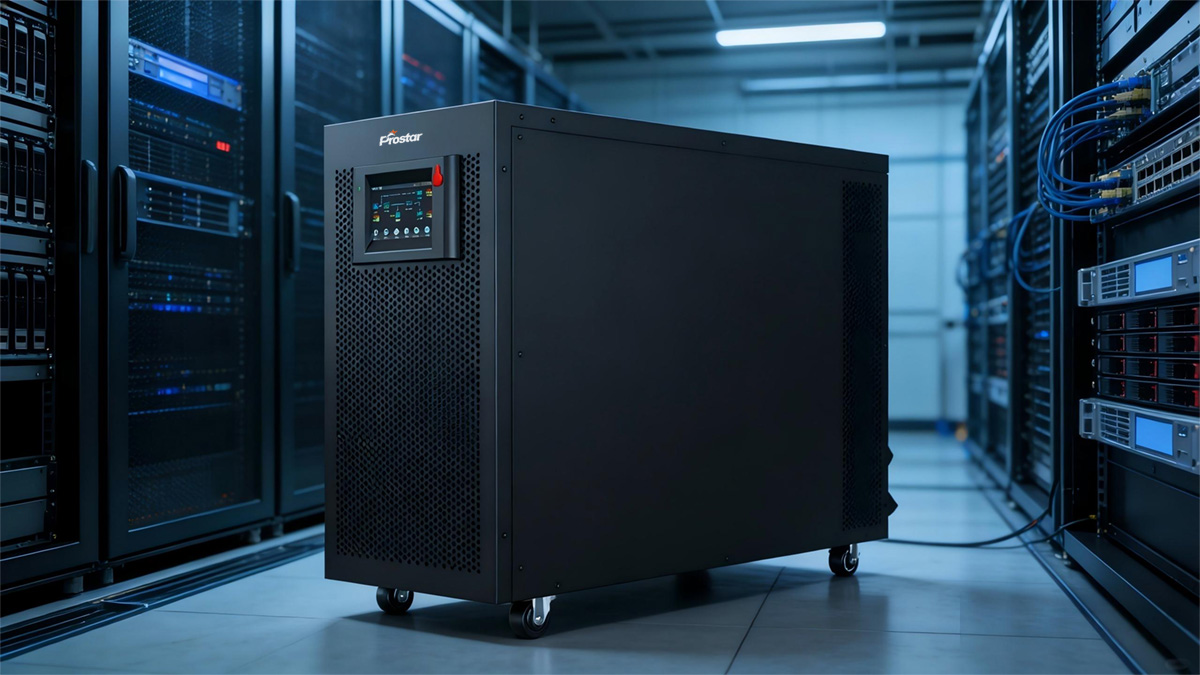

10kVA UPS System Key Features
True Double-Conversion Online Technology
Provides zero transfer time and complete electrical isolation for maximum power protection.
Comprehensive Protection Functions
Includes overload, short-circuit, over-temperature, over-voltage, under-voltage, and battery protection.
3-Phase Input / 3-Phase Output Design
Ideal for balanced three-phase loads in medical, commercial, and IT environments.
Wide Input Voltage and Frequency Range
Maintains stable operation under unstable grid conditions, reducing battery usage and extending battery life.
Intelligent Battery Management
Supports flexible battery configuration and optimized charging control.
High Efficiency and Energy Saving
Optimized power conversion reduces operating costs and improves overall system performance.
User-Friendly LCD Display and LED Indicators
Real-time monitoring of system status, alarms, and electrical parameters for easy operation and maintenance.
UPS Power Supply Connection Diagram
The online double-conversion UPS acts as the core of the system. It continuously converts incoming AC power to DC. Then it converts the DC back to clean, regulated AC power. This design fully isolates the load from input power disturbances such as voltage fluctuations, frequency variations, and electrical noise.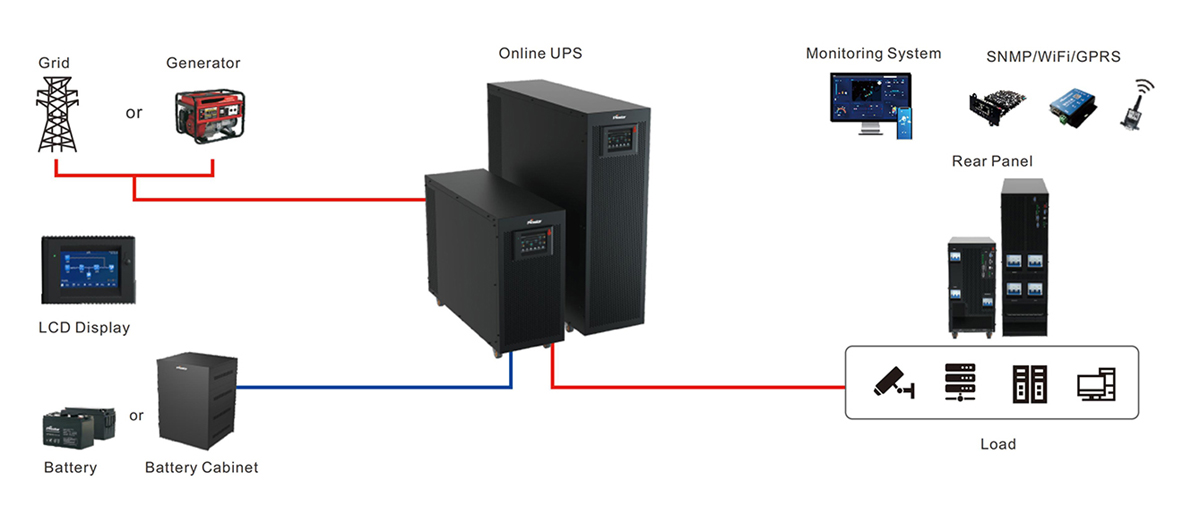

An external battery bank or battery cabinet is connected to the UPS to provide uninterrupted backup power during mains failure. The UPS automatically switches to battery mode without interruption, ensuring continuous operation of connected equipment.
The conditioned and regulated output power from the UPS is delivered to various critical loads. This includes servers, data centers, security systems, networking equipment, and industrial devices. This ensures maximum protection and reliability.
Uninterruptible Power Supply System Details
Rear Panel Shown
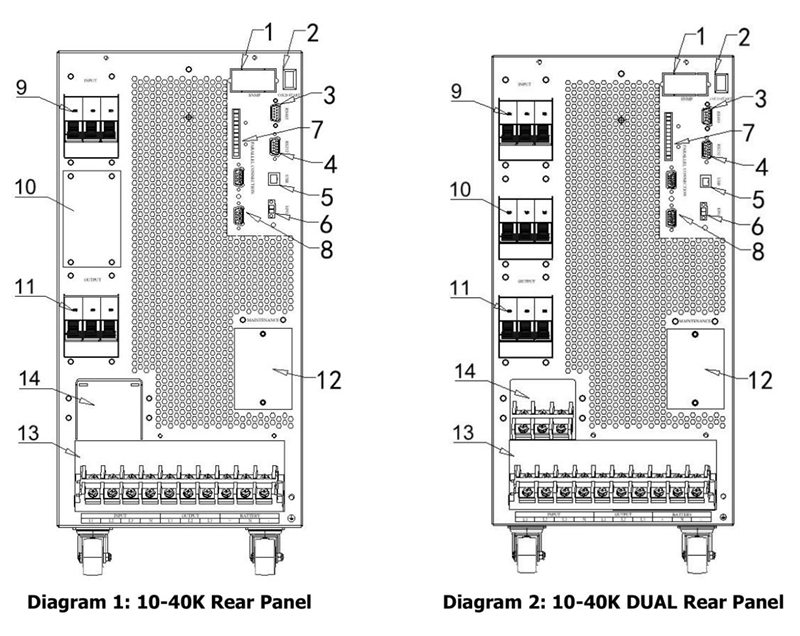

| 1. SNMP intelligent slot | 2. Cold start function | 3. RS485 communication port |
| 4. RS232 communication port | 5. USB communication port | 6. Emergency power off function connector |
| 7. Share current port(only for parallel model) | 8. Parallel port (only for parallel model) | 9. Line input circuit breaker/switch |
| 10. Manual bypass switch (10kVA – 40kVA optional configuration) | 11. Output switch | 12. Maintenance bypass switch |
| 13. Line connection terminal | 14. Bypass input terminal (10kVA-40kVA optional configuration) | 15. Battery switch |
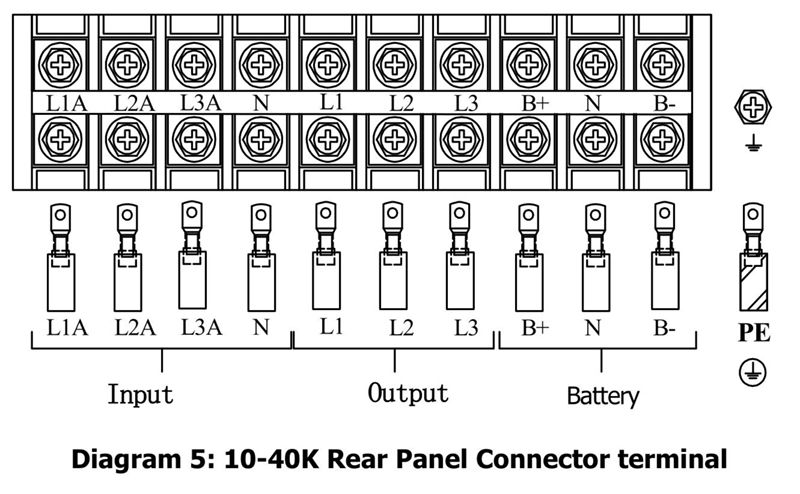
Rear Panel Connection Terminal

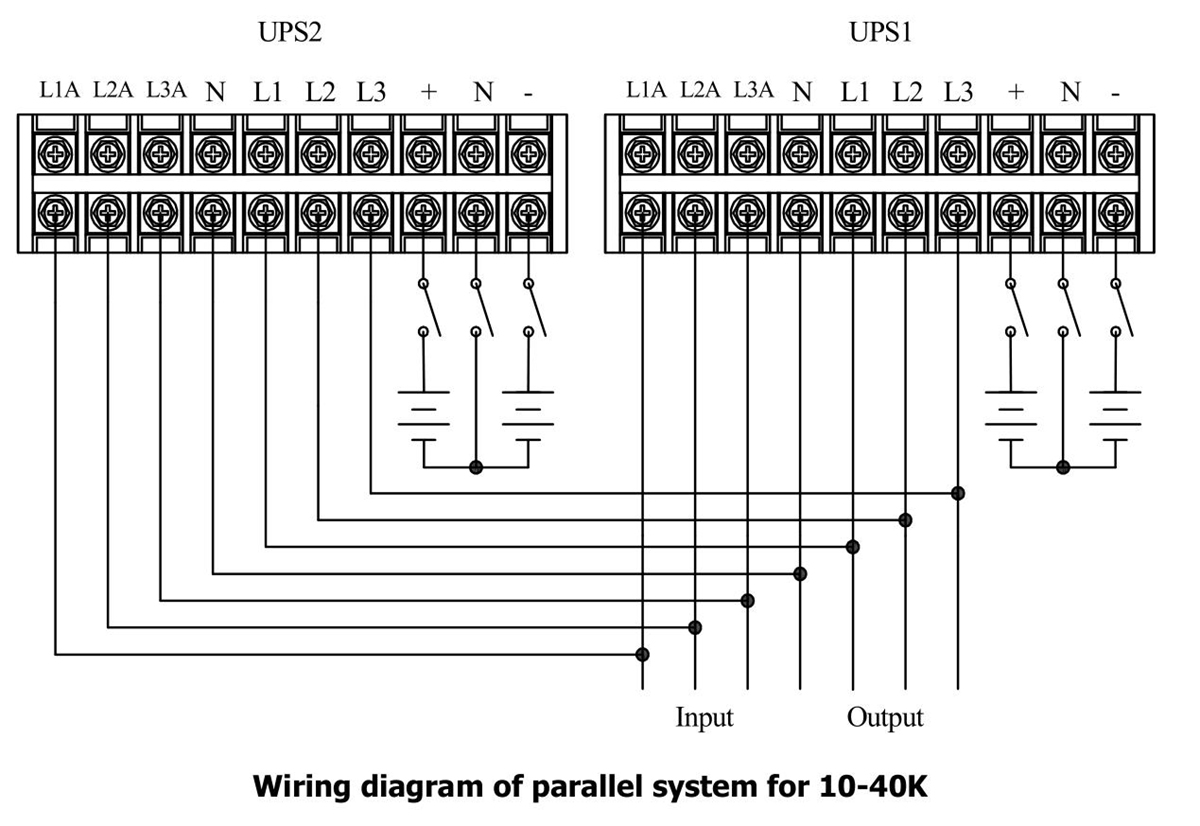
Parallel Wiring Diagram

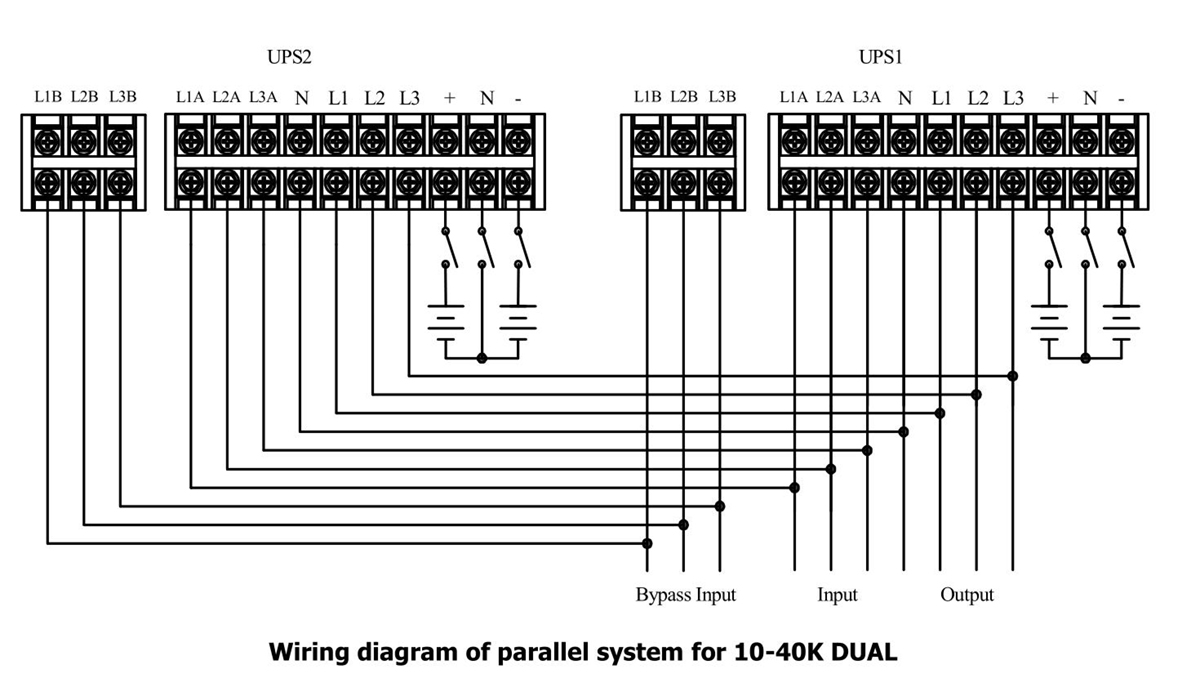
Dual Input in Parallel Operation

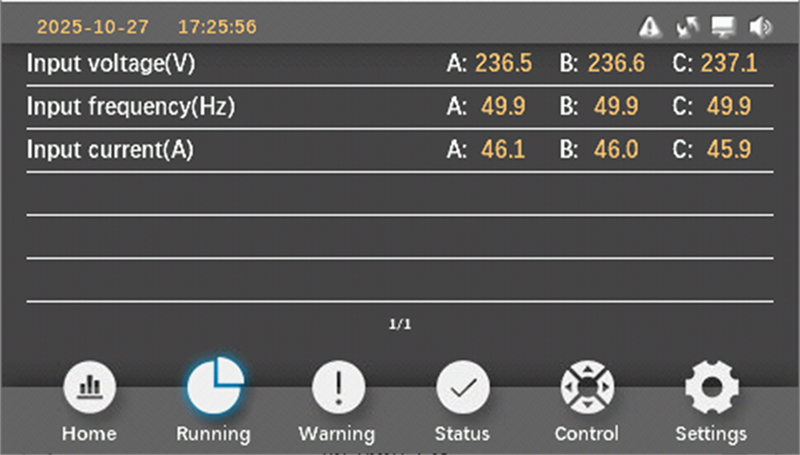
AC Input Data

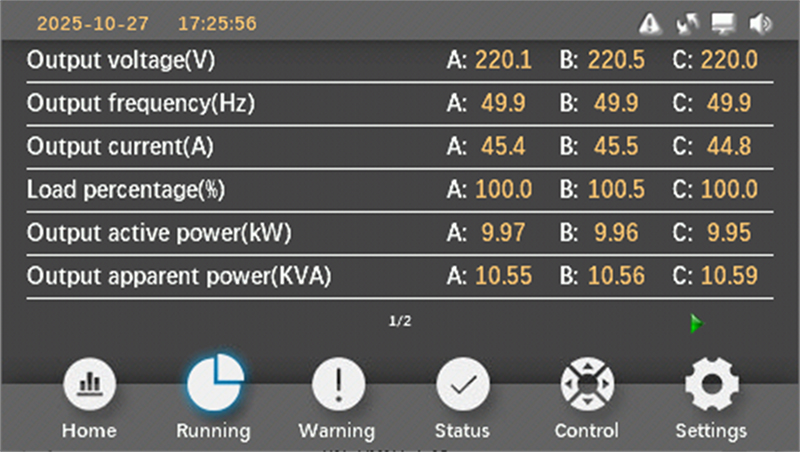
AC Output Information

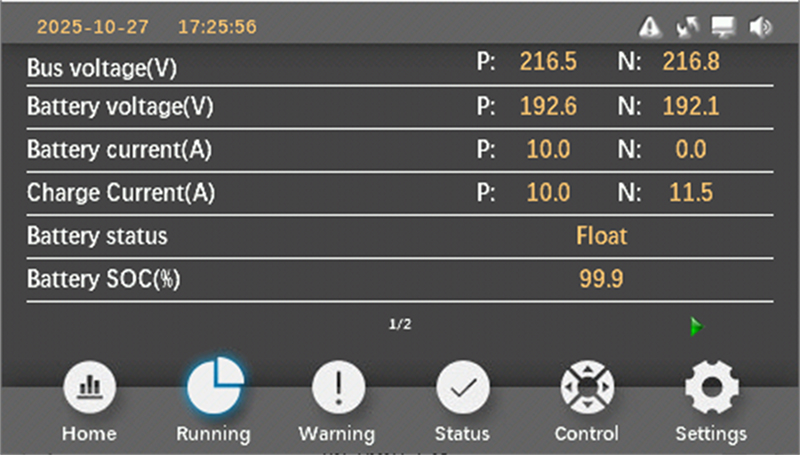
Battery Information
UPS Specifications
Rated Capacity
-
Power Range: 10kVA/10kW
-
Output Power Factor: 1.0
AC Input
-
Input Phase: Three-phase (3P + N + PE)
-
Nominal Voltage: 380 / 400 / 415 Vac
-
Voltage Range: 110Vac – 300Vac (P-N)
-
Frequency: 50 / 60 Hz (auto-sensing)
-
Power Factor: ≥ 0.99
-
Input THDi: ≤ 3%
AC Output
-
Output Phase: Three-phase (3P + N + PE)
-
Output Voltage: 380 / 400 / 415 Vac
-
Voltage Regulation: ±1%
-
Frequency Accuracy:
-
Utility mode: synchronized to input
-
Battery mode: ±0.1Hz
-
-
Waveform: Pure sine wave
-
Total Harmonic Distortion (THDv):
-
Linear load: ≤ 2%
-
Non-linear load: ≤ 5%
-
Battery
-
Battery Type: VRLA / External battery bank
-
Battery Configuration: 32-40 units(adjustable) for 12v battery
-
Backup Time: Configurable via battery capacity
-
Charging Method: Intelligent multi-stage charging
Parallel Operation
-
Parallel Capability: Up to 4 units
-
Parallel Mode: Capacity expansion or N+1 redundancy
-
Battery System: Shared battery bank supported
Communication & Monitoring
-
Display: LCD + LED indicators
-
Standard Interface: RS232 / RS485 / USB
-
Optional Interface: SNMP, WiFi, GPRS, Dry Contact
-
Monitoring: Local and remote real-time monitoring
Mechanical
-
Design: Transformerless, high-frequency
-
Installation: Tower / Cabinet type
-
Cooling: Intelligent forced air cooling
-
Protection Level: IP20
- Dimension: 250x695x545mm
How to Install
Safety Precautions
-
Installation must be performed by qualified electrical personnel only.
-
Before installation, ensure the input power supply is completely disconnected.
-
Use proper personal protective equipment (PPE) during installation.
-
Ensure the UPS is properly grounded to prevent electric shock.
-
Do not operate the UPS if there is visible damage.
Positioning the UPS
-
Place the UPS on a flat, stable surface or mount it according to the cabinet design.
-
Ensure the unit is level and securely positioned to prevent movement.
Electrical Wiring (Three Phase)
Important: Follow the wiring diagram provided on the UPS or in the manual.
Input Power Connection
-
Connect the three-phase input cables (L1, L2, L3), Neutral (N), and Earth (PE) to the input terminals.
-
Verify correct phase sequence.
-
Use cables with appropriate cross-sectional area according to rated current.
Output Power Connection
-
Connect the three-phase output cables (L1, L2, L3), Neutral (N), and Earth (PE) to the output terminals.
-
Ensure proper tightening of all terminals.
Grounding
- Connect the UPS protective earth (PE) terminal securely to the site grounding system.
Battery Connection
-
Ensure the battery circuit breaker is OFF before connecting batteries.
-
Connect the batteries according to the specified DC voltage and polarity.
-
Do not reverse battery polarity, as this may damage the UPS.
-
Use cables of sufficient size to handle the DC current.
-
After confirming correct wiring, switch ON the battery breaker.
Load Connection
-
Connect loads gradually after the UPS is operating normally.
-
Ensure the total load does not exceed 100% rated capacity.
-
Balance loads evenly across the three phases.
Functional Check
-
Confirm input, output voltage, frequency, and load levels on the LCD.
-
Perform a battery test if supported.
-
Simulate a mains failure to verify backup operation.
Ideal Applications
-
Data centers and server rooms
-
Industrial and manufacturing facilities
-
Medical and healthcare systems
-
Financial institutions
-
Telecommunications and network infrastructure
The Articles You may Like
- The Essential Role of Industrial Grade UPS Systems in Modern Manufacturing
- Split-phase electric power – Wikipedia
- What is the CT Sensor in Solar Inverter On Off Grid
- Business UPS Solutions for Small and Large Enterprises
- How to Select Three Phase Online UPS for Industrial Power Backup
- Safeguard Your Electronics with a UPS Backup Power Supply for Home