

Digital Signal Processor DSP based industrial ups systems represent a paradigm shift in industrial power protection technology. Unlike conventional UPS architectures, which rely on analog control circuits and mechanical components, DSP-based systems use real-time digital control. They deliver superior power quality. They also offer faster dynamic response and enhanced operational efficiency. These systems have become the industry standard for facilities where power continuity and quality are non-negotiable—from hyperscale data centers to pharmaceutical manufacturing plants and financial institutions
The fundamental advantage of DSP-based technology lies in its ability to process multiple feedback signals simultaneously. It can execute complex control algorithms in real-time. This enables the UPS to respond to power disturbances in microseconds rather than milliseconds.
What is a DSP-Based Industrial UPS?
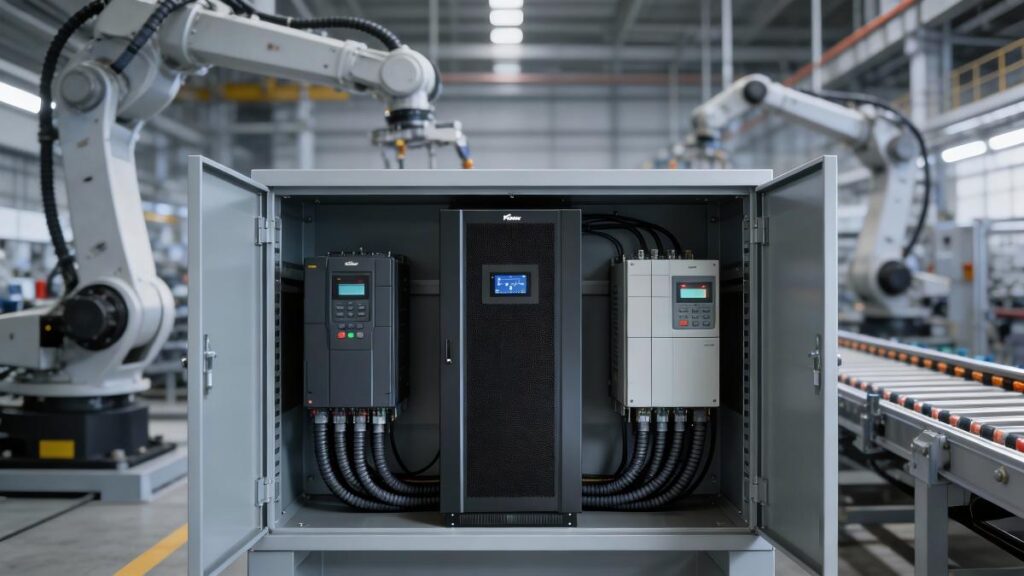
A UPS system is designed to provide backup power during mains failure, ensuring seamless operation of connected devices. Traditional UPS systems often rely on analog controls, which can be limited in handling complex power scenarios. In contrast, DSP based industrial UPS incorporates Digital Signal Processing. This is a technology that uses microprocessors to analyze and manipulate electrical signals in real-time.
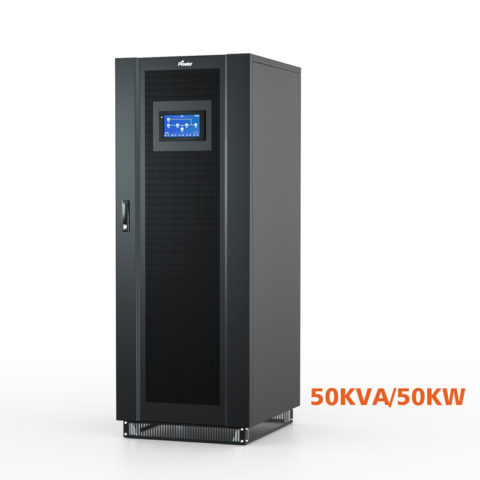
At its core, DSP involves converting analog signals, such as voltage and current, into digital data. This data is processed through algorithms. Finally, it is converted back to analog output. This allows for precise control over the power waveform, typically producing a pure sine wave output. Prostar DSP industrial UPS systems are built to handle higher capacities, ranging from 10 kVA to 500 kVA or more. They are available in single-phase or three-phase configurations. These configurations suit heavy-duty environments like manufacturing plants, data centers, hospitals, and oil refineries.
Key Benefits for Automation and Control
Fast, deterministic control
DSPs execute real-time control loops with microsecond-level determinism, minimizing transfer time and voltage excursions during disturbances.
High-quality output power
Advanced PWM strategies and real-time filtering produce low THD and tight voltage/frequency regulation, protecting sensitive PLCs, servo drives, and instrumentation.
Adaptive response
DSPs enable adaptive control algorithms (e.g., model-predictive control, adaptive droop) that optimize inverter behavior under varying load types—nonlinear, single-phase imbalances, and dynamic motor-start events.
Improved diagnostics and predictive maintenance
Real-time monitoring of waveforms, harmonic content, temperature, and battery state-of-charge allows early fault detection and predictive alerts, reducing unplanned downtime.
Grid-interactive features
Fast synchronization is easier to implement and tune with DSP platforms. Seamless transfer and islanding detection are also easier. Additionally, support for ride-through in weak-grid conditions benefits from DSP platforms.
DSP Control Framework for Industrial UPS
System Architecture and Digital Processing Pipeline
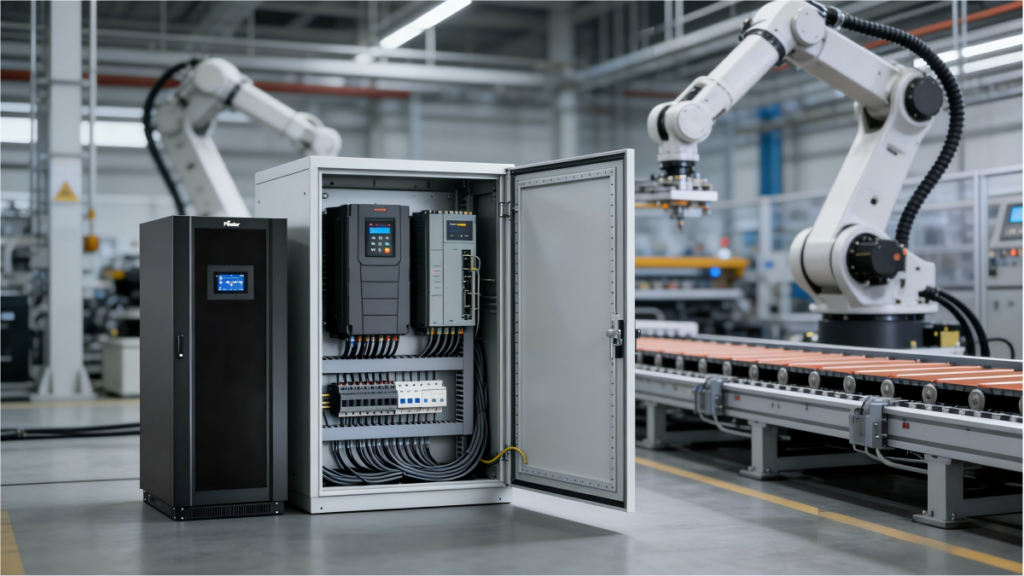
Prostar DSP based industrial UPS relies on a fully digital, distributed control architecture. This system integrates four core subsystems. These subsystems are the DSP main control unit, human–machine interface (HMI), communication module, and comprehensive fault protection system.
State-of-the-art designs increasingly adopt dual-core or multi-core DSP platforms—enabling parallel execution of real-time control tasks. This architecture significantly enhances control bandwidth, fault response speed, and overall system reliability.
Typical switching frequencies range from 10 kHz to 19.2 kHz. This allows the DSP to sample input and output voltages and currents. The sampling rates exceed 40 kHz in advanced implementations. Each control cycle starts a deterministic processing sequence. This sequence involves high-speed ADC sampling. It also includes the execution of voltage and current control algorithms. Harmonic compensation is performed. Lastly, PWM signal generation drives IGBT power stages with precise timing.
Multi-Loop Control Strategy
Industrial DSP-based UPS systems employ a hierarchical, nested multi-loop control structure that divides system regulation into distinct functional domains:
Inner Current Loop
Operating at a crossover frequency of approximately 1.5 kHz, the inner current loop ensures accurate control of switching currents. This minimizes electromagnetic interference (EMI) and provides instantaneous current limiting for short-circuit and overload protection. Proportional compensation parameters are typically optimized through MATLAB/Simulink-based simulation before deployment.
Middle Voltage Loop
The crossover frequency is around 1 kHz. At this frequency, the voltage loop regulates the DC bus. It also controls the output AC voltage amplitude. Feed-forward compensation significantly reduces steady-state error. It is derived from real-time input voltage sampling. This maintains output voltage regulation within ±1–2% under fluctuating load conditions.
Outer RMS Regulation Loop
The RMS loop operates at approximately 10 Hz. It dynamically adjusts the voltage reference amplitude to ensure output RMS voltage stays within 99% of nominal. This stability is maintained even under rapid load variations. A PI controller with carefully tuned gains eliminates static regulation error. It maintains phase margins above 55°. This ensures robust system stability.
To further enhance waveform quality, advanced DSP implementations incorporate repetitive control techniques in the frequency domain. These algorithms suppress harmonic distortion caused by dead-time effects and nonlinear loads. They reduce total harmonic distortion (THD) from 9–30% in legacy designs to below 2% in high-performance systems.
Power Quality Management: Harmonic Mitigation and PFC
Total Harmonic Distortion Reduction
The DSP based industrial UPS technology is its ability to actively control and suppress harmonic distortion at the source. Traditional diode-rectifier front ends generate significant low-order harmonics like the 5th and 7th. They also produce the 11th and 13th harmonics. This results in THD levels of 15–30%. Power factors can be as low as 0.7.
DSP-controlled active power factor correction (PFC) rectifiers fundamentally transform the conversion process. By dynamically modulating IGBT switches, the DSP synthesizes input currents that are sinusoidal and phase-aligned with the input voltage. This approach consistently achieves input current THD below 2% and power factors above 0.99, while simultaneously reducing thermal stress on upstream transformers and distribution infrastructure.
The DSP performs real-time state-space calculations for three-phase boost rectifier stages. It computes duty cycles for each phase leg based on instantaneous voltage and current measurements. This enables stable, low-distortion operation across a wide input voltage range—typically ±30% of nominal in industrial environments.
PFC Topology Advantages
Prostar industrial UPS systems utilize IGBT-based PWM rectifiers operating in continuous-current mode, delivering several critical advantages:
- Bidirectional power flow for seamless generator compatibility
- Reduced EMI due to continuous inductor current
- Simplified LC filter requirements through inherent current smoothing
These benefits allow DSP-based online double-conversion UPS systems to achieve efficiencies of 96–99% while maintaining exceptional power quality.
Real-Time Control Performance
Dynamic Load Response
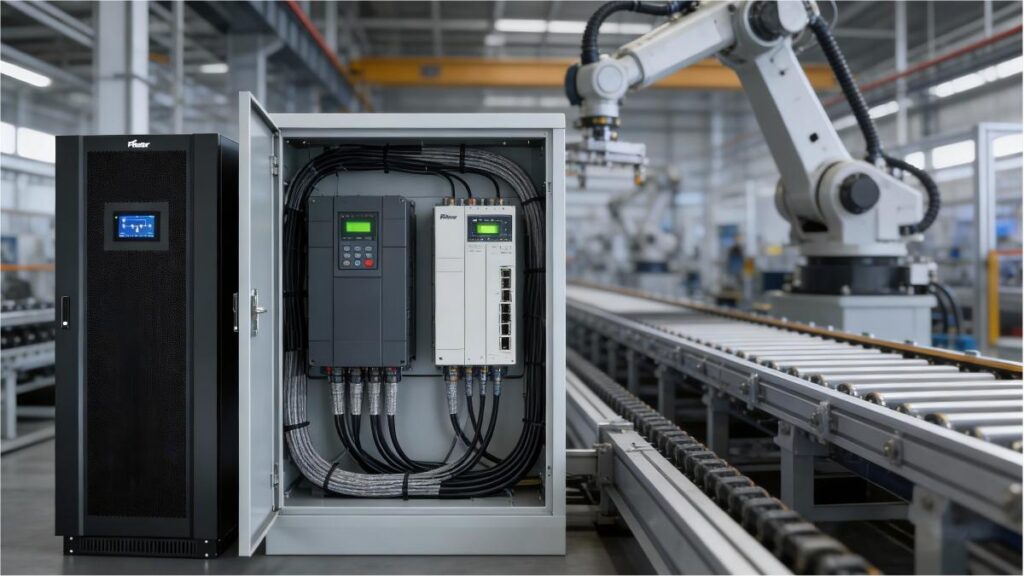
DSP based industrial UPS systems demonstrate outstanding dynamic response to load transients. Validation testing on a 10 kVA three-phase prototype reveals recovery times under 10 ms for linear load steps. It also shows recovery within four fundamental cycles for nonlinear load changes. This is 10–50 times faster than analog-controlled systems, which typically require 100–500 ms to stabilize.
This performance is enabled by the elimination of analog compensation delays. It is also driven by the use of predictive digital control algorithms. Additionally, the inherent linearity of numerical computation across the operating range enhances performance.
Load disturbance rejection is achieved through coordinated action of three mechanisms. The first is fast inner-loop current control. The second is feed-forward voltage compensation. The third is outer-loop voltage regulation ensuring zero steady-state error.
Battery Management and Runtime Optimization
Prostar DSP based industrial UPS integrate intelligent battery management algorithms. These algorithms extend battery service life by 30–40%. This is a significant improvement compared with traditional float-charging designs. Multi-stage charging profiles include bulk charging, absorption charging, and temperature-compensated float charging to prevent overcharge and thermal degradation.
The DSP continuously adjusts float voltage based on temperature feedback. This adjustment is typically −3 mV/°C relative to 25°C. State-of-charge estimation combines coulomb counting with periodic voltage-curve calibration. This combination ensures accurate runtime prediction.
Support for lithium iron phosphate (LiFePO₄) batteries is increasingly common, enabled through firmware updates. These chemistries provide 5–10× cycle life improvements. Modular battery packs have integrated BMS units. These units communicate via CAN bus. This setup enables fault isolation and redundancy at the cell or module level.
Industrial Applications and Benefits
Data Centers and High-Density Computing
These UPS systems use DSP technology. They are now standard in modern data centers. Active-PFC server power supplies present challenging leading power factor characteristics. Unlike legacy magnetic designs, DSP-controlled IGBT systems maintain precise synchronization with such loads without derating.
DSP-based UPS installations can actively suppress harmonic injection. This improves upstream grid power quality. It is an increasingly important advantage in regions enforcing strict harmonic compliance standards.
Manufacturing and Process Industries
Manufacturing facilities rely on DSP-based UPS systems to protect VFDs, PLCs, and CNC equipment from voltage sags and harmonic disturbances. These systems eliminate sags through double-conversion operation. They also isolate reflected harmonics. As a result, they reduce unplanned downtime and equipment failures by 15–25% in applications such as plastics, paper, and textiles.
Healthcare and Life-Critical Systems
Hospitals depend on zero-transfer-time UPS systems to support diagnostic imaging, life-support equipment, and surgical systems. DSP-based online UPS technology eliminates voltage notches and frequency deviations inherent in legacy designs.
MRI systems particularly benefit from DSP control. This control provides tight voltage regulation and harmonic isolation. As a result, the need for costly external isolation transformers is often eliminated.
Telecommunications Infrastructure
Telecom switching centers and base stations increasingly require uninterrupted power with zero transfer time. DSP based industrial UPS systems eliminate the 4–10 ms transfer delays of standby designs. This prevents packet loss and service degradation. They also reduce infrastructure costs through superior input power factor performance.
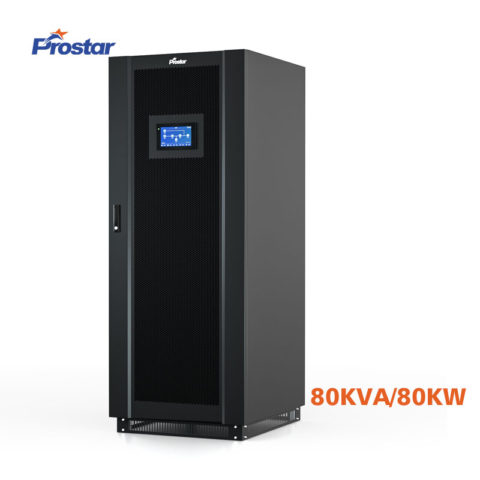
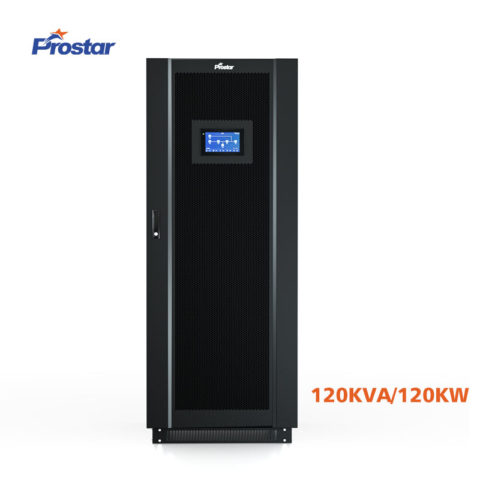
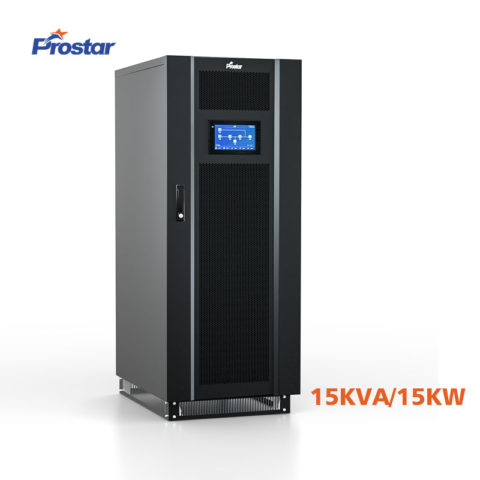
Related DSP Based Industrial UPS

Comparison with Legacy Technologies
| Performance Metric | Traditional Standby UPS | Analog Online UPS | DSP-Based Online UPS |
|---|---|---|---|
| Transfer Time (mains→battery) | 4-10 ms | 0 ms (double-conversion) | 0 ms |
| Input Power Factor | 0.6-0.7 | 0.8-0.9 | 0.99+ |
| Input Current THD | 20-30% | 8-15% | < 3% |
| Output Voltage Regulation | ±8-10% | ±3-5% | ±1-2% |
| Load Transient Response | 100-300 ms | 50-100 ms | 5-15 ms |
| Efficiency (full load) | 80-85% | 85-92% | 95-99% |
| Thermal Dissipation | High | Moderate | Minimal |
| Harmonic Compensation | None | Passive filtering | Active algorithmic |
| Remote Monitoring | Limited | Partial | Multiple |
| Lifecycle Cost (10-year) | Moderate-High | High | Moderate |
DSP based industrial UPS systems represent the maturation of power protection technology. They shift the focus from reactive failure prevention toward proactive power quality management. They also emphasize predictive asset protection. Modern processors enable real-time digital control. This capability fundamentally outperforms analog architectures across nearly every performance dimension. It also reduces energy consumption and operational costs.
The Articles You may Like
- High Capacity 3-Phase Industrial UPS for CNC Machine
- Stand-alone power system – Wikipedia
- What is the CT Sensor in Solar Inverter On Off Grid
- Business UPS Solutions for Small and Large Enterprises
- Top 5 Benefits of Installing Solar Battery Backup System
- How to Choose 3 Phase Online UPS for Laser Cutting Machine