

Laser cutting machines—especially fiber laser and CO₂ laser systems—require extremely stable and clean power. This stability is needed to maintain cutting precision, ensure equipment reliability, and guarantee operational safety. Factories demand higher productivity and tighter tolerances. As a result, a 3 phase online UPS for laser cutting has become a standard power-protection solution. The 3-phase online UPS for laser cutting is ideal. It provides double-conversion topology. This system constantly conditions input power through an inverter. It ensures zero transfer time and full isolation from grid fluctuations.
Power Challenges in Laser Cutting
Laser cutting machines are highly sensitive to fluctuations in the AC supply. Common electrical problems in industrial environments include:
- Voltage sag and surge when large motors start/stop
- Harmonic distortion from inverters, welders, compressors, and CNC machinery
- Frequency instability in weak grids
- Short power outages caused by grid switching
- Spikes and noise from nearby equipment
These disturbances can lead to:
- Laser power drop
- Cutting quality defects
- Servo motor malfunction
- CNC system reboot
- Increased downtime
- Premature failure of expensive lasers and drivers
A 3 phase online UPS for laser cutting machine provides the clean, continuous power required to avoid these problems.
Why Laser Cutting Machines Need a 3-Phase UPS
Laser Cutters Are Heavy 3-Phase Loads
Most industrial laser cutters above 1 kW use 380–480 V three-phase power. Essentially all machines 3 kW and higher also require this power type. They draw 20–100+ kVA depending on laser source power, chiller, dust collector, and motion system. Single-phase UPS systems simply cannot deliver this amount of power economically or reliably. A proper 3-phase UPS is designed from the ground up to manage both balanced and unbalanced 3-phase loads. Derating is minimal. Heat distribution across phases is even.
Even Millisecond Interruptions Are Catastrophic
When utility power drops for even 10–20 ms:
- The laser source (fiber or CO₂) shuts down instantly for safety.
- Motion axes lose position feedback or emergency-stop.
- The cutting head crashes into the material or nozzle burns.
- The job is ruined, often in the last 5 % of a long nested sheet.
- Re-starting the chiller and laser source can take 10–30 minutes.
A true online double-conversion 3-phase UPS provides zero-transfer-time backup. The laser never sees the outage.
Voltage Sags and Swells Destroy Power Supplies
Laser sources contain very expensive IGBT modules, capacitors, and rectifier sections. Brownouts (voltage sags) force these components to draw excessive current, while swells overstress insulation. Many laser manufacturers state explicitly in their installation manuals. They specify that input voltage must stay within ±5 % or ±10 % continuously. Industrial power in many regions regularly dips 15–30 % when nearby motors or welders start. Only an online 3-phase UPS for laser cutting can regulate output voltage to ±1 % regardless of input fluctuations.
In the event of downstream faults:
- Transformer-based UPS can supply higher fault current
- Faster protection device tripping
- Improved safety for operators and equipment
This is particularly important in large laser cutting machines connected to multiple subsystems.
Inrush Current Would Destroy Single-Phase UPS System
When a fiber laser or CO₂ RF generator restarts, it can pull 3–8× running current for several seconds. A properly sized 3-phase online UPS includes oversized rectifiers. It also features battery chargers to handle this without collapsing the DC bus. This design prevents tripping breakers.
Transformer-based UPS systems can typically handle:
- 125–150% overload for short durations
- Better tolerance to sudden load changes
- Stable operation without inverter shutdown
This makes them more reliable than transformerless UPS systems in heavy-duty laser applications.
Chillers Are Just as Sensitive
Modern high-power lasers require water chillers that are themselves 3-phase loads (10–40 kW). If the chiller stops even for a short time, the laser source overheats. This situation triggers an alarm or causes permanent damage to optics and pump diodes. The UPS must keep both the laser and the chiller long enough for a controlled shutdown or until generator starts.
Planned and Unplanned Outages
Many factories perform maintenance shutdowns or experience generator tests. Without a UPS, every switchover means lost production. A 3-phase UPS with 10–30 minutes of battery autonomy bridges the gap to a standby diesel generator. This setup allows seamless transfer via an ATS (automatic transfer switch).
How to Choose UPS for Laser Cutting Machine
Step 1: Calculate Your Power Requirements Accurately
Start by determining the total power load to avoid under- or oversizing, which can lead to inefficiency or premature failure.
Measure active and peak loads
Laser cutters often have high inrush currents during startup (up to 2-3x steady-state). Use a power analyzer or check the machine’s nameplate for kVA/kW ratings. Add 20-30% headroom for future expansions or transients.
Account for 3-phase specifics
Confirm voltage (e.g., 380V, 400V, or 480V) and phase balance. Calculate total kVA as
kVA=3×V×I×PF1000 , where V is line voltage, I is current per phase, and PF is power factor (typically 0.8-0.95 for lasers).
Example:
A 10kW laser cutter with 0.9 PF might need a 20kVA – 30kVA UPS to handle peaks.
Aim for a UPS rated at least 20-50% above your calculated load for reliability.
Step 2: Prioritize Key Features for Laser Cutting Demands
Not all UPS models suit high-precision industrial tools—focus on these must-haves:
Pure sine-wave output with low THD
Lasers are sensitive to harmonics; choose <3% Total Harmonic Distortion (THD) to prevent waveform distortion.
High overload capacity
Look for 150-200% overload for 1-10 minutes to manage cutting spikes.
Battery runtime
Select 10-30 minutes at full load for safe shutdown, or longer with extended battery banks. Lithium-ion batteries offer better density and lifespan than lead-acid for space-constrained shops.
Efficiency and eco-mode
>95% efficiency in online mode; eco-mode for non-critical times reduces heat and energy costs.
| Feature | Why It Matters for Laser Cutters | Recommended Spec |
|---|---|---|
| Online Topology | Zero transfer time, constant conditioning | Double-conversion |
| Output Voltage Regulation | ±1% stability | Essential for servo drives |
| Battery Type | Long life, fast recharge | Li-ion or VRLA |
| Monitoring | Remote alerts via SNMP/Modbus | Prevents surprises |
Step 3: Evaluate Backup Time and Scalability
Laser operations can’t afford blackouts—plan for your environment.
Assess runtime needs
Short (5-15 min) for auto-shutdown; longer (30+ min) for bridge-to-generator setups in areas with frequent outages.
Scalability
Modular UPS allow parallel operation (N+1 redundancy) for growth—crucial if expanding your shop.
Environmental factors
Ensure IP rating (e.g., IP20+), operating temp (0-40°C), and cooling for dusty workshops.
Factor in total cost of ownership: Initial price + batteries + maintenance over 10 years.
Step 4: Consider Compatibility and Installation
Match input/output
Verify 3-phase input/output compatibility, frequency (50/60Hz), and bypass mode for maintenance.
Integration
Choose UPS with dry contacts or software for laser controller sync.
Professional assessment
Consult a power audit specialist to simulate loads and ensure grounding compliance (e.g., IEC 62040 standards).
Related Transformer-based Online UPS

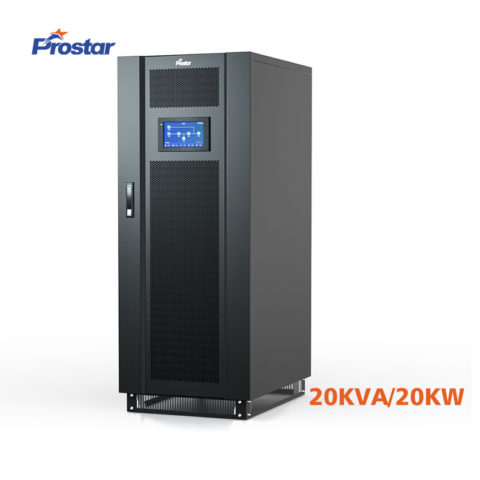
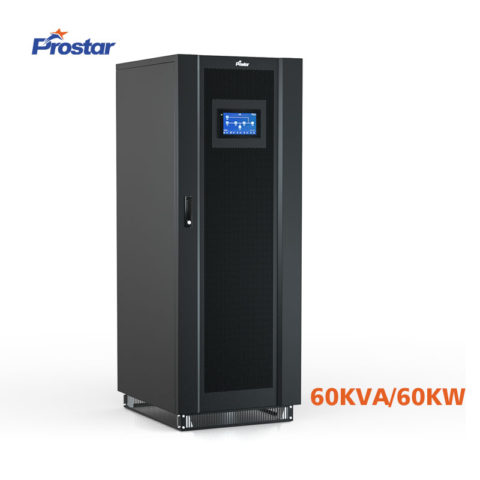
Why Transformer-based Online UPS Would be Selected
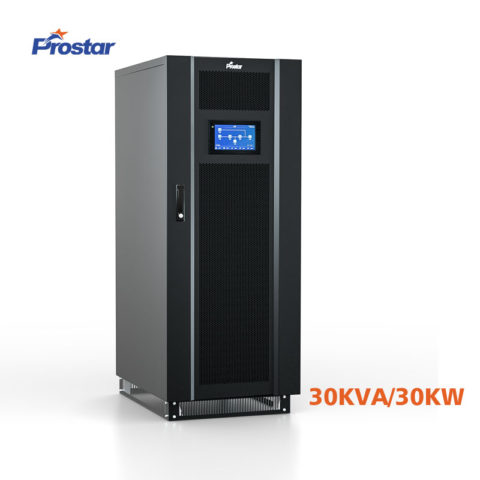
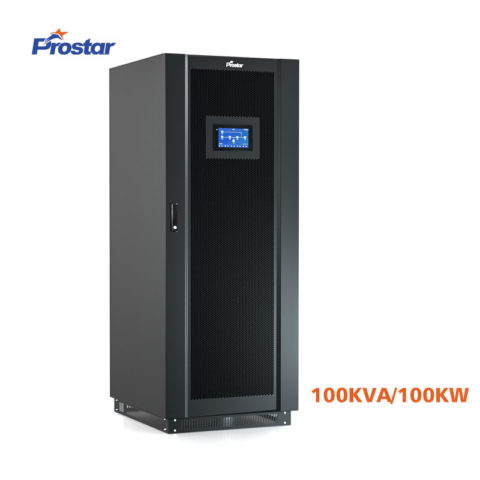
For laser cutting machines (3 kW up to 30 kW+), laser manufacturers clearly recommend a transformer-based UPS. This is also called a low-frequency three-phase online double-conversion UPS. Experienced integrators also advise this. A transformerless (high-frequency) UPS is not recommended.
Here’s why transformer-based UPS wins every time for this application:
| Factor | Transformer-based UPS (Low-Frequency) | Transformerless UPS (High-Frequency) | Winner for Laser Cutters |
|---|---|---|---|
| Galvanic isolation | Yes – full isolation between input/output and battery | Usually none or only on bypass | Transformer-based |
| Tolerance to heavy inrush current | Excellent (5–10× overload for seconds) | Poor – IGBT front-end collapses easily | Transformer-based |
| Ability to handle regenerative loads / back-EMF | Very robust | Often trips or damages rectifier | Transformer-based |
| Short-circuit withstand & fault clearing | Extremely high (transformer limits current) | Limited – relies only on electronics | Transformer-based |
| Harmonic distortion & poor PF tolerance | Very tolerant (6/12-pulse rectifier + big filter) | Sensitive – can overheat or shut down | Transformer-based |
| Overload capacity (e.g., chiller + laser restart) | 150–200 % for 30–60 s, 1000 % for 100 ms | Usually 125–150 % for a few seconds only | Transformer-based |
| Resistance to dust, moisture, heat in shop environment | Proven decades in harsh industrial floors | Sealed, but cooling fans clog faster | Transformer-based |
| Initial cost | 20–40 % higher | Cheaper | Transformerless |
When to Use Transformer-Based UPS
A transformer-based UPS is strongly recommended if:
- Laser power ≥ 3 kW
- Multiple motors and chillers are connected
- Factory power quality is poor
- Generator operation is required
- High safety and reliability are priorities
The Articles You may Like
- How to Select Three Phase Online UPS for Industrial Power Backup
- Stand-alone power system – Wikipedia
- What is the CT Sensor in Solar Inverter On Off Grid
- High Capacity 3-Phase Industrial UPS for CNC Machine
- The Essential Role of Industrial Grade UPS Systems in Modern Manufacturing
- The Best Uninterruptible Power Supply UPS Backup Power for Desktops