
Every data center, hospital operating suite, financial trading floor, and industrial automation plant shares one existential vulnerability. A single millisecond of unclean or interrupted power can trigger cascading failures worth millions of dollars. In clinical environments, such a power disruption can cost lives. A conventional 200kVA mission critical UPS might keep the lights on. However, it won’t protect sensitive equipment from the kinds of power anomalies that cause silent data corruption or premature hardware failure. These anomalies can also lead to cascading system crashes.
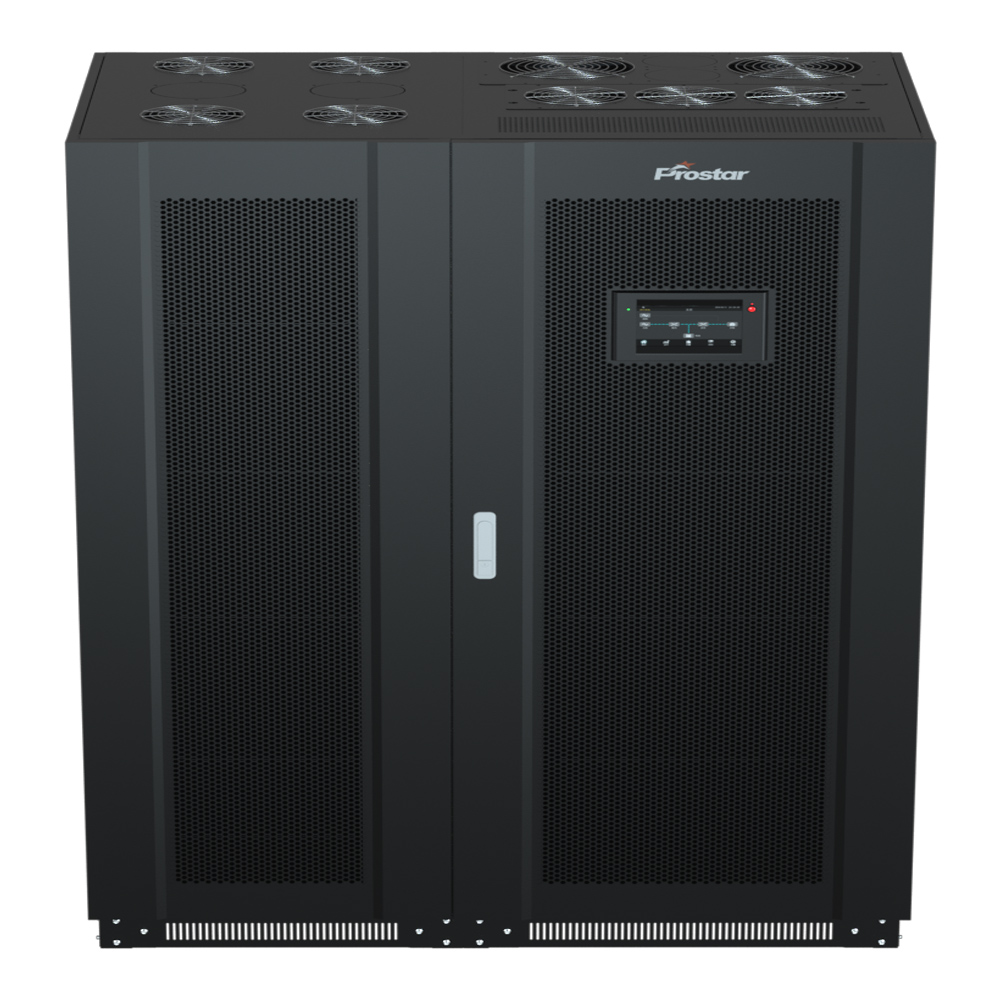
The Prostar ET200K HV is a three-phase, 200kVA mission-critical UPS that addresses this problem at its root. It achieves this not through workarounds or compromises, but through a double-conversion online topology combined with built-in isolation transformers on both the input and output sides. Additionally, it provides full 100% unbalanced load support.
What is 200kVA Mission Critical UPS?
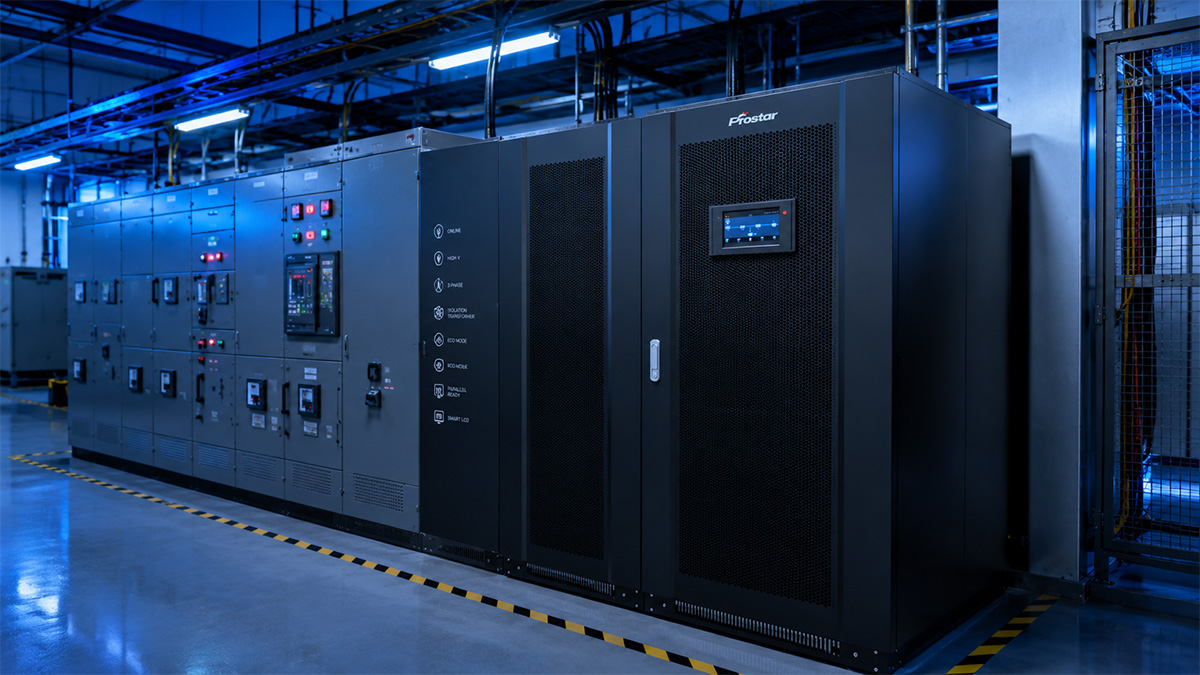
A 200 kVA mission-critical UPS is a high-capacity, three-phase power protection system designed to provide continuous, clean, and reliable electrical power to critical loads when utility power fails or degrades. Prostar ET200K HV 3-Phase 200 kVA UPS is engineered for environments where downtime is unacceptable. These environments include data centers, hospital facilities, telecommunications hubs, industrial control rooms, and financial institutions. The system combines high availability, scalability, and robust electrical performance.
Typical components
- Rectifier/charger: Converts incoming AC to DC and charges the battery while supplying the inverter.
- DC bus and batteries: Stores energy for inverter use during outage; includes battery monitoring and management.
- Inverter: Converts DC back to regulated AC power for the load.
- Static switch/bypass: Routes power around the inverter when necessary.
- Control and communications module: Manages system operation, alarms, and interfaces.
Operational modes
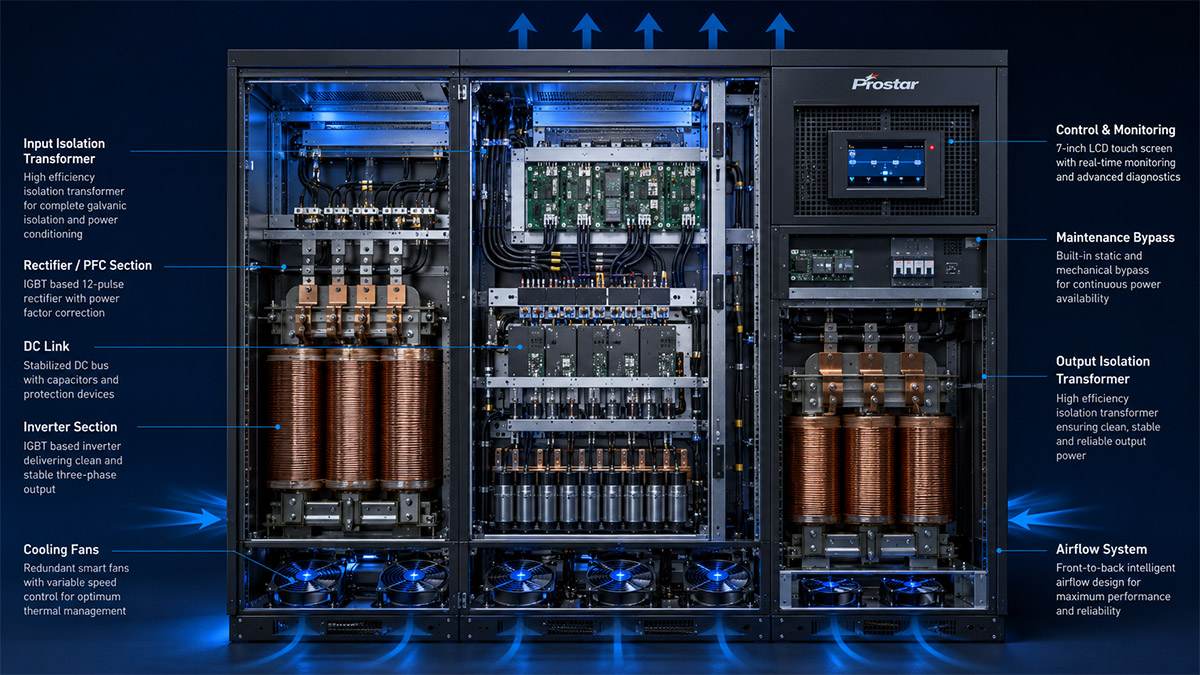
Online double-conversion: In normal operation, utility feeds the rectifier; the inverter supplies the load, isolating sensitive equipment from mains disturbances.
ECO/High-efficiency mode: Bypass-based operation for improved efficiency when input quality is acceptable, with automatic transfer back to double-conversion on disturbance.
Battery/inverter mode: On mains failure, the inverter runs on battery DC to supply the load without interruption.
Maintenance bypass: Manual transfer to bypass to permit service.

Who Needs a 200kVA Mission Critical UPS?
Before examining the solution, it helps to define the problem precisely.
A 200kVA mission critical UPS is not a commodity power backup device. It is a power conditioning and protection platform intended for environments where all of the following conditions apply simultaneously:
- Load criticality is absolute. There is no graceful degradation path — either the load receives clean, stable power or a critical failure occurs.
- Three-phase power distribution is required. Facilities at this scale operate large HVAC units, server rows, medical imaging equipment, or industrial drives that demand balanced three-phase supply.
- Power quality threats are persistent. The upstream grid carries harmonics, transients, voltage sags, and frequency deviations that would damage sensitive downstream equipment.
- Load balance cannot be guaranteed. In real-world deployments, three-phase loads are rarely distributed evenly across all phases.
Typical deployment environments for a three-phase 200kVA mission critical UPS include:
- Hospital ICUs, operating theaters, and diagnostic imaging suites
- Financial trading infrastructure and colocation facilities
- Broadcast and telecommunications hubs
- Semiconductor manufacturing and precision industrial automation
- Emergency services dispatch and command centers
If your environment falls into any of these categories, the specifications of the UPS you choose are not a purchasing consideration — they are an engineering requirement.
Why Standard 200kVA Mission Critical UPS Systems Fall Short
Unlike conventional UPS systems, the ET200K HV is designed specifically for high-power industrial applications where reliability is non-negotiable.
Grid Disturbances Reach Sensitive Loads
Modern power grids carry substantial harmonic distortion generated by switching power supplies, variable-frequency drives, and non-linear loads across the network. These harmonics cause overheating in motors, data corruption in servers, and premature failure in power supplies. Voltage transients — spikes lasting microseconds — can destroy semiconductor components that cost thousands of dollars to replace.
Prostar ET200K HV online ups uses a true online double-conversion architecture. In double-conversion operation, incoming AC power is converted to DC and then re-synthesized as clean AC output — 100% of the time, not only during grid anomalies. This means the load never sees the raw grid signal. The output is always a freshly generated sine wave at the correct voltage, frequency, and phase angle, regardless of what the input grid is doing.
Galvanic Isolation and Ground Loop Noise
Many UPS systems in the market — even those marketed for critical applications — rely on transformerless topologies to reduce weight and cost. While transformerless designs offer efficiency advantages in benign environments, they create a shared ground path between input and output. This allows ground-referenced noise, common-mode interference, and leakage currents to propagate through to sensitive loads. In healthcare environments, this is a patient safety issue. In industrial settings, it causes erratic behavior in PLCs and motion controllers.
The ET200K HV integrates isolation transformers on both the input side and the output side. This is an uncommon design decision that reflects a mission critical engineering philosophy rather than a cost-optimization one.
The input isolation transformer serves three functions:
- It decouples the UPS rectifier from the upstream grid, reducing harmonic injection back into the building distribution system.
- This provides surge and transient suppression through the inherent impedance of the transformer windings.
- It allows the UPS to accept a wider range of input configurations and voltages without requiring external matching equipment.
The output isolation transformer provides an additional layer of protection:
- This creates complete galvanic isolation between the UPS inverter and the load, eliminating the shared ground path.
- It suppresses common-mode noise that would otherwise appear on the neutral conductor.
- It enables the output neutral to be independently referenced, which is mandatory for certain medical and industrial grounding schemes.
Unbalanced Three-Phase Loads in Real Deployments
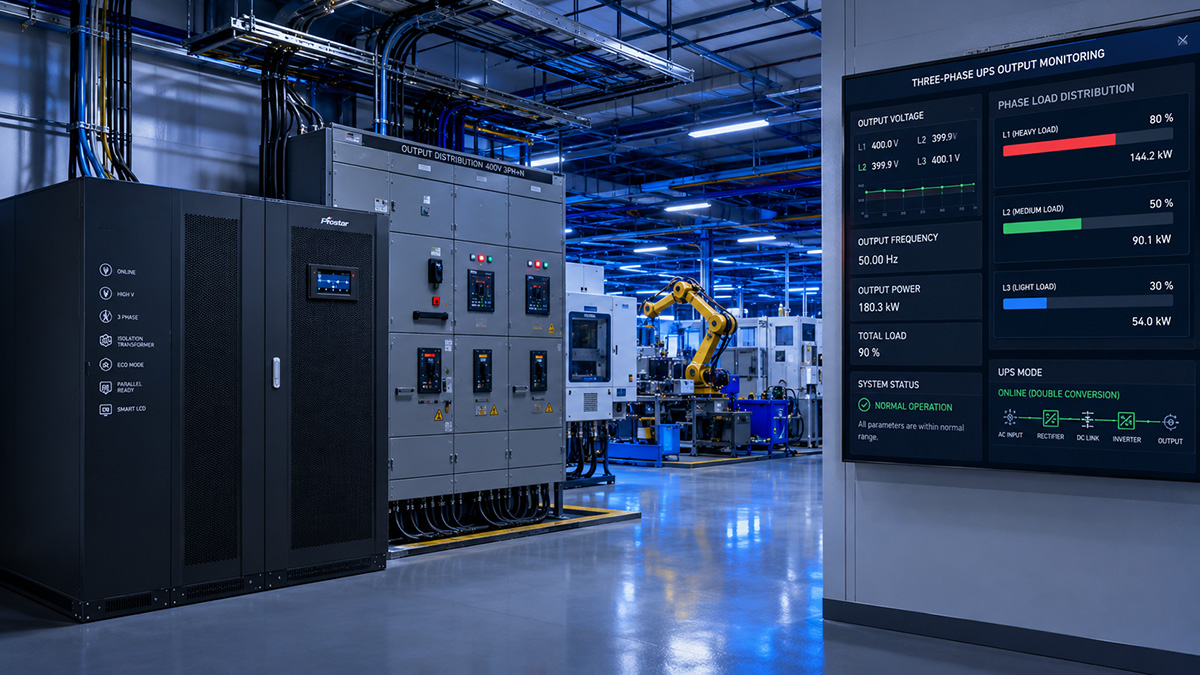
Electrical engineers designing three-phase power systems aim for balanced load distribution across all three phases. In practice, this balance is rarely achieved and never static. Server loads shift as workloads change. Medical equipment is used intermittently. Industrial drives start and stop on variable schedules. The result is persistent phase imbalance — which, in standard UPS designs without transformers, causes output voltage asymmetry, increased neutral current, and potential damage to loads on the heavily loaded phase.
Industry guidance typically warns operators to maintain phase imbalance below 20–25%. Exceeding this threshold causes derating in most UPS systems: the unit reduces its rated capacity to protect internal components, leaving the facility with less effective power protection than specified.
The ET200K HV is engineered to support 100% unbalanced load across its three output phases. This means the entire 200kVA capacity can be applied to a single phase — for example, 200kVA on Phase A with zero load on Phases B and C — without triggering derating, output voltage distortion, or any protective shutdown.
For facility managers who operate mission critical UPS systems for data centers or healthcare environments, this translates directly into operational freedom: you do not need to meticulously balance server loads across PDUs to stay within the UPS’s tolerance band. The system handles imbalance transparently.
| Phase A | Phase B | Phase C | Conventional UPS | ET200K HV |
| 100% | 0% | 0% | Derated to ~65% | Full 200kVA |
| 70% | 20% | 10% | Partial derating | Full 200kVA |
| 40% | 40% | 20% | OK | Full 200kVA |
Harmonic Feedback Into the Building Distribution System
Three-phase UPS rectifiers draw non-sinusoidal current from the grid. This current contains harmonic frequencies (primarily the 5th, 7th, 11th, and 13th harmonics) that flow back into the building’s electrical distribution system. High harmonic content causes transformer overheating, circuit breaker nuisance tripping, and interference with other sensitive equipment sharing the same distribution panel. In facilities with strict power quality requirements — hospitals, financial institutions, semiconductor fabrication — harmonic injection is a compliance issue as well as an engineering one.
The input isolation transformer in the ET200K HV provides inherent harmonic attenuation by presenting a high-impedance path for harmonic currents attempting to propagate upstream. Additionally, the ET200K HV employs an active front-end rectifier design that achieves input current total harmonic distortion (THDi) of less than 5% under full load conditions.
This low harmonic footprint makes the ET200K HV suitable for installation in facilities where online double conversion UPS harmonic distortion would otherwise be a disqualifying factor.
Generator Compatibility for Extended Outages
Mission critical facilities rely on diesel or gas generators as the long-term backup power source behind the UPS battery bank. However, generators present different power quality challenges than the utility grid: slower frequency response, higher voltage regulation tolerance, and sensitivity to non-linear loads. A UPS that draws high harmonic current from a generator can cause the generator’s automatic voltage regulator (AVR) to hunt — oscillating between over- and under-voltage — which can damage both the generator and the UPS.
The combination of low input THDi and the input isolation transformer makes the ET200K HV highly compatible with generator power sources. The transformer’s impedance dampens the interaction between the rectifier’s non-linear current draw and the generator’s AVR, reducing hunting instability. This is a critical consideration for industrial UPS 200kVA generator compatibility — a specification that is frequently overlooked during procurement but becomes apparent during commissioning.
Technical Specifications
| Parameter | ET200K HV Specification |
| Rated Capacity | 200 kVA / 200 kW |
| Topology | Online Double Conversion |
| Input | 480V, 3-phase + Neutral + PE |
| Output Phases | 480V, 3-phase + Neutral + PE |
| Isolation Transformer | Built-in |
| Unbalanced Load Capacity | 100% (full rated output on single phase) |
| Input Voltage Range | Configurable; wide window tolerance |
| Input THDi | < 2% at full load (active rectifier front end) |
| Output Voltage THD | < 2% (linear load), < 5% (non-linear load) |
| Output Frequency | 50 Hz or 60 Hz |
| Transfer Time to Battery | 0 ms (true online, no transfer) |
| Efficiency (ECO mode) | Up to 98% |
| Efficiency (Double Conversion) | Up to 93% |
| Cooling | Forced air with intelligent speed control |
| Protection Rating | IP31 |
| Communication Interfaces | RS-232, RS-485, USB, SNMP, Modbus, dry contacts |
| Standards Compliance | IEC 62040-1, IEC 62040-2, IEC 62040-3, CE |
Key Features
The ET200K HV combines advanced power conversion technology with industrial-grade reliability.
- 200kVA / High Voltage Three-Phase UPS
- True Online Double Conversion
- Built-in Input Isolation Transformer
- Built-in Output Isolation Transformer
- Supports 100% Unbalanced Load
- DSP Intelligent Digital Control
- High Overload Capability
- Excellent Voltage Regulation
- Low Harmonic Distortion
- Generator Compatible
- Parallel Redundancy Capability
- Intelligent Battery Management
- Remote Monitoring Options
- Industrial-Grade Reliability
How to Evaluate Whether Uninterruptiblle Power Supply is Right for Your Facility
The following decision framework helps facilities engineers determine whether the ET200K HV’s specification set matches their requirements:
Step 1: Confirm the criticality classification.
If a power outage of any duration would result in data loss, patient harm, production loss exceeding equipment replacement cost, or regulatory non-compliance, you need a true online double-conversion UPS — not a line-interactive or standby design.
Step 2: Assess your load imbalance reality.
Measure actual phase current on your existing distribution for 30 days. If any phase regularly carries more than 120% of the average of all three phases, you need either a UPS with explicit unbalanced load support or an expensive load rebalancing project. The ET200K HV eliminates the need for the latter.
Step 3: Check your grounding and isolation requirements.
Review applicable codes (NEC Article 517 for healthcare in the US; IEC 60364-7-710 internationally; local wiring regulations). If isolated ground systems are required for any portion of your load, a UPS with an output isolation transformer is the correct specification.
Step 4: Evaluate your generator infrastructure.
If backup runtime extends beyond battery capacity and a generator is in the plan, verify that your generator’s AVR type is compatible with active rectifier front-end UPS systems. The ET200K HV’s low THDi and input transformer make this compatibility nearly universal.
Step 5: Calculate total cost of ownership, not purchase price.
A mission critical UPS for data center or healthcare applications that requires external isolation transformers, harmonic filters, or oversized generators due to high THDi will cost more over its service life than an integrated solution at a higher upfront price.
Why Choose the ET200K HV 200kVA Mission Critical UPS?
Organizations selecting large-capacity UPS systems typically prioritize reliability over initial purchase cost.
The ET200K HV delivers value through:
- Superior electrical isolation
- Exceptional load adaptability
- Stable operation under harsh industrial conditions
- Reduced maintenance requirements
- Long service life
- High availability for mission-critical infrastructure
Its integrated transformer design and ability to handle fully unbalanced loads make it particularly well suited for heavy industrial environments where conventional UPS systems may struggle.
FAQ
The Articles You may Like
- Can Off Grid Solar Inverter Charge Controller Run without Battery
- Stand-alone power system – Wikipedia
- What is the CT Sensor in Solar Inverter On Off Grid
- How Long Should the Durable Online UPS Systems Last
- Navigating the Data Realm with Futuristic Rack Mountable UPS Solutions
- How to Choose 3 Phase Online UPS for Laser Cutting Machine