
Power reliability is critical for modern data centers where downtime leads to significant financial loss. Many facilities struggle with scalability, maintenance complexity, and system redundancy.
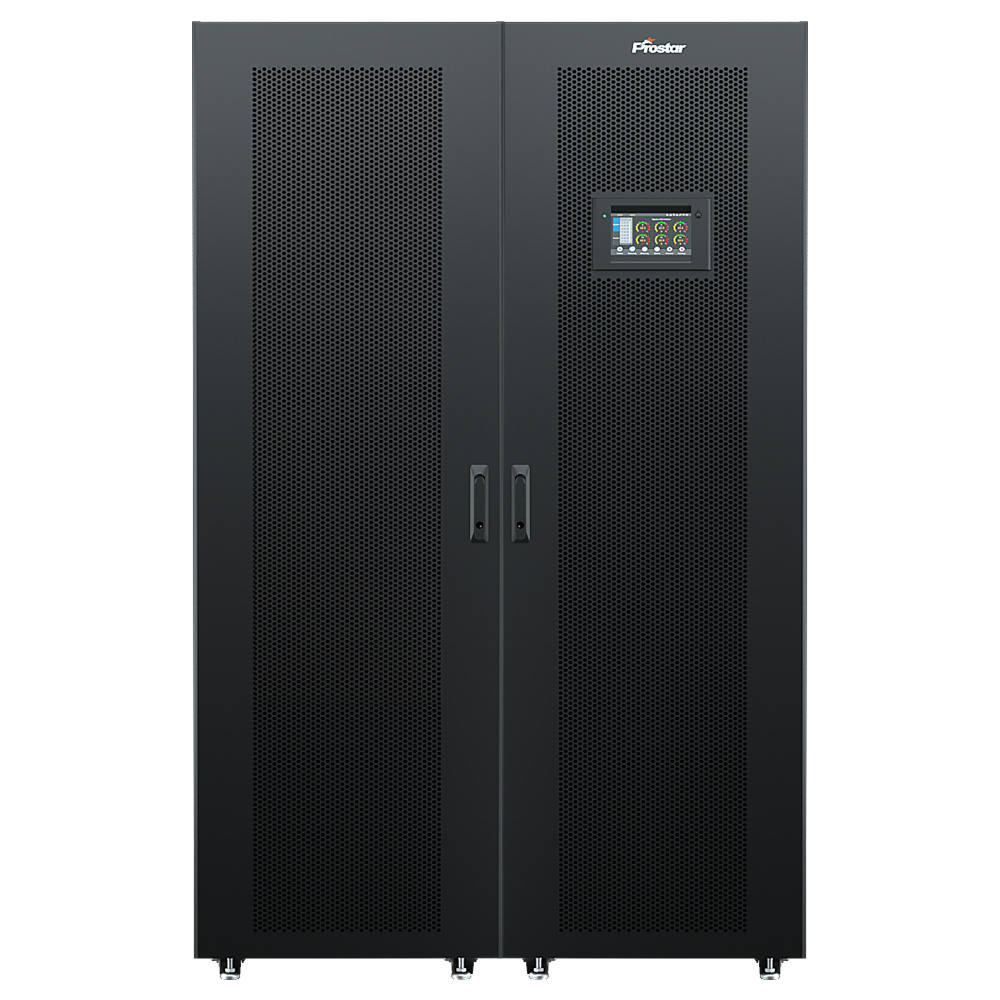
Prostar MPS500K-50K three phase modular data center ups online 500kva designed specifically for mission-critical data center environments. This 500kVA online double-conversion modular data center UPS is engineered for scalability.
A 500kVA modular data center UPS is a scalable power protection system. It uses interchangeable power modules to deliver reliable backup power. The ups system is redundant and easily expandable. It provides backup power without system downtime.
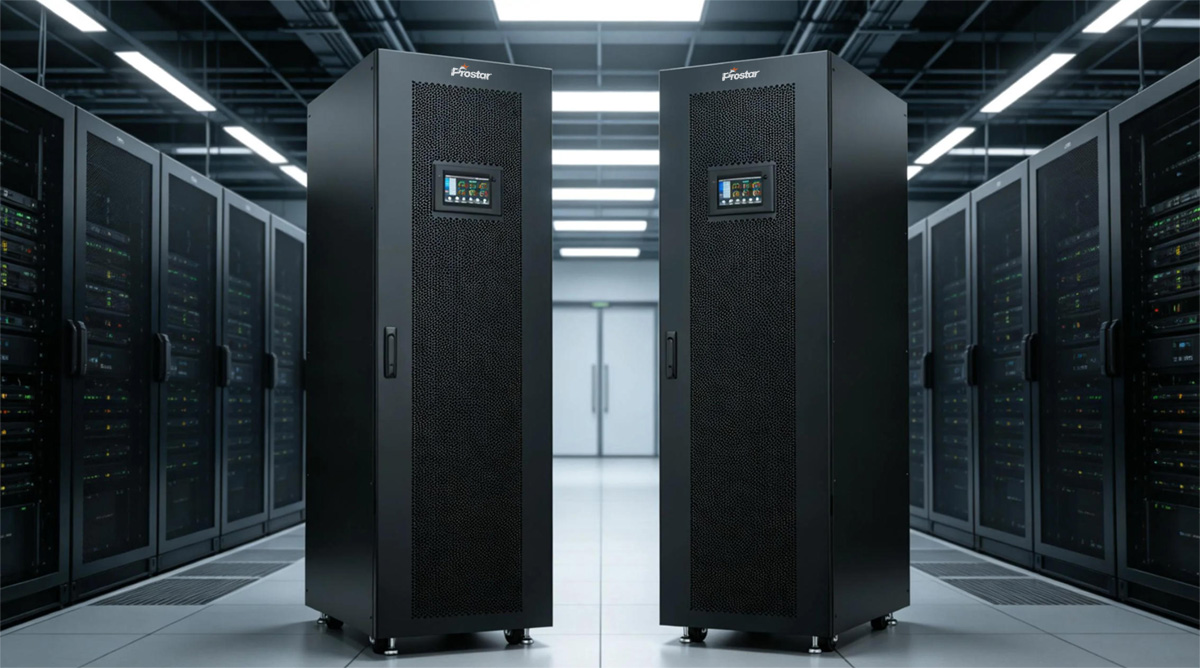
This 500kVA UPS system with redundancy provides a flexible and scalable power protection solution. It is highly reliable and designed specifically for data centers and mission-critical applications.

Modular Data Center UPS Key Features
Scalability
The system frame supports up to 500kVA and contains individual power modules (typically 50kW/kVA per module). Users can start with a smaller configuration (e.g., 50kVA, 100kVA) and add modules as load requirements increase.
Hot-Swap Capability
Power modules, static switches, and control units are designed for hot-swap replacement. This enables “Zero Downtime” maintenance. Technicians can replace faulty modules in seconds without transferring the critical load to bypass or shutting down IT equipment.
High Efficiency (Online Mode)
-
Peak Efficiency: Up to 95.5% in double-conversion mode.
- Eco-Mode Efficiency: Up to 98.5%.
The high efficiency reduces heat dissipation. It lowers cooling requirements and operational costs. As a result, there is a lower TCO (Total Cost of Ownership) and PUE (Power Usage Effectiveness) for your facility.
Advanced Redundancy (N+X)
The modular architecture allows for configurable redundancy. Users can configure the system for N+1 or N+X redundancy. This setup ensures that if one module fails, the remaining modules instantly take over the full load. There is no interruption, guaranteeing 100% load availability.
LCD Touch Screen
Offers an intuitive user interface for easy monitoring and configuration, along with remote access for convenience and management.
Remote Management
The system is equipped with multiple communication slots for SNMP, Modbus, and TCP/IP protocols. This allows seamless integration with data center infrastructure management (DCIM) platforms and remote monitoring tools.
Extended Battery Life
Features intelligent battery management, including temperature-compensated charging and automatic battery testing to prolong battery lifespan.
Modular 500 kVA UPS Systems
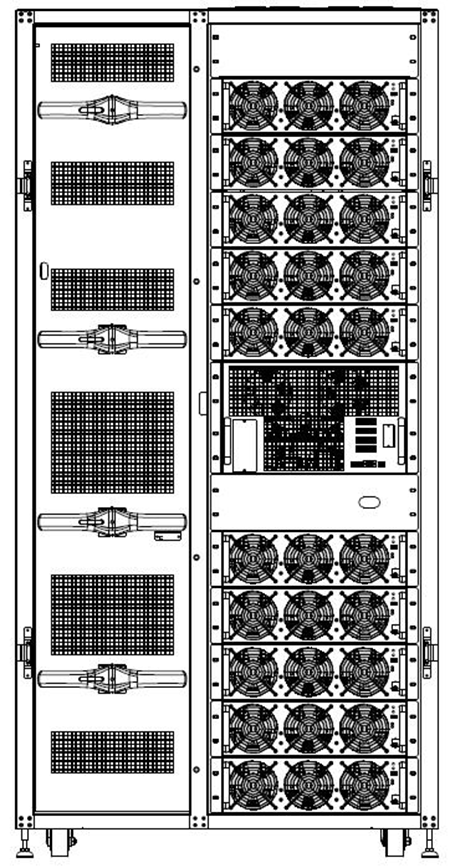

The system is constructed using hot-swappable 50kVA power modules. A standard cabinet can house up to 10 modules to achieve the full 500kVA capacity.
This modular UPS features 50kVA/50kW power modules, allowing fast installation and flexible upgrades. When a module needs maintenance, you can replace it quickly. This is possible through a hot-swappable structure, which significantly reduces system downtime. It also helps lower maintenance costs. More details: MPS50K 3 phase modular ups hot-swappable power module 50kW
High Scalability for Growing Data Centers
The MPS500K-50K adopts a 50kVA / 50kW power module design. This design enables flexible system configuration. Capacities range from lower levels up to 600kVA within a single cabinet. Additional cabinets can be paralleled for even higher power demands.
-
Power module: 50kVA / 50kW
-
System capacity: Up to 600kVA per cabinet
-
Parallel expansion capability for large power systems
-
Hot-swappable power modules without downtime
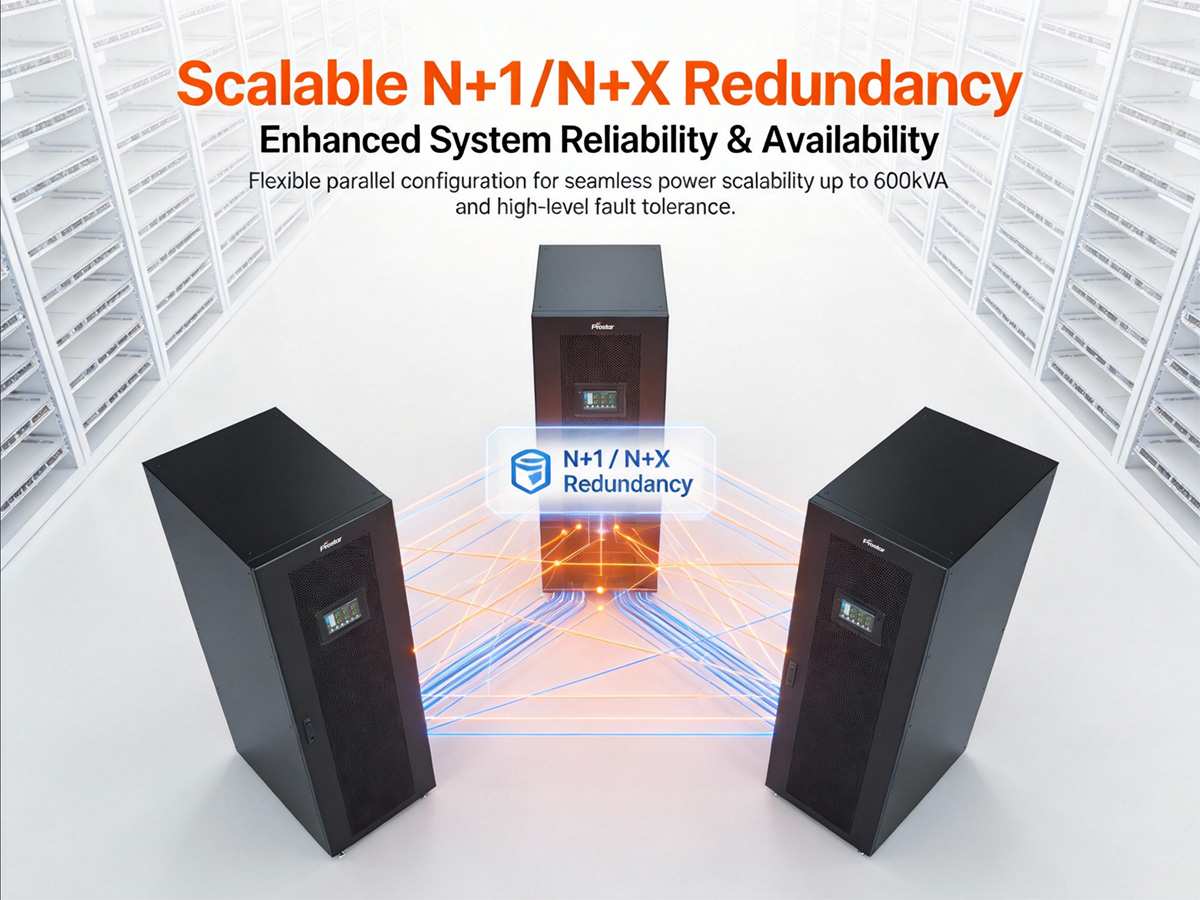

This modular architecture allows data center operators to invest according to current needs. It maintains the flexibility to expand as business grows.
Redundant design and hot-swappable components allow maintenance without interrupting the protected load, significantly improving system availability.
LCD Display
The 500kVA modular data center UPS system integrates a 7-inch touch LCD display. It is a user-friendly, high-resolution capacitive touchscreen interface. This interface is designed to provide intuitive real-time monitoring. It also allows control and configuration of the entire power system.
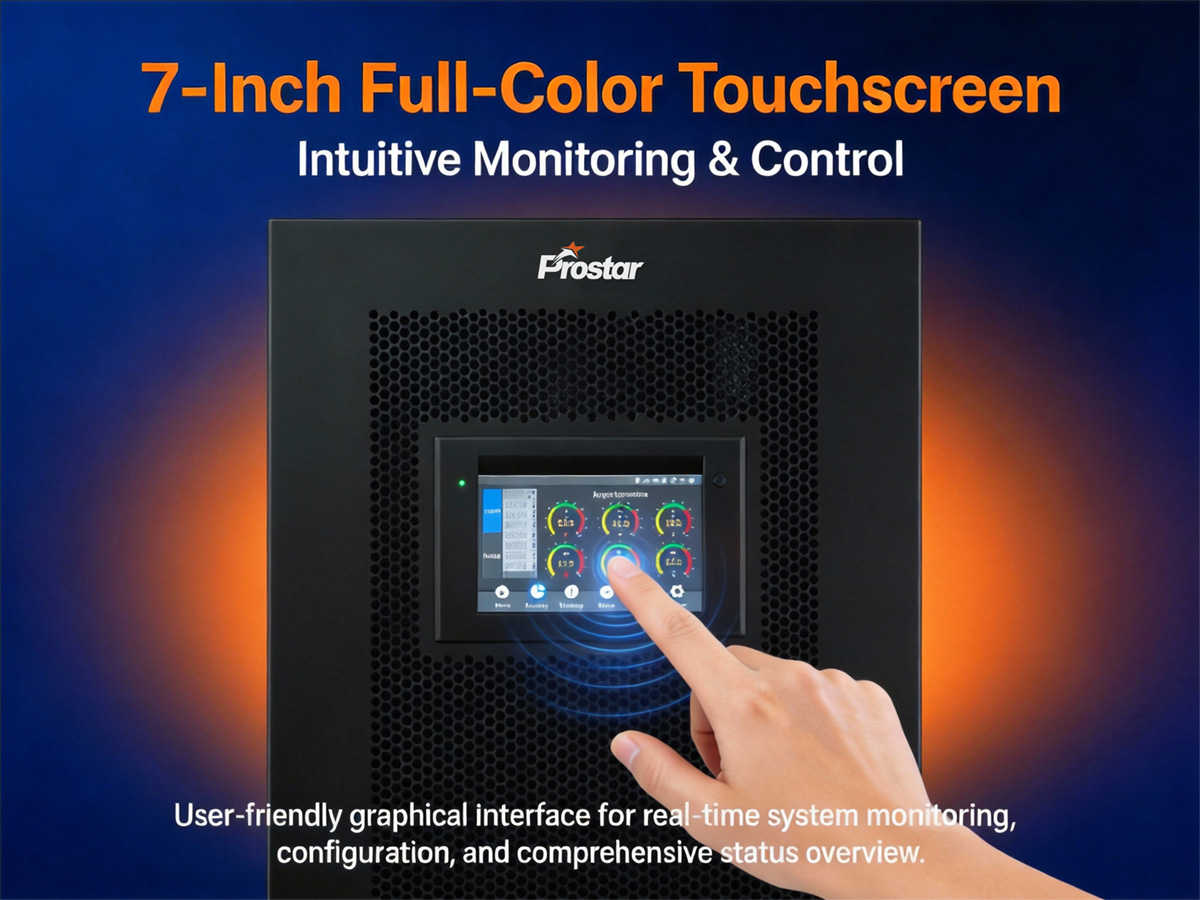
Intuitive Graphical Interface — Modern, icon-based layout with clear menus, real-time dashboards, and color-coded status indicators (green for normal, yellow for warning, red for fault/alarm).
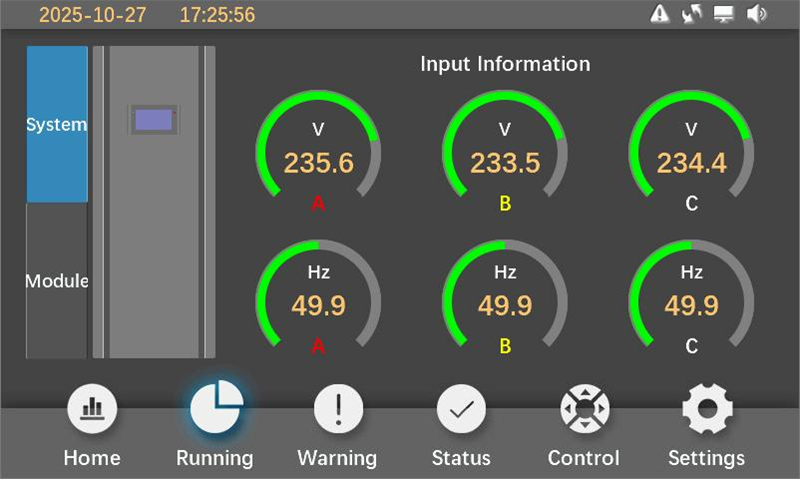
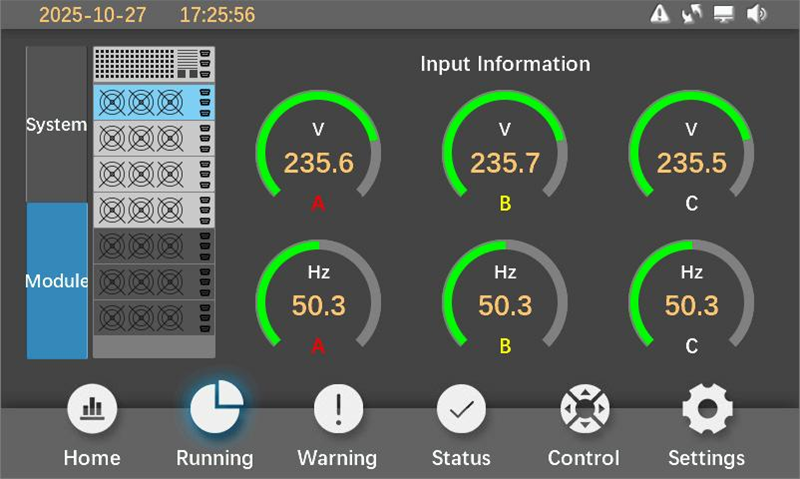
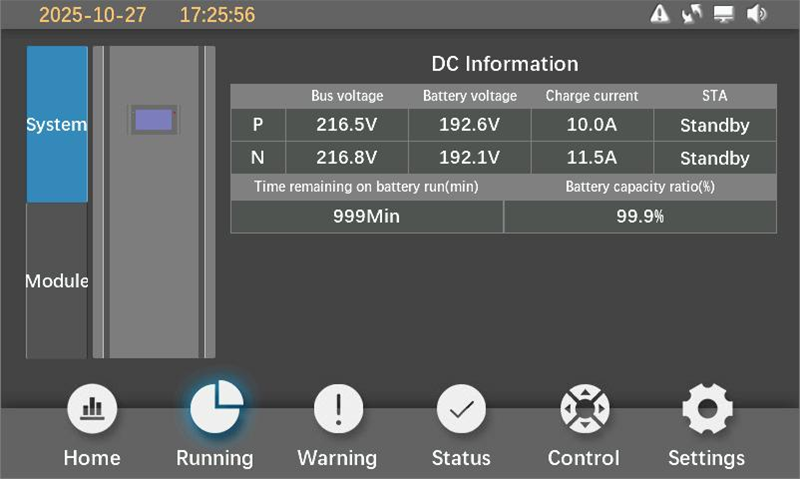
Real-time Monitoring — Displays critical parameters such as:
- Input/output voltage, current, frequency, and power (kVA/kW)
- Load percentage and crest factor
- Battery voltage, charge/discharge current, remaining runtime, and capacity
- Inverter/bypass/rectifier status
- Module status (each 50 kW power module)
Alarm & Event Management — Full fault records, operation logs, and predictive warnings with timestamps; supports detailed alarm descriptions and troubleshooting guidance.
Technical Specification
| Item | Specification |
|---|---|
| UPS Type | Modular Online UPS (Double Conversion) |
| Rated Capacity | 500kVA / 500kW |
| Power Factor | 1.0 |
| Power Module | 50kVA / 50kW |
| Phase | 3 Phase In / 3 Phase Out |
| Input Voltage | 380/400/415Vac (optional) |
| Output Voltage | 380/400/415Vac |
| Input Frequency | 50/60Hz, 40Hz ~70Hz |
| Output Frequency | 50/60Hz, 46Hz ~ 54Hz or 56Hz ~ 64Hz |
| Transfer Time | 0ms |
| Battery Voltage | ±192VDC ~ ±240VDC |
| Output Waveform | Pure Sine Wave |
| Efficiency | Utility Mode: 95.5%; ECO Mode: 98.5%; Battery Mode: 94.5% |
| Overload Capacity | 60 mins for 110%, 10 mins for 111%-120%,; 1 min for 121%-150%, 200ms for >150% |
| Display | LCD display |
| Communication | RS232 / RS485 / Dry Contact / SNMP (optional) |
| Parallel Function | Supported |
| Protection | Overload, short circuit, over-temperature, battery low voltage, etc. |
| Application | Data center, telecom, hospital, industrial, banking |
Online UPS Details
System Input Information

Power Module Input Information
System Battery Information
Why Choose a Modular UPS Instead of Traditional UPS?
| Feature | Modular UPS | Traditional UPS |
|---|---|---|
| Scalability | Flexible expansion | Fixed capacity |
| Maintenance | Hot-swappable | Requires shutdown |
| Reliability | High (N+1 redundancy) | Lower |
| Downtime Risk | Minimal | Higher |
| Total Cost | Optimized long-term | Higher lifecycle cost |
Modular UPS systems provide superior flexibility, lower downtime, and better long-term ROI compared to traditional monolithic UPS systems.
Application Scenarios
Data Centers
- Server rooms
- Cloud infrastructure
- Colocation facilities
Telecom Systems
- Base stations
- Network hubs
Critical Infrastructure
- Financial institutions
- Healthcare IT systems
- Industrial automation
How to Size a 500kVA Modular UPS System
Choosing the correct UPS capacity depends on load requirements and redundancy strategy.
Step-by-step guideline:
- Calculate total load (kW/kVA)
- Add future expansion margin (20–30%)
- Choose redundancy level (N+1 recommended)
- Select module configuration
Example:
- Load: 500kVA
- Redundancy: N+1
- Module size: 50kVA
Required modules:
(500 ÷ 50) + 1 = 11 modules
Benefits for Data Centers
- Zero downtime maintenance
- Flexible capacity expansion
- Reduced total cost of ownership (TCO)
- Improved energy efficiency
- High system availability (>99.999%)
People Also Ask
What is a 500kVA modular UPS?
A 500kVA modular UPS is a scalable uninterruptible power supply system. It is composed of multiple power modules. This allows flexible expansion and provides high redundancy for critical applications.
How many power modules are needed for 500kVA?
Typically, a 500kVA system uses 10 power modules of 50kVA each, plus additional modules for redundancy (N+1).
How does data center modular UPS redundancy work (N, N+1, 2N)?
N means capacity equals load. N+1 adds one spare module for failover. 2N duplicates the entire system for full redundancy. Choose based on acceptable single‑point failures and maintenance needs.
Are modular UPS units hot‑swappable?
Yes—most modular UPS designs allow hot‑swap of power modules so faulty modules can be replaced without interrupting protected loads, preserving uptime.
How do I size a modular UPS for growth?
Estimate current kW load, add expected growth over 3–5 years, and include redundancy (e.g., N+1). Select module count so you can add modules to meet future capacity without replacing the chassis.
The Articles You may Like
- Customizable UPS Solutions for Reliable Power Protection
- Stand-alone power system – Wikipedia
- How 3 Phase Lithium UPS System Enhances Backup Power Performance
- Choosing the Best Uninterruptible Power Supply UPS for Home Use
- How Low Frequency UPS Safeguards Critical Information
- What is the Difference Between Monolithic UPS vs Modular UPS