

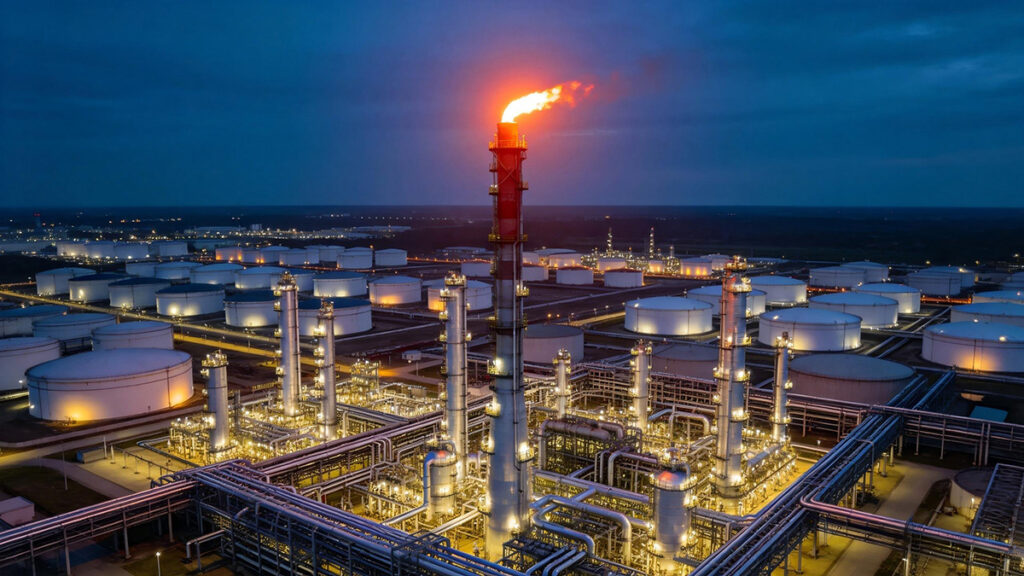
In the high-stakes world of oil and gas refining, processes run 24/7 under extreme conditions. Even a momentary power disruption can lead to catastrophic consequences. Equipment damage, production halts, safety risks, and massive financial losses are all on the line. This is precisely why a robust Industrial UPS for Oil and Gas Refineries is not just an option, but a necessity.
Industrial UPS systems are designed specifically for harsh industrial environments. They provide seamless, reliable backup power to keep critical operations running smoothly. This ensures both operational continuity and personnel safety.
Why Oil and Gas Refineries Need Specialized Industrial UPS
Energy Supply Backbone
Oil and gas refineries are the primary sources of liquid fuels that power the global transportation sector. Without continuous operation, the global supply chain would grind to a halt. A dedicated industrial UPS for oil and gas refineries ensures that production lines remain active. This prevents supply disruptions that could affect international trade and essential services.
Economic Powerhouse
The refining industry is a major economic driver, generating direct and indirect employment across transportation, logistics, and petrochemicals. Refineries also contribute significantly to government revenues through taxes and royalties. In many oil-producing nations, refining and export revenues constitute a substantial portion of national budgets. These funds support public services, infrastructure, and social welfare programs.
Petrochemical Feedstock Provider
Refineries supply critical feedstocks such as ethylene, propylene, and benzene beyond fuels. These materials serve as the building blocks for plastics, synthetic fibers, fertilizers, pharmaceuticals, and countless other products. The petrochemical sector, a key driver of innovation and economic growth, depends directly on reliable refinery operations.
Energy Security Guarantor
A good refining network supports energy independence. An industrial UPS for oil and gas refineries helps keep reserves and emergency response ready. This remains true even when there are problems with the power grid or issues around the world.
Importance of Industrial UPS for Oil and Gas Refineries
Protecting Critical Equipment
Refineries rely on sophisticated, high-value machinery—distillation columns, reactors, compressors, and pumps—all highly sensitive to power fluctuations.
An industrial UPS acts as a buffer between the main power source and this equipment. It provides instantaneous, seamless power during voltage sags, surges, or short-term outages. This prevents equipment damage and maintains process integrity.
For example, a sudden power loss during distillation can disrupt component separation, leading to product quality issues and mechanical stress.
Ensuring Safety
With flammable and toxic substances present, safety systems (fire suppression, emergency shutdowns, gas monitoring) must remain operational at all times. An industrial UPS for oil and gas refineries guarantees these systems function during disturbances, protecting lives and the environment.
Minimizing Production Losses
Refineries operate continuously to meet high energy demand. Any production interruption results in significant financial losses. Industry estimates indicate that a single hour of downtime at a large-scale refinery can cost millions of dollars. These losses stem from lost production, additional maintenance, and potential contractual penalties. Industrial UPS systems minimize these losses by providing backup power during outages. This allows operators to either sustain production or execute an orderly shutdown, thereby reducing operational impact.
Key Features of Industrial UPS for Refineries
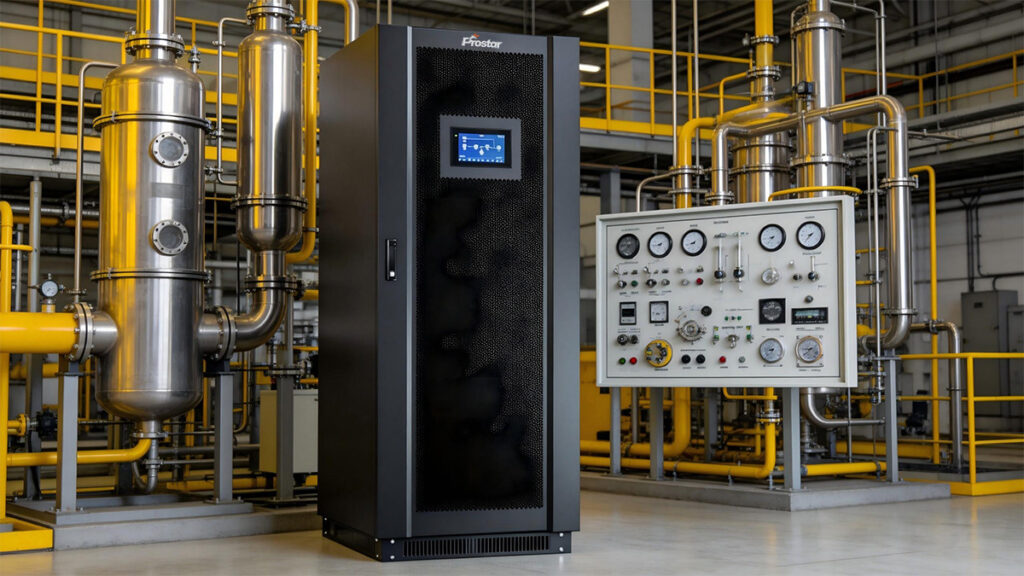
Modern Industrial UPS for Oil and Gas Refineries systems are engineered for durability and performance:
1. Ruggedized Design
- Wide operating temperature range (typically –25°C to +55°C or higher with derating)
- Seismic and vibration resistance for earthquake-prone or high-vibration areas
- Corrosion-resistant enclosures (stainless steel or specialized coatings)
2. High Reliability and Redundancy
- True online double-conversion topology for zero-transfer-time protection
- Parallel redundant configurations (N+1 or 2N) for maximum availability
- Hot-swappable modules for maintenance without shutdown
- Mean Time Between Failures (MTBF) often exceeding 500,000 hours
3. Advanced Monitoring and Integration
- Modbus, DNP3, Profibus, and Ethernet communication protocols
- Integration with refinery DCS and asset management systems
- Remote monitoring, predictive maintenance analytics, and battery health diagnostics
4. Long Battery Autonomy
- Support for extended runtime using VRLA, lithium-ion, or nickel-cadmium batteries
- Battery management systems optimized for high-temperature environments
Major Applications in Refineries
An industrial UPS for oil and gas refineries is deployed across:
- Crude distillation and cracking units
- Hydrotreating and desulfurization
- Tank farms and loading terminals
- Power generation and substations
- Control rooms (servers, HMIs, workstations)
Many modern refineries implement tiered UPS architectures. This approach combines small distributed units near field instruments with larger centralized systems for control buildings to optimize cost and performance.
Technological Advances in Industrial UPS
Recent advances in battery technology, especially lithium-ion, are making industrial UPS systems more efficient and compact. Compared to traditional lead-acid batteries, lithium-ion offers longer lifespan, faster charging, and reduced maintenance. This makes it highly attractive for refinery applications.
Additionally, modern UPS systems increasingly incorporate smart technology, enabling better integration with existing energy management systems. This facilitates a more holistic approach to energy use and operational reliability.
Case Study: Large-Scale Refinery in the Middle East
A major refinery in the Middle East faced frequent power quality issues due to an unstable grid. After installing a high-capacity Industrial UPS for Oil and Gas Refineries, the facility achieved 30 minutes of backup power. This duration is enough to smoothly transfer to generators during prolonged outages. Results included a significant reduction in equipment failures, production losses, and enhanced reputation as a reliable global supplier.
Related Industrial UPS

FAQ
How long can an industrial UPS power refinery equipment during an outage?
What maintenance does an industrial UPS require?
Can industrial UPS systems be integrated with existing refinery control systems?
What type of battery is best for an Industrial UPS in a refinery environment?
How do I determine the right UPS size for my refinery application?
The Articles You may Like
- What is Slew Rate in UPS System?A Complete Guide
- Stand-alone power system – Wikipedia
- What is the CT Sensor in Solar Inverter On Off Grid
- Modular UPS for Hospitals: Reliable Power Backup Solutions
- Modular UPS vs Monolithic UPS: Key Differences
- How to Choose 3 Phase Online UPS for Laser Cutting Machine