
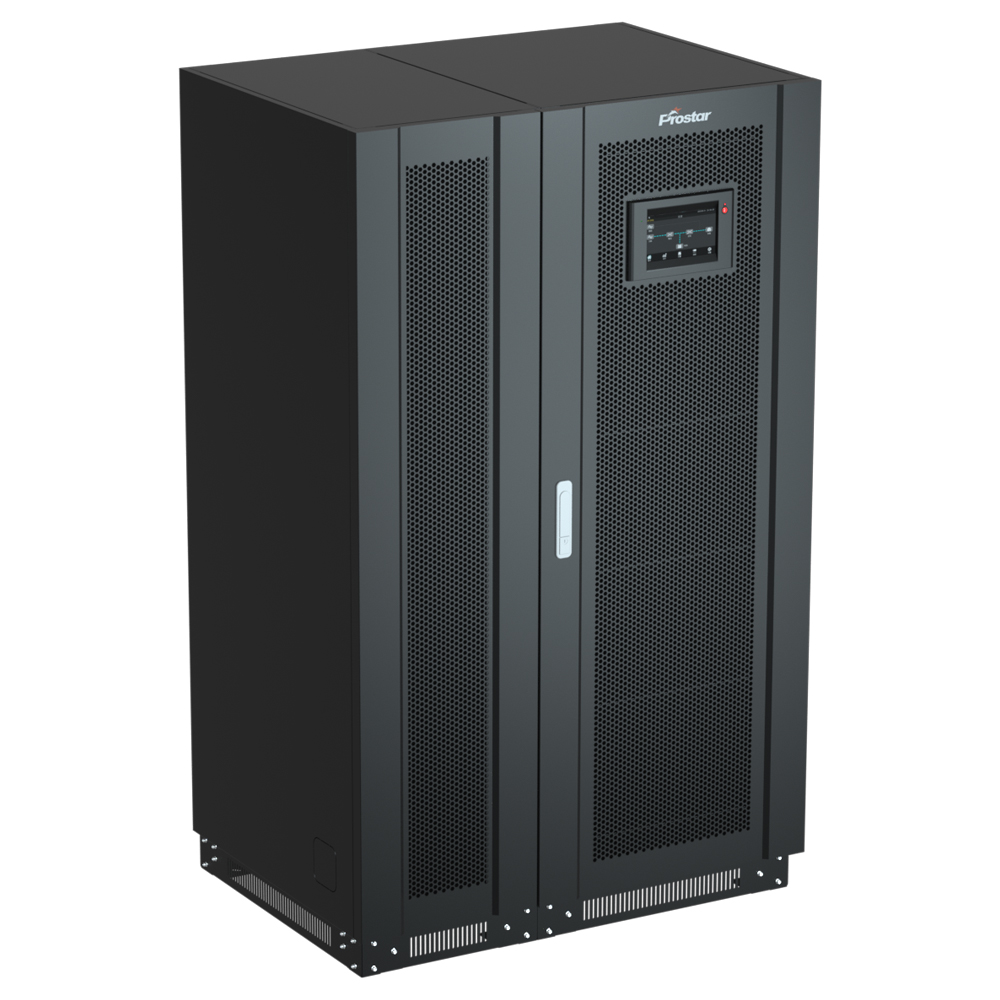
In an automated manufacturing environment, even a brief power interruption poses serious risks. It can result in production downtime, equipment damage, data loss, and significant financial losses. Factory equipment includes CNC machines, robotic production lines, PLC control systems, automated packaging equipment, and industrial servers. These systems require a continuous and stable power supply to maintain operational efficiency.
Prostar ET100K HV stable power 100kva ups system is specifically designed to provide reliable backup power for industrial machinery and critical factory operations. With advanced online double conversion technology, this online UPS system continuously converts incoming AC power to DC and back to clean AC. This means zero transfer time, zero output distortion, and complete isolation from grid noise, sags, surges, and frequency drift. For facilities that demand reliable backup power for industrial machinery, this architecture is non-negotiable.
Typical Factory Power Challenges
Manufacturing facilities often face various power quality issues, including:
Voltage Sags and Surges
Heavy industrial loads frequently cause voltage instability. Motors, compressors, and welding equipment can create sudden voltage drops that affect sensitive electronic systems.
Unexpected Power Outages
Grid failures, transformer faults, and severe weather conditions can lead to unexpected production stoppages.
Harmonic Distortion
Modern industrial equipment generates harmonics that can negatively impact power quality and reduce equipment lifespan.
Increasing Automation Requirements
As factories adopt Industry 4.0 technologies, stable power becomes increasingly important for networked equipment, industrial computers, and automated control systems.
A high-performance 100kVA UPS system helps eliminate these risks and ensures continuous production.

Why Choose 100kVA UPS System for Your Factory?
Prostar ET100K HV is a premium 100kVA UPS system engineered for demanding industrial environments.
Online Double Conversion Protection
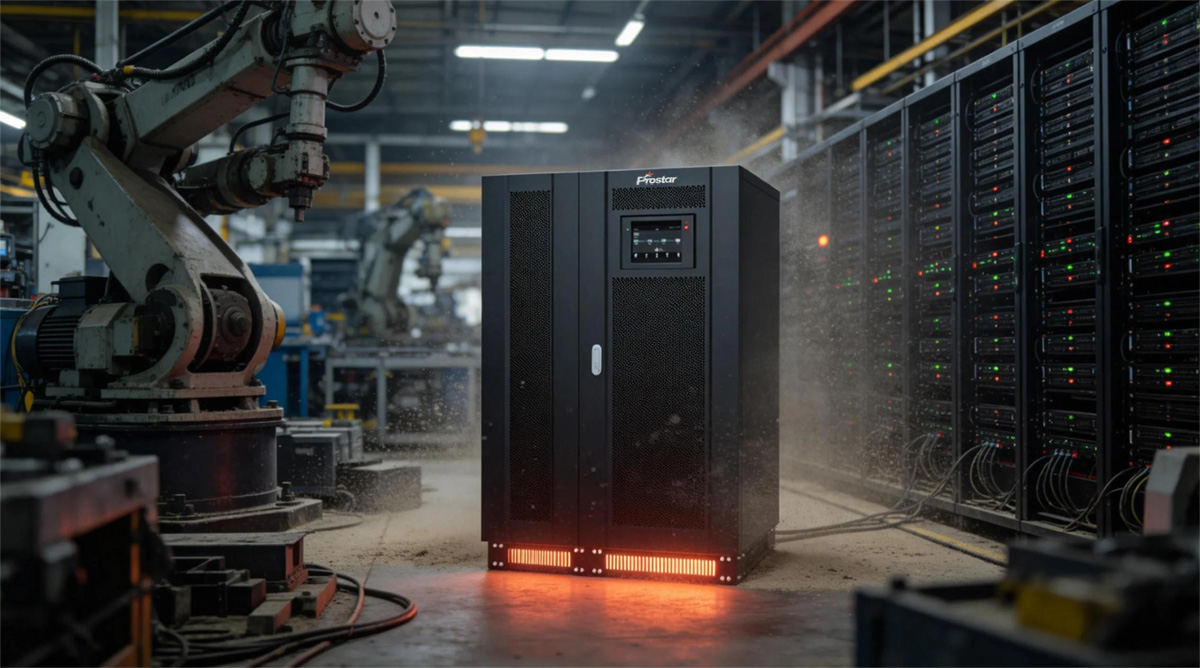
The system continuously converts incoming AC power into DC and then back into clean AC power. This online double conversion UPS architecture completely isolates connected loads from utility power disturbances.
Your factory can get:
- Zero transfer time
- Pure sine wave output
- Stable voltage regulation
- Frequency stabilization
- Protection from power anomalies
Three-Phase Power Architecture
The ET100K HV supports 480V three phase UPS system applications, making it suitable for large industrial facilities and heavy-duty equipment.
Wide Input Voltage and Frequency Range
Industrial power grids often experience voltage fluctuations and frequency instability, especially in manufacturing facilities with heavy electrical loads.
The ET100K HV 100kVA UPS system supports a wide input voltage range and frequency range, allowing the UPS to continue operating normally without unnecessarily switching to battery mode. This feature significantly extends battery life while improving overall system reliability.
Benefits are including:
- Reduced battery discharge cycles
- Enhanced power availability
- Better adaptation to unstable utility grids
- Lower battery maintenance costs
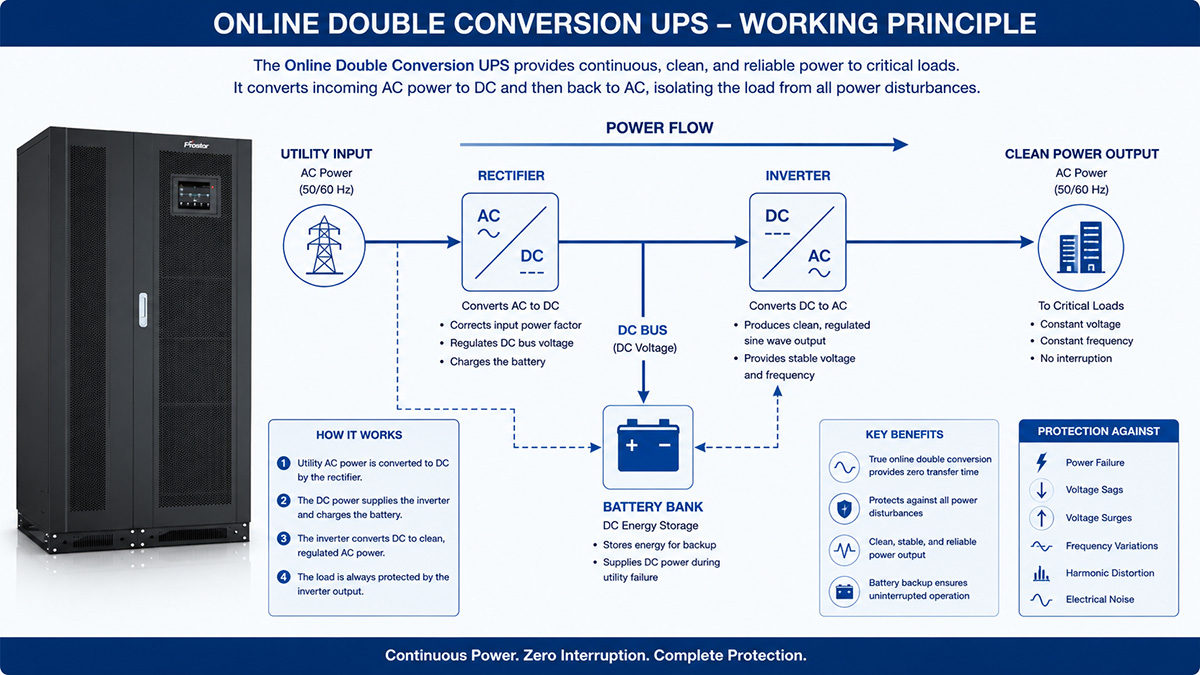

Convenient Bottom Cable Entry Design
The ET100K HV adopts a bottom cable entry structure for simplified installation and maintenance.
This design is particularly beneficial in industrial environments where power cables are routed through cable trenches or raised floors.
Advantages:
- Cleaner cable management
- Faster installation
- Improved maintenance accessibility
- Enhanced safety and professional appearance
Superior Overload Capability
Factory equipment often experiences temporary load surges during startup, motor acceleration, or process switching.
The 480V three phase UPS system provides exceptional overload performance to maintain stable operation under demanding conditions.
| Load Condition | UPS Performance |
| ≤ 105% Load | Continuous operation |
| 105% – 125% Load | Transfers to bypass after 10 minutes |
| 125% – 150% Load | Transfers to bypass after 1 minute |
This super overload capacity protects critical production equipment while preventing unnecessary system shutdowns.
Industrial benefits:
- Supports motor starting currents
- Handles temporary production load peaks
- Improves overall system stability
- Reduces risk of unexpected downtime
Parallel Redundancy Capability
As manufacturing operations grow, power requirements often increase.
The UPS system for manufacturing facilities supports parallel-redundant operation with up to 8 units connected in parallel, providing exceptional scalability and system availability.
Capacity Expansion
Users can gradually increase UPS capacity without replacing existing equipment.
N+1 Redundancy
Additional UPS modules can be installed to create fault-tolerant systems, ensuring continuous operation even if one UPS unit becomes unavailable.
Increased Reliability
Parallel redundancy minimizes the risk of production interruptions caused by power system failures.
Generator Compatibility
The system works seamlessly with diesel generators, providing stable power during extended utility outages.
How the 100kVA UPS System Protects Factory Equipment
Utility Failure
When utility power fails, the 100kVA UPS system instantly draws energy from the battery bank without any interruption to connected equipment.
Voltage Fluctuations
The UPS continuously regulates output power, ensuring sensitive equipment receives stable voltage regardless of utility conditions.
Harmonic Disturbances
Advanced filtering technology minimizes harmonic distortion and delivers clean power to critical loads.
Generator Operation
The UPS conditions generator output power and eliminates fluctuations before supplying power to protected equipment.
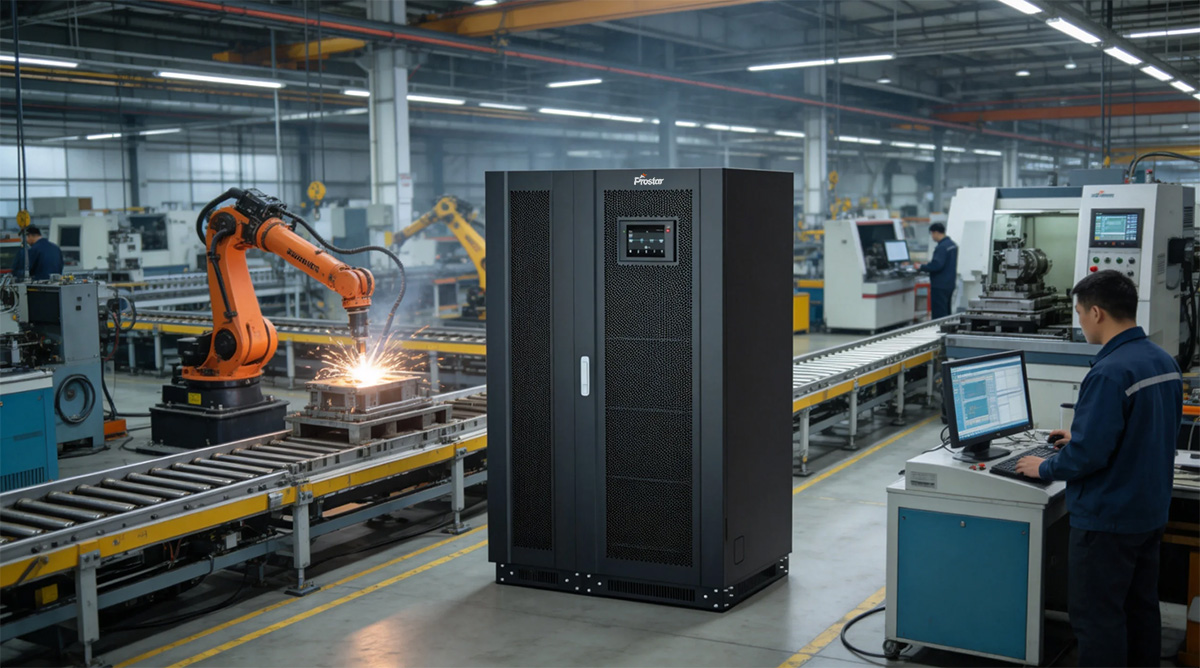
Technical Specification
| Model | ET100K HV |
| Capacity | 100KVA/80KW |
| Topology | Double conversion online |
| Input Nominal Voltage | 480Vac, 3P+N+PE |
| Input Voltage Range | 384 – 576Vac |
| Input Rated Frequency | 50Hz/60Hz (Automatically) |
| THDi | < 3% at full load |
| Output Rated Voltage | 480Vac, customized 208Vac/220Vac ± 1% |
| Frequency | Mains mode: synchronized with bypass input, 50Hz/60Hz±0.01%(By Battery) |
| THDu | <2% at 100% liner load, <5% at 100% non-liner load |
| Overload Capacity | 105-110%: 60 mins, 110-125%: 10 mins, 125-150%: 1 min, >150%: 200ms |
| Crest Factor | 3:1 |
| Wave Form | Pure sine wave |
| Transfer Time | 0ms |
| Efficiency at full load(AC-AC) | > 93% |
| Efficiency at ECO Mode | > 98% |
| Battery Type | Support VRLA battery or LiFePO4 battery option |
| Battery Voltage | 360Vdc default, 336-384VDC |
| Enclosure | IP31 |
| Parallel Number | Up to 8 units |
| Cooling Method | Forced air cooling (fans) |
| Display | 7-inch color LCD touch screen |
| Operating Temperature | 0℃ to 40℃ |
| Communication | RS232, RS485, USB, Dry contact, EPO |
Alarm Code
| Code | Alarm Message | Possible Causes | Recommended Service Action |
| 1 | Mains abnormality | Input power failure | Check mains power supply |
| 4 | Bypass abnormality | Bypass voltage / frequency out of range, wiring issue, exceed the number of bypass switching | Check bypass input voltage, frequency, and wiring. Turn off UPS and re-start again. |
| 8 | Abnormal mains voltage | Mains voltage out of range | Stabilize input voltage |
| 9 | Abnormal mains frequency | Frequency instability | Check generator or grid quality |
| 10 | Reversal of phase sequence of main input | Phase wiring error | Correct main input phase sequence |
| 11 | Over-voltage of Phase A of AC input | Phase A voltage too high | Check Phase A input |
| 12 | Under-voltage of Phase A of AC input | Phase A voltage too low | Check Phase A input |
| 13 | Over-voltage of Phase B of AC input | Phase B voltage too high | Check Phase B input |
| 14 | Under-voltage of Phase B of AC input | Phase B voltage too low | Check Phase B input |
| 15 | Over-voltage of Phase C of AC input | Phase C voltage too high | Check Phase C input |
| 16 | Under-voltage of Phase C of AC input | Phase C voltage too low | Check Phase C input |
| 30 | Abnormal bypass voltage | Over/under bypass voltage | Measure bypass voltage and correct power source |
| 32 | Bypass overload | Load exceeds bypass capacity | Reduce load and check load distribution |
| 33 | Bypass overload delay timeout | Long-term overload on bypass | Reduce load and restart UPS |
| 34 | Bypass frequency over-tracking | Unstable bypass frequency | Check bypass power quality |
| 29 | Bypass phase sequence reversal | Phase sequence incorrect | Correct bypass phase sequence |
| 35 | Shutdown due to bypass abnormality | Severe bypass abnormality | Inspect bypass input and restart |
| 50 | Fan failure | Fan blocked or damaged | Replace fan and check airflow |
UPS Troubleshooting
Code 32 & 33 – Bypass Overload / Timeout
These indicate the load has exceeded the KVA rating of the SCRs (Static Switches).
Action:
- Check the Crest Factor of the load. High non-linear loads (like servers) can trigger peak current alarms even if the RMS current seems normal.
- Check for “Load Unbalance.” In 3-phase systems, if Phase A is at 110%and Phases B/C are at 20%, the UPS will still trigger an overload. Redistribute the load across phases.
Code 29 – Bypass Phase Sequence Reversal
The UPS logic compares the phase angle of the Inverter vs. the Bypass. If they are 120° out of sync, the “Static Switch” cannot transfer without damaging the load.
Action:
- Use a Phase Rotation Meter at the Bypass Input Terminals.
- Ensure rotation is Clockwise (L1 \ L2 \ L3).
- Check the “Sync” signal on the control board; if the phase is physically correct but the error persists, the sensing transformer or control board is faulty.
Code 10 – Reversal of Phase Sequence of Main Input
The Rectifier (SCR or IGBT based) synchronization depends on the “Zero Crossing” of the input waves. Wrong sequence prevents the Rectifier from firing correctly.
Action:
- Measure VL1-L2, VL2-L3, andVL3-L1. All should be approximately equal (e.g., 380V/400V/415V).
- Swap any two input cables (e.g., L1 and L2) at the Main Input Breaker to correct rotation.
Code 11 – 16 – Phase Specific Over/Under Voltage
If only one phase (e.g., Phase A) reports an error, it is likely a local distribution issue or a “Neutral Drift.”
Action:
- Check the Neutral (N):In a 3-phase 4-wire system, a loose Neutral can cause phase voltages to “float.” Measure VL-N for all phases.
- Input Fuse Check:If a phase reports “Under-voltage” (0V), check the high-speed input fuses located before the Rectifier.
- Sensing Board:If your external multi-meter shows 230V but the UPS LCD shows 160V, replace the Voltage Sampling Board.
Code 50 – Fan Failure
Fans stop and alarm.
Action:
- Physical Inspection:Power off the fan and check for any foreign objects obstructing the blades. Manually rotate the fan to check for smooth rotation.
- Direct Measurement:Measure the AC supply to the fan (usually 220VAC). If there is no voltage, check the motherboard power supply fuse.
- Thermal Correlation:Check if Code 53 Heatsink Over-temp If not, the sensor might be the only issue. If yes, the airflow is physically blocked.
- Feedback Signal:If the fan rotates normally but the error message persists, the third wire of the fan (speed detection wire) may be broken or the control board interface may be faulty.
FAQ
The Articles You may Like
- How to Size Modular UPS for Server Room Without Overspending
- Stand-alone power system – Wikipedia
- Modular UPS vs Traditional UPS: Which One is Better?
- What is Slew Rate in UPS System?A Complete Guide
- Choosing the Best Uninterruptible Power Supply UPS for Home Use
- Benefits of Lithium Battery for UPS Systems