
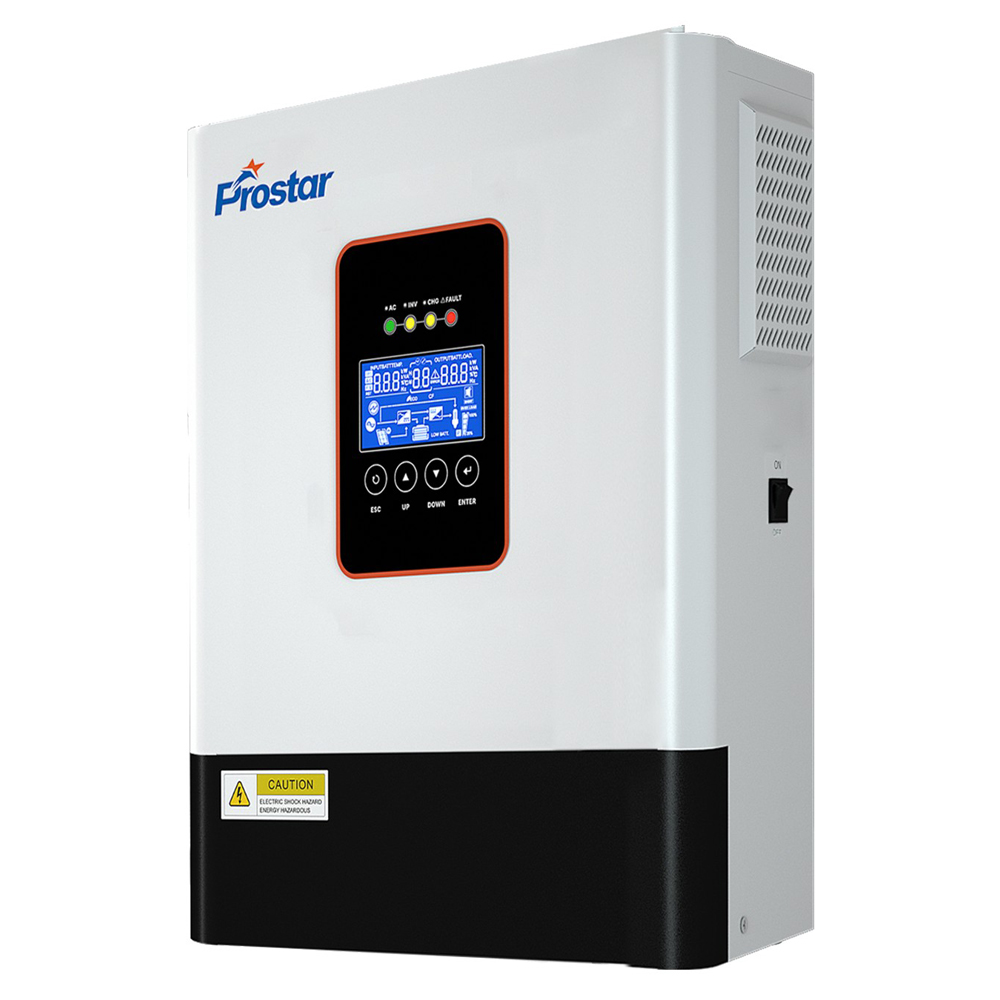
Prostar PIE2K-12L 2000w pure sine wave inverter for solar power systems supports up to 3,000W PV input, a 30–400VDC MPPT range, 100A maximum charging current, and 12V lead-acid or lithium battery compatibility. Its grid-tie function, 4,000VA surge capacity, and compact wall-mounted design provide flexible solar energy management.
The PIE2K-12L is a 2,000VA/2,000W pure sine wave inverter developed for residential solar power systems and small-scale distributed energy applications. It combines solar charging, AC charging, battery management, and DC-to-AC power conversion in one compact unit. The integrated MPPT solar charge controller supports solar PV arrays up to 3,000W.
Unlike conventional standalone inverters, this 2000W pure sine wave inverter supports grid-tie functionality. It provides greater flexibility when integrating solar generation, battery storage, and utility power.
The system operates with a 12VDC battery bank and supports lead-acid, lithium-ion, and user-defined battery configurations.
The following table summarizes the main electrical and mechanical specifications of the PIE2K-12L.
| Parameter | Specification |
|---|---|
| Model | PIE2K-12L |
| Rated Power | 2,000VA / 2,000W |
| Output Phase | Single Phase, L+N+PE |
| Output Waveform | Pure Sine Wave |
| Maximum PV Array Power | 3,000W |
| MPPT Voltage Range | 30–400VDC |
| Maximum PV Open Circuit Voltage | 450VDC |
| Maximum PV Input Current | 18A |
| Maximum PV Charging Current | 100A |
| Maximum AC Charging Current | 100A |
| Maximum Hybrid Charging Current | 100A |
| Battery Voltage | 12VDC |
| Surge Power | 4,000VA |
| Grid-Tie Function | Supported |
| Maximum DC-to-AC Efficiency | 91.0% |
| Output THD | ≤3% (Linear Load) |
| Transfer Time | 10ms / 20ms |
| Installation | Wall-Mounted |
| Dimensions | 331 × 270 × 112mm |
| Net Weight | 4.5kg |
2000W Pure Sine Wave Inverter Features
Pure Sine Wave Output for Household Loads
The PIE2K-12L delivers 2,000W rated AC output with a pure sine wave waveform. Its output voltage is selectable at 208V, 220V, 230V, or 240V AC.
The output voltage regulation is ±5%. Total harmonic distortion is ≤3% under linear loads.
Pure sine wave output provides a sinusoidal AC waveform similar to utility power. Low harmonic distortion helps reduce electrical interference and unwanted heating in compatible equipment.
The inverter also supports 4,000VA surge power to accommodate temporary increases in load demand.
This 2000W pure sine wave inverter can supply power to a variety of residential electrical equipment, including:
- Computers and networking equipment.
- LED lighting systems.
- Refrigerators and freezers.
- Television sets and entertainment systems.
- Small pumps and household appliances.
- Other compatible 230V electrical loads.
The actual load capacity depends on appliance rated power, startup current, and the inverter’s overload characteristics.

3,000W Maximum PV Input for Higher Solar Generation
The PIE2K-12L 2000w pure sine wave inverter supports a maximum PV array power of 3,000W, which is 1.5 times its rated AC output power.
Its integrated MPPT controller provides:
- MPPT operating voltage: 30–400VDC.
- Maximum PV open-circuit voltage: 450VDC.
- Maximum PV input current: 18A.
- Number of MPPT trackers: 1.
- Strings per MPPT: 1.
The higher PV input capacity allows users to connect a larger solar array relative to the inverter’s rated output.
The wide MPPT voltage range provides flexibility when designing solar panel strings.
MPPT technology continuously adjusts the operating point of the PV array to extract available solar power under changing irradiance and temperature conditions.
Users can install a larger PV array to increase daily solar energy generation, improve battery charging opportunities, and reduce dependence on utility electricity.
This configuration is particularly useful for residential solar power systems with limited installation space or varying daily energy demand.
Up to 100A Charging Current for Battery Energy Storage
The PIE2K-12L supports up to 100A maximum charging current through its PV, AC, and hybrid charging functions.
It also offers configurable battery charging algorithms:
- Two-stage charging: CC/Float.
- Three-stage charging: CC/CV/Float.
- Configurable PV charging.
The flexible charging configuration allows the inverter to accommodate different battery technologies and charging requirements.
The system supports lead-acid, lithium-ion, and user-defined battery settings.
Users can select a suitable battery type and charging profile according to their energy storage requirements.
This helps improve charging flexibility across different residential solar installations.
| Charging Parameter | Specification |
|---|---|
| Maximum PV Charge Current | 100A |
| Maximum AC Charge Current | 100A |
| Maximum Hybrid Charge Current | 100A |
| Nominal Battery Voltage | 12VDC |
| Floating Charge Voltage | 13.5VDC |
| Overcharge Protection | 16VDC |
| Supported Battery Types | Lead-acid / Lithium-ion / User-Defined |
12V Battery Compatibility for Flexible Energy Storage
This 2000W pure sine wave inverter uses a 12VDC battery system.
It supports three battery configuration categories:
- Lead-acid batteries.
- Lithium-ion batteries.
- User-defined battery parameters.
The compatibility with multiple battery technologies provides flexibility when selecting an energy storage solution.
Users can configure charging parameters according to battery manufacturer recommendations.
The inverter can be integrated into different residential solar power projects without restricting users to a single battery chemistry.

However, battery selection requires careful consideration of discharge current.
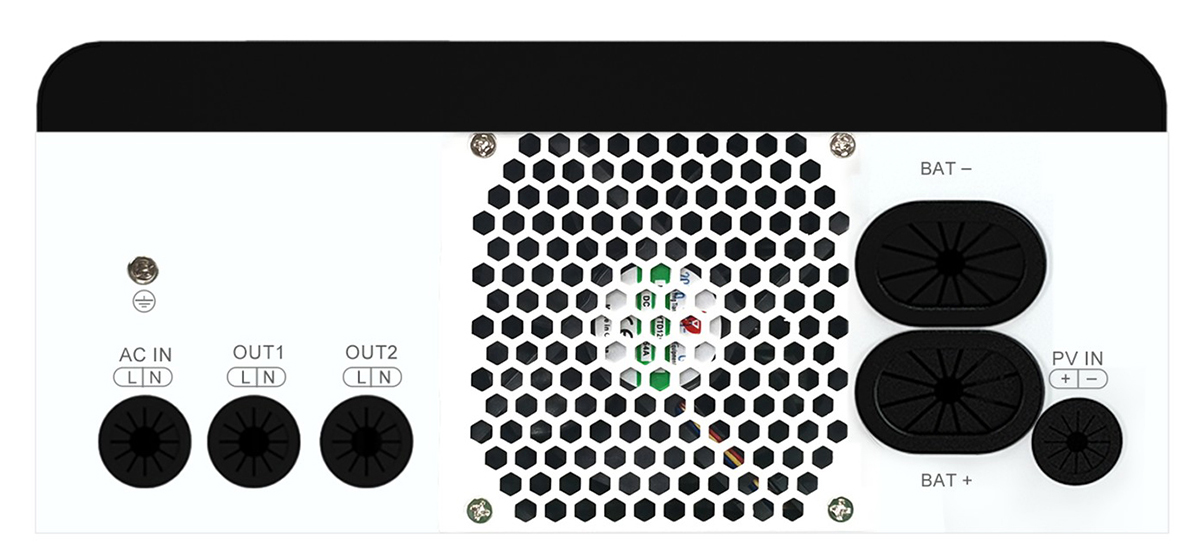
At 2,000W output, the theoretical DC current at 12V is approximately 167A before accounting for conversion losses.
Therefore, the battery bank, BMS, cables, terminals, fuses, and DC circuit breakers must be appropriately rated for the actual operating current.
For lithium battery installations, confirm voltage compatibility and BMS communication or protection requirements before commissioning.
Grid-Tie Function for Integrated Solar Power Systems
The PIE2K-12L supports grid-tie functionality and accepts utility or generator input.
Its selectable AC input voltage ranges are:
- UPS mode: 170–264VAC.
- APL/GEN mode: 90–280VAC.
The nominal input frequency supports 50Hz and 60Hz automatic sensing, with an operating range of 40–70Hz.
The grid-tie function provides additional flexibility when integrating solar power with utility electricity.
The wide AC input voltage range also accommodates different grid and generator conditions.
The input power factor is ≥0.99.
Users can configure solar power systems to work with available utility or generator supplies, depending on the inverter’s supported operating modes and system configuration.
This is useful for residential installations where solar energy is the primary energy source but grid or generator power remains available as backup.
Fast Transfer Time for Backup Power
The inverter provides two specified transfer times:
| Application | Transfer Time |
|---|---|
| Personal Computers | 10ms |
| Home Appliances | 20ms |
The inverter is suitable for residential backup power applications involving computers, routers, lighting, and other compatible electrical equipment.
For particularly sensitive loads, verify the equipment’s ride-through capability and compatibility with the actual transfer behavior.
Wide AC Output Compatibility and Low Harmonic Distortion
The PIE2K-12L supports selectable output voltages of 208V, 220V, 230V, and 240V AC.
Its output frequency operates as follows:
- Grid mode: synchronized to the utility grid.
- Battery mode: 50Hz / 60Hz ±0.1%.
The specified THD is ≤3% under linear loads.
Selectable voltage and frequency settings allow the inverter to accommodate different residential electrical systems.
The low-distortion pure sine wave output provides suitable power quality for compatible electronic equipment.
Distributors and solar system integrators can use one inverter platform for different market voltage requirements, subject to the local electrical installation and certification requirements.
LCD Display and Remote Monitoring Options
The inverter integrates a 2.7-inch LCD screen and LED indicators.
Standard communication interfaces include:
- USB.
- RS485.
Optional monitoring accessories include:
- Wi-Fi module.
- GPRS module.
- Ethernet connectivity.
- CT sensor or meter.
The display provides local operating information, while communication interfaces support system monitoring and configuration.
Optional remote monitoring expands the available monitoring methods.
Installers and end users can monitor system operating conditions more conveniently.
This is particularly useful for solar distributors and service providers managing multiple residential installations.
Typical Applications
Residential Solar Power Systems
The inverter can support household loads such as lighting, computers, televisions, refrigerators, and other compatible appliances.
Its 3,000W maximum PV input provides additional flexibility for residential solar panel configurations.
Home Backup Power Systems
When utility power is unavailable, the battery supplies DC energy to the inverter for AC load operation.
The specified 10ms transfer time for personal computers and 20ms for home appliances makes it suitable for many household backup applications.
Small Off-Grid Solar Systems
For remote homes, cabins, and locations without reliable utility access, the inverter can combine PV generation with battery storage.
Its 12V battery architecture requires careful battery capacity and discharge-current calculations, particularly when operating close to the 2,000W rated output.
Small Commercial Solar Applications
The PIE2K-12L can also serve small shops, offices, and commercial facilities requiring a 2kW solar inverter.
Typical loads include lighting, computers, communication equipment, and selected small appliances.
Motor-driven loads must be evaluated according to their startup current and the inverter’s overload capacity.
Frequently Asked Questions (FAQ)
The Articles You may Like
- How to Choose 3 Phase Online UPS for Laser Cutting Machine
- Split-phase electric power – Wikipedia
- What is the CT Sensor in Solar Inverter On Off Grid
- Why Does a Lithium Polymer Battery Need a BMS?
- How 3 Phase Lithium UPS System Enhances Backup Power Performance
- Top 5 Reasons to Switch to Lithium Solar Batteries