
Choosing online UPS for boiler backup power is an excellent way to maintain home heating during short power outages. This is particularly important for modern gas or oil boilers. They rely on electricity for ignition, controls, circulation pumps, fans, or blowers. A boiler system is a critical component in residential, commercial, and industrial heating applications. Boilers are used for space heating, hot water supply, or industrial processes. They rely heavily on stable electrical power. This power operates control circuits, circulation pumps, safety valves, and monitoring systems.
A UPS provides instantaneous power in milliseconds when the grid fails. This prevents boiler lockouts, ignition failures, or frozen pipes during brief blackouts. However, UPS systems are best suited for short-to-medium runtime (minutes to several hours), while longer outages often require a generator.
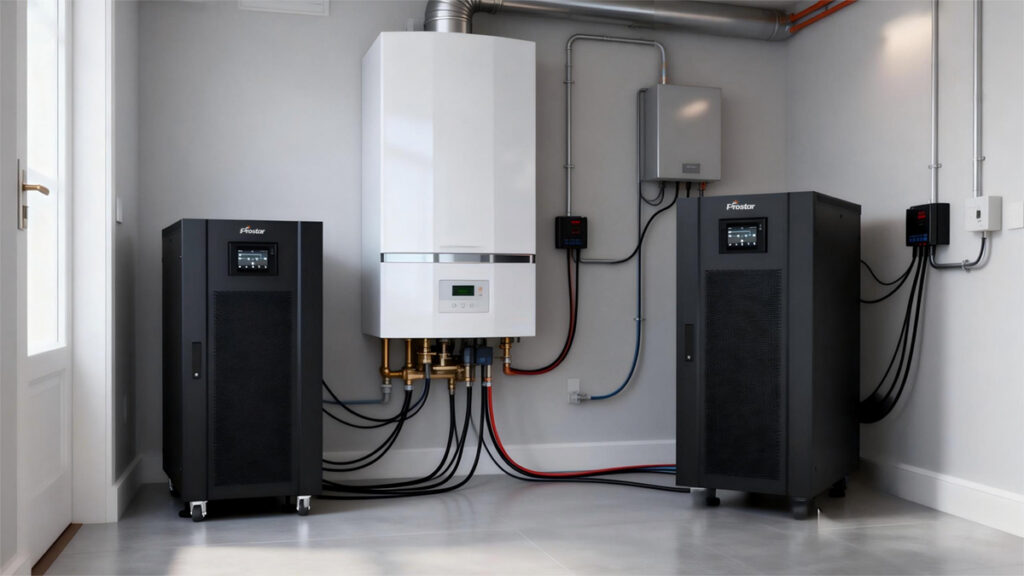
Why Boilers Need UPS Backup Power
Most modern boilers (especially condensing gas models or those with electronic controls) cannot operate without electricity. Typical electrical components include:
- Control board and ignition system
- Gas valve
- Circulation pump(s)
- Induced draft fan or blower
- Sensors and safety circuits
Power loss often causes the boiler to lock out, requiring a manual reset even after power returns. A UPS keeps these components running seamlessly.
Functions of Online UPS for Boiler System
Power Continuity
The UPS provides uninterrupted power to the boiler’s control board. It also powers the ignition system and circulation pumps. This setup prevents unexpected shutdowns during power outages.
Voltage Stabilization
Boilers are sensitive to voltage fluctuations. A UPS with automatic voltage regulation (AVR) protects electronic components from under-voltage, over-voltage, and power surges.
Safe Shutdown and System Protection
In extended outages, the UPS allows the boiler to complete a controlled shutdown. This process reduces thermal stress and prevents damage to heat exchangers and pumps.
Improved Reliability in Cold Climates
In regions with unstable grids or harsh winter conditions, a UPS ensures heating systems remain operational. This protects buildings from freezing and related damage.
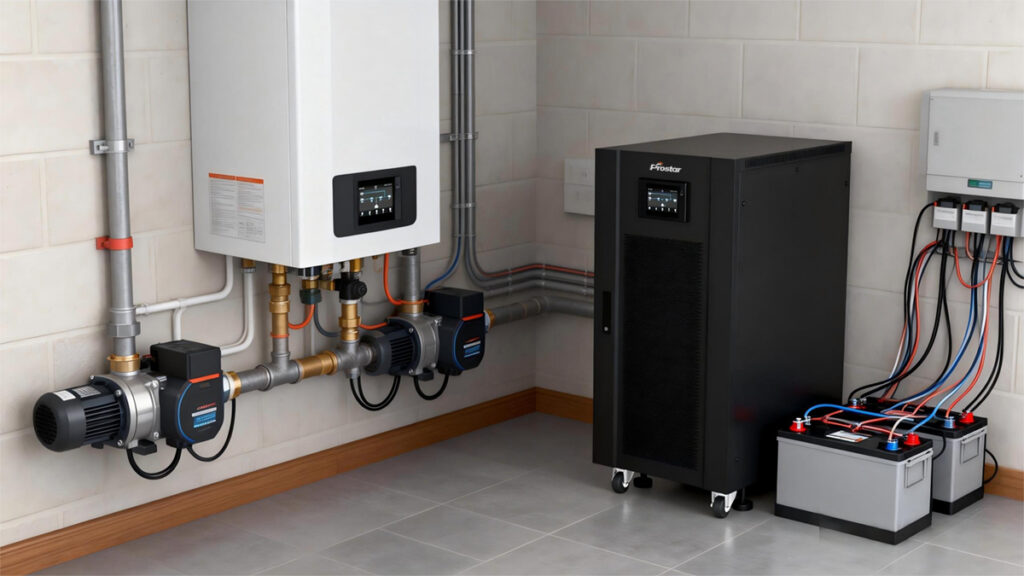
How to Calculate Boiler Starting Surge Current
For a domestic boiler, you usually estimate starting surge (inrush) from the motors, like the circulation pump and fan. The starting surge is not estimated from the electronics, which draw almost the same at start and at steady state. A practical way is to treat each motor as a small induction motor. Then, apply a multiplier to its normal running current.
1. Get the motor running current
Find the boiler’s nameplate or manual and note:
- Supply voltage (for example, 230 V 50 Hz).
- Rated current in amps (A) or rated power in watts (W) for the pump/fan.
If you only have power in watts, approximate running current as
I = P / (V*PF)
where PF (power factor) is often around 0.8 for small motors.
Example: 500 W pump at 230 V, PF 0.8:
I = 500 W / (230 V * 0.8) = 2.72 A
2. Apply a surge multiplier
Small single‑phase induction motors started “direct‑on‑line” typically pull several times their running current for a short moment. This surge lasts a few hundred milliseconds to a couple of seconds. A common engineering rule of thumb:
- Inrush current for small pumps and fans (as experience, we will choose 5).
Many motor references use 5–7× FLA (full‑load amps) as a conservative upper bound for direct‑on‑line starting.
So you can calculate:
Istart ≈ k×Irun
with chosen depending on how conservative you want to be:
- Mild assumption: .
- Typical: or 5.
- Very conservative: .
3. Example for a boiler pump
Suppose:
- Boiler circulation pump rated 100 W at 230 V, PF ≈ 0.8.
- Running current (from above).
Then:
- With : .
- With : .
For UPS sizing and breaker checks, you would usually design for the higher figure.
4. Using nameplate current directly
If the pump/fan nameplate already lists the rated current (for example, 0.6 A):
- Take that as .
- Estimate starting surge as
.
5. When you need more accuracy
Rules of thumb are good enough for sizing a UPS or small breaker for a domestic boiler. If you need more precise figures (for a large boiler or tight protection settings):
- Check the motor or boiler datasheet for “locked‑rotor current,” “LRA,” or “starting current” — that is the surge current.
- Use a clamp meter with inrush function on the pump supply while the boiler starts, and record the peak.
Share the pump power (W or A) and supply voltage with me. I can calculate the inrush estimate for your specific boiler. I will guide you through it step-by-step.
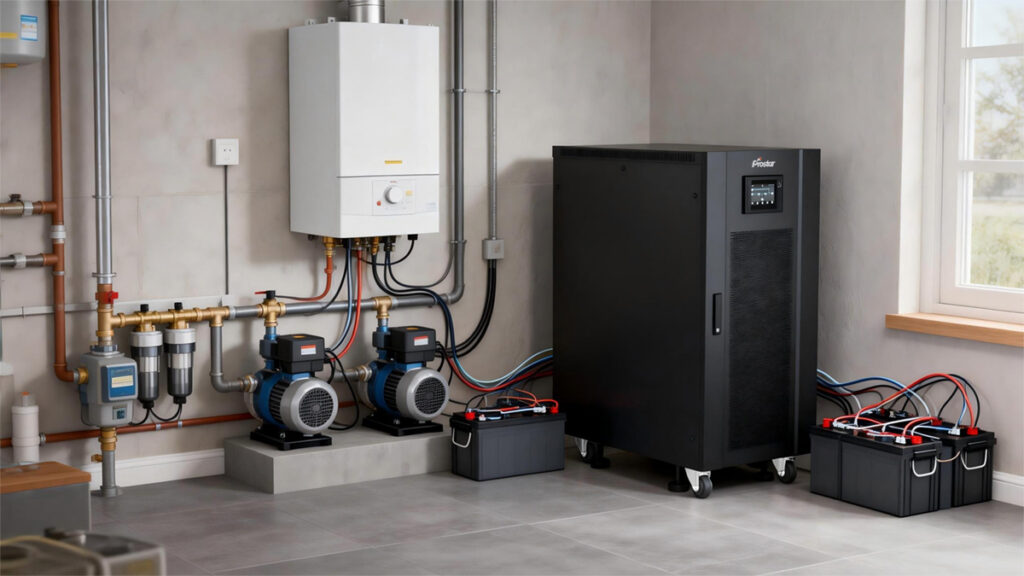
How to Size UPS for Boiler
Sizing a UPS for boiler (typically a gas or oil-fired heating boiler) involves several steps. First, calculate the actual power load. Then, account for startup surges. Finally, select a unit that provides reliable backup without risking damage to the equipment.
Modern boilers often require electricity for the control board, ignition system, gas valve, blower fan, and especially circulation pumps. A UPS ensures the boiler stays running during short power outages. It prevents lockout, frozen pipes, or loss of heat.
Step 1: Determine the Total Running Power Consumption
Check your boiler’s manual, nameplate, or manufacturer’s specs for power ratings. If unavailable, use these typical ranges for residential systems:
- Boiler controls + ignition + electronics — 40–150 W (many condensing gas boilers average ~80–120 W).
- Circulation pump (one common in most homes) — 50–100 W. Modern energy-efficient pumps often use 25–80 W. Older ones may consume up to 100+ W.
- Additional components (e.g., draft inducer fan, extra zone pumps) — 30–150 W each.
Typical total running load examples:
- Basic wall-hung combi gas boiler + 1 pump → 100–250 W
- Floor-standing boiler + 1–2 pumps + fan → 200–500 W
- High-end system with multiple zones → 400–800 W or more
The best method: Use a plug-in watt meter (e.g., Kill-A-Watt) to measure actual draw while the boiler and pump are running normally.
Step 2: Account for Startup Surge (Inrush Current)
Pumps and fans have motors that draw 3–6× more power for a few seconds when starting.
- Example: A 80 W running pump might surge to 200–400 W briefly.
- Boiler electronics usually have minimal surge, but the pump dominates.
Add a safety margin of 20–50%. Alternatively, more conservatively, add 3× the running watts of motor loads. This will handle inrush without the UPS overloading or shutting down.
Practical formula:
- Minimum UPS watt rating = (Total running watts) × 3 to 5 (or higher for heavy pumps)
- Example: 200 W running load → Aim for 600–1000 W minimum UPS capacity (watts output)
Step 3: Understand VA vs. Watts Ratings
UPS units are rated in VA (volt-amps, apparent power) and often watts (real power).
- For boiler loads (motors + electronics), the power factor is typically 0.7–0.9.
- Watts = VA × Power Factor (or VA = Watts / Power Factor)
- Focus on the watts rating for real capability, but ensure the VA rating is higher.
Many experts recommend the UPS watt rating be 20–30% above your calculated load.
Example:
- Load = 250 W running
- With surge margin → Target 750–1500 W UPS output
- Corresponding VA (at ~0.8 PF) → ~875–1875 VA minimum
Common residential boiler UPS choices:
- 500–800 VA / 300–500 W — For light loads
- 1000–1500 VA / 600–1000 W — Most common recommendation for typical home boilers + pumps
- 2000+ VA — For larger systems or longer runtime
Step 4: Choose Runtime (Battery Capacity)
Runtime depends on battery size and load.
- Formula: Runtime (hours) ≈ (Battery capacity in Wh × Efficiency) / Load in W (Efficiency ~0.8–0.9 for UPS)
Typical built-in batteries provide:
- 100–300 W load → 10–60 minutes
- Many boiler-specific UPS models support external batteries (e.g., deep-cycle or AGM) for 4–24+ hours.
Decide based on your needs:
- Short blips/outages (minutes) → Small UPS sufficient
- Longer outages (hours) → Add external batteries or consider a hybrid inverter system
Step 5: Select the Right UPS Type
Critical requirements for boilers:
- Pure sine wave output — Mandatory for circulation pumps, fans, and sensitive electronics. Modified/stepped sine wave can cause humming, overheating, motor damage, or control failures.
- Line-interactive or online (double-conversion) types for better regulation.
- Fast transfer time (<10 ms) to prevent boiler lockout.
Avoid cheap computer/back-office UPS models with modified sine wave.
Related Online UPS
Benefits of Using a UPS for Boilers
- Prevents unplanned shutdowns
- Extends the lifespan of boiler electronics
- Enhances system safety and reliability
- Reduces maintenance and downtime costs
- Ensures continuous heating during power failures
The Articles You may Like
- Can Off Grid Solar Inverter Charge Controller Run without Battery
- Stand-alone power system – Wikipedia
- What is the CT Sensor in Solar Inverter On Off Grid
- How Long Should the Durable Online UPS Systems Last
- Navigating the Data Realm with Futuristic Rack Mountable UPS Solutions
- How to Choose 3 Phase Online UPS for Laser Cutting Machine