
An uninterruptible power supply for healthcare delivers instantaneous backup power during outages, protecting life-saving equipment, patient data, and critical operations. Medical uninterruptible power supply for critical care prevents downtime in operating rooms, ICUs, and monitoring systems. Reliable uninterruptible power supply for hospital backup power systems also prevents downtime in those same critical areas. Best uninterruptible power supply for healthcare equipment combines pure sine wave output, extended runtime, and seamless switching. These features ensure compliance, patient safety, and data integrity. Key benefits include zero interruption for patient monitoring systems, operating room equipment, and intensive care units. They also include zero interruption for healthcare data protection and emergency medical power systems.
Key facts at a glance:
- Why it matters: Even a 10–15 second power gap can shut down ventilators, dialysis machines, and ICU monitors before a generator starts.
- What it protects: Operating rooms, ICUs, emergency departments, imaging equipment (MRI/CT), pharmacy refrigeration, and hospital data centers/EHR systems.
- Standard requirement: NFPA 99 and NFPA 110 classify healthcare power as “Type 1 Essential Electrical Systems,” requiring seamless transfer with zero interruption for critical branches.
- Typical bridge time: A healthcare-grade UPS must cover the 10-second gap between utility loss and generator activation, as mandated by NEC Article 517.
Why Every Healthcare Facility Needs an Uninterruptible Power Supply
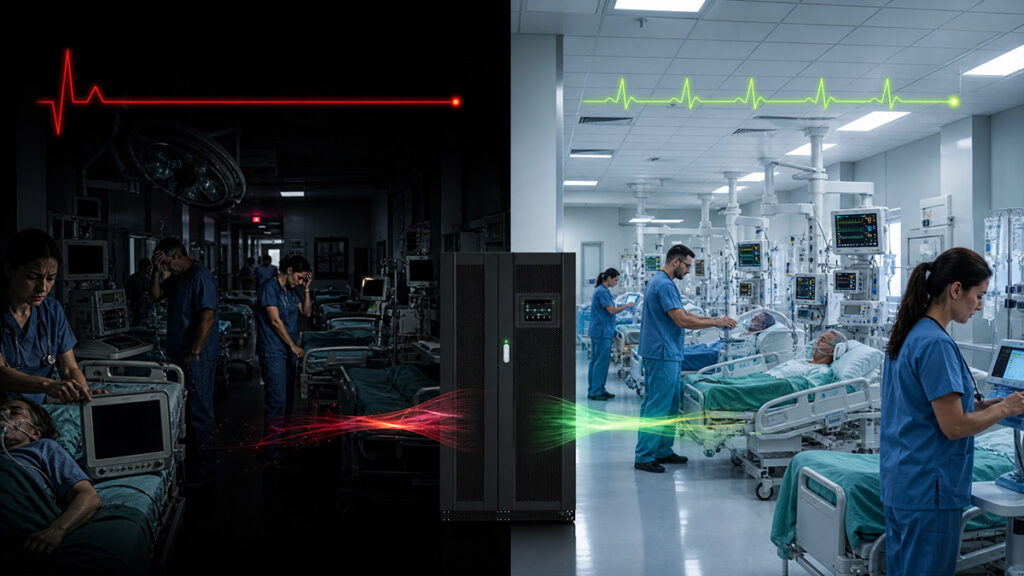
Modern hospitals depend on electricity every second of every day. Even a one-second outage can interrupt surgeries, disable life-support systems, corrupt medical records, or stop patient monitoring devices.
A uninterruptible power supply for healthcare is designed to bridge the gap between utility failure and generator startup while continuously delivering clean, regulated power.
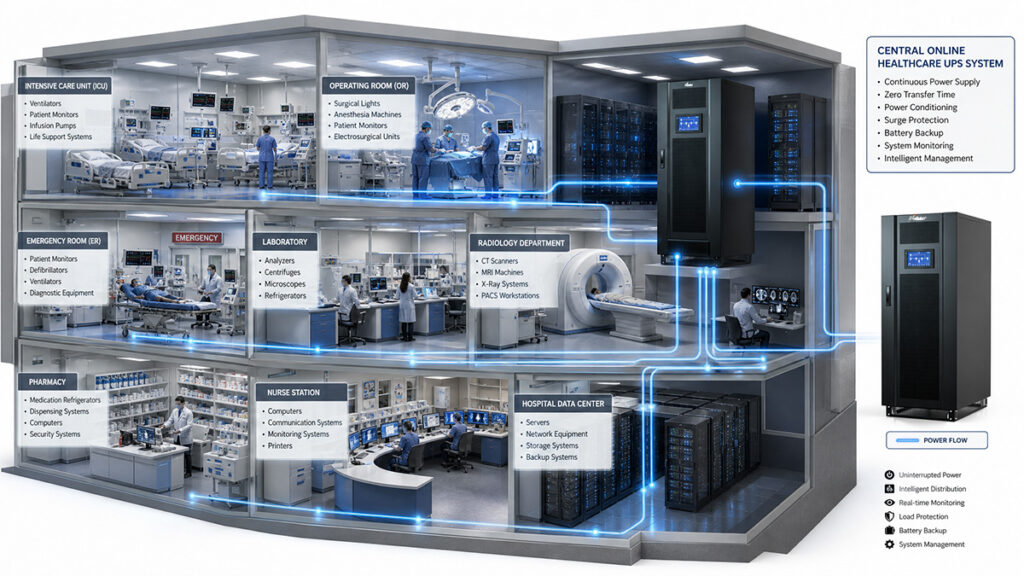
Unlike standard backup generators, a UPS reacts instantly—within milliseconds or with zero transfer time depending on the topology.
Healthcare organizations rely on UPS systems to protect:
- Intensive Care Units (ICUs)
- Operating theaters
- Emergency departments
- Diagnostic imaging centers
- Clinical laboratories
- Pharmacy automation
- Hospital data centers
- Nurse call systems
- Telemedicine infrastructure
- Electronic Medical Record (EMR) servers
Without continuous power protection, patient safety and hospital operations are placed at significant risk.
Common Power Problems in Healthcare Facilities
| Vulnerability | Clinical Risk | Typical Duration |
|---|---|---|
| Utility outage before generator start | Life-support interruption | 0–15 seconds |
| Voltage sag/brownout | Equipment resets, false alarms | Milliseconds–seconds |
| Generator transfer switch failure | Extended blackout in critical areas | Minutes–hours |
| Harmonic distortion / power quality issues | Gradual equipment degradation | Continuous, cumulative |
| Server/network power loss | EHR downtime, data loss | Seconds–hours |
An advanced uninterruptible power supply for healthcare isolates medical equipment from these disturbances while maintaining a perfectly regulated output.
Hidden Cost of Power Failure in Clinical Settings
Beyond immediate patient risk, power failures carry compounding costs:
Clinical liability
Interrupted procedures or lost monitoring data can trigger adverse events and malpractice exposure.
Equipment damage
Sudden power loss and restoration cycles stress sensitive electronics like imaging systems, shortening their service life.
Regulatory penalties
Joint Commission and CMS surveys can flag inadequate emergency power systems, risking accreditation.
Operational disruption
Canceled surgeries, ambulance diversions, and delayed lab results ripple across the entire facility.
Data integrity loss
An uninterruptible power supply for healthcare data protection strategy is now as critical as physical power protection. This is because so much clinical decision-making depends on EHR uptime.
Why Online Double-Conversion UPS Is the Healthcare Standard
Healthcare environments require the highest level of electrical protection.
Unlike line-interactive UPS systems, online double-conversion UPS continuously converts incoming AC power into DC and then back into clean AC power.
This architecture offers:
- Zero transfer time
- Stable output voltage
- Stable output frequency
- Harmonic isolation
- Surge suppression
- Voltage regulation
- Frequency regulation
- Continuous clean sine wave output
These characteristics make it the preferred medical uninterruptible power supply for critical care environments where even a brief interruption is unacceptable.
Healthcare Areas That Depend on UPS Protection
1. Intensive Care Units (ICU)
ICU patients depend on continuous monitoring and life-support devices.
Typical protected equipment includes:
- Ventilators
- Patient monitors
- Infusion pumps
- Dialysis machines
- Defibrillators
A dedicated uninterruptible power supply for intensive care units ensures these systems remain operational during power disturbances.
2. Operating Rooms
Operating theaters demand absolute power continuity.
Critical equipment includes:
- Surgical lighting
- Anesthesia systems
- Electrosurgical units
- Imaging equipment
- Surgical navigation systems
A high-performance uninterruptible power supply for operating room equipment eliminates power interruptions during complex surgical procedures.
3. Patient Monitoring Systems
Modern hospitals continuously collect real-time patient data.
UPS protection prevents:
- Monitor shutdown
- Alarm failures
- Lost patient data
- Communication interruptions
This makes a uninterruptible power supply for patient monitoring systems an essential component of patient safety infrastructure.
4. Hospital Data Centers
Hospitals increasingly rely on digital infrastructure.
UPS systems protect:
- EMR databases
- PACS imaging servers
- HIS systems
- Laboratory Information Systems
- Pharmacy databases
- Cloud gateways
A dedicated uninterruptible power supply for healthcare data protection prevents data corruption and maintains continuous clinical access.

5. Emergency Departments
Emergency rooms must remain operational regardless of utility conditions.
A uninterruptible power supply for emergency medical power systems ensures uninterrupted operation of:
- Trauma equipment
- Emergency imaging
- Triage systems
- Communication platforms
- Ambulance coordination systems
Choosing the Best Uninterruptible Power Supply for Healthcare Equipment
Selecting the right system requires matching UPS capacity, runtime, and redundancy to the criticality of each load. Below is a practical sizing and selection framework.
UPS Sizing Reference by Department
| Department/Load | Recommended UPS Capacity | Minimum Runtime | Redundancy |
|---|---|---|---|
| Operating rooms | 10–40 kVA per suite | 15–30 min | N+1 |
| ICU / Critical care | 20–60 kVA per unit | 15–30 min | N+1 |
| Patient monitoring stations | 1–10 kVA per station cluster | 30–60 min | N+1 |
| Imaging (MRI/CT) | 40–200 kVA | 10–15 min (bridge to generator) | N+1 |
| Hospital data center / EHR servers | 20–500 kVA | 15–45 min | 2N |
| Pharmacy refrigeration | 3–10 kVA | 30–60 min | N+1 |
| Emergency department | 20–100 kVA | 30-90 min | N+1 |
Note: Runtime figures represent the battery bridge to generator start-up, not full outage duration. Generators should be sized to carry critical loads for extended outages.
Key Selection Criteria
- Zero transfer time — non-negotiable for direct patient-care loads
- N+1 or 2N redundancy — a single UPS failure should never take down a critical branch
- Battery chemistry — lithium-ion offers longer lifespan and smaller footprint versus VRLA, at higher upfront cost
- Scalability — modular UPS architecture allows capacity to grow with facility expansion
- Remote monitoring — real-time alerts for battery health, load levels, and temperature
- Compliance certification — UL 1778, NFPA 99, and IEC 62040 compliance
Battery Chemistry Comparison: VRLA vs. LiFePO4
The energy storage subsystem dictates the footprint, lifecycle costs, and operational reliability of the medical power protection scheme.
| Parameter Matrix | Valve-Regulated Lead-Acid (VRLA) | Lithium Iron Phosphate (LiFePO4) |
| Design Life Profile | 3 to 5 Years | 10 to 15 Years |
| Footprint / Weight Ratio | Heavy, high floor-loading stress | Compact, up to 60% lighter footprint |
| Thermal Sensitivity | High performance drop above 25℃ | Robust performance up to 40℃ |
| Total Cost of Ownership (TCO) | Low upfront cost; high maintenance/replacement | High initial capital outlay; lowest long-term TCO |
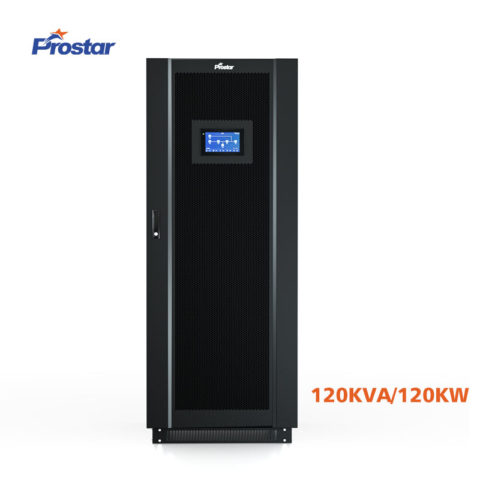
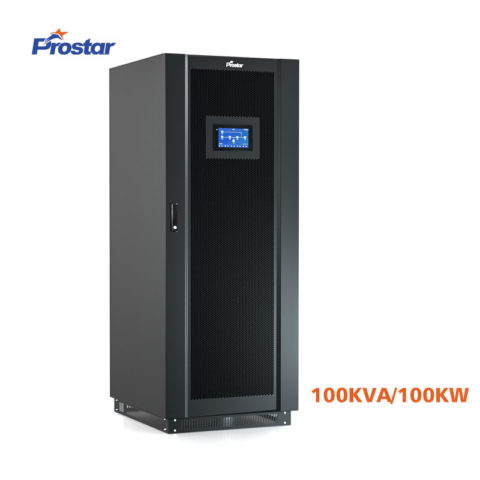
Related Uninterruptible Power Supply for Healthcare
How UPS Works Together with Hospital Generators
A common misconception is that generators eliminate the need for UPS systems.
In reality, generators require time to start.
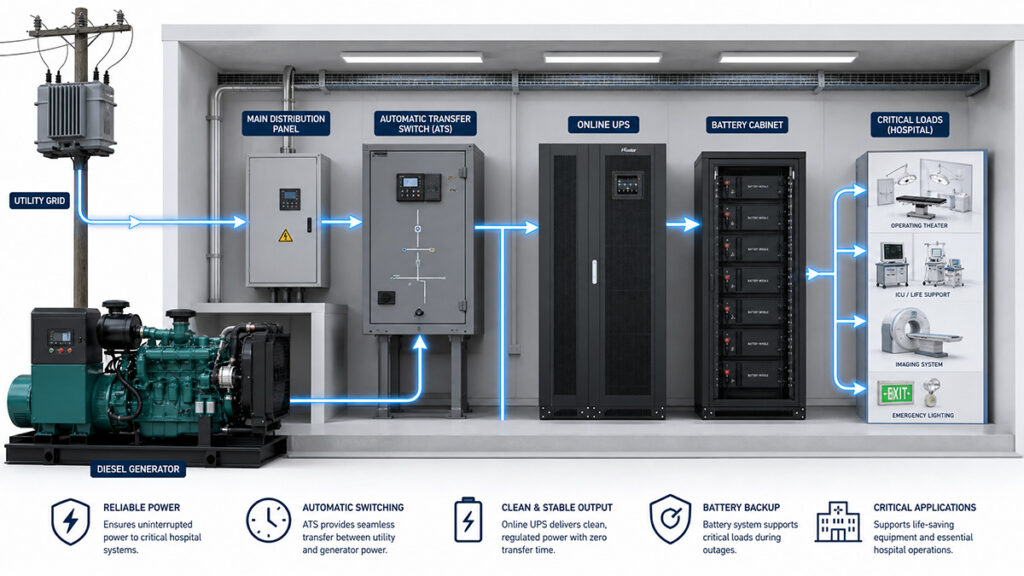
Typical sequence:
- Utility power fails.
- UPS immediately powers connected loads.
- Automatic Transfer Switch (ATS) detects outage.
- Generator starts.
- Generator reaches stable voltage and frequency.
- ATS transfers hospital load.
- UPS resumes battery charging.
Without UPS protection, sensitive equipment experiences complete shutdown during generator startup.
A Step-by-Step Healthcare UPS Implementation Framework
Transitioning a healthcare estate to a resilient power architecture requires a systematic deployment framework. This framework must prioritize safety, capacity optimization, and zero runtime disruption.
1. Comprehensive Inrush & Load Auditing
Conduct thorough load profile testing using power quality analyzers. It is vital to measure the specific inrush current spikes generated by heavy inductive medical equipment. This equipment includes MRI gradient coils, CT scanner tubes, or large refrigeration compressors. Doing so helps avoid sizing an under-capacity inverter that trips on overload during startup.
2. Galvanic Isolation Integration
Verify that all UPS models slated for deployment within the patient care vicinage include a built-in medical-grade isolation transformer. This ensures absolute input-to-output grounding separation, permanently suppressing system leakage current to levels well below the 300μA regulatory ceiling mandated by UL 60601-1.
3. Dual-Bus Power Path Configuration
Route parallel independent power feeds from separate upstream distribution boards directly into a 2N configuration panel. Ensure all dual-corded critical diagnostic arrays and life‑support lines are plugged separately into both independent power paths. This eliminates single points of failure across the power train.
4. External Maintenance Bypass Interlocking
Install a wrap-around, make-before-break external manual maintenance bypass switchboard. This dedicated bypass system allows biomedical engineers to safely isolate, service, or completely swap out the internal UPS components. All of this is done without dropping the live medical load. This ensures 100% facility uptime during preventative maintenance cycles.
FAQ
Absolutely not. Standard IT UPS systems lack specialized low-leakage isolation transformers. They routinely emit stray chassis leakage currents exceeding 1,000μA, which poses a severe micro-shock hazard to patients with invasive lines, and actively violates NFPA 99 and IEC 60601-1 codes.
Enough to bridge the gap until generators activate — usually under a minute — though critical circuits are often designed with extended battery runtime of 15-30 minutes as an added safety margin.
Large hospitals typically use multiple UPS systems distributed across departments or centralized modular UPS systems with redundant architecture to improve reliability and simplify maintenance.
Yes. Lithium-ion batteries are increasingly favored for healthcare applications because of their longer service life, faster recharge, reduced maintenance, and lower lifecycle costs.
Yes. Generators cannot start instantly — there is always a gap of several seconds. A UPS is what covers that gap, ensuring truly uninterrupted power to critical equipment while the generator comes online.
Without redundancy, a UPS failure during an outage can cause the exact interruption the system was meant to prevent — which is why N+1 or 2N redundant architecture is strongly recommended for ICUs, ORs, and data centers.
The Articles You may Like
- Why Every Server Room Needs a Rackmount Uninterruptible Power Supply
- Stand-alone power system – Wikipedia
- How to Size Modular UPS for Server Room Without Overspending
- Industrial UPS Design: When to Use an Autotransformer vs. Isolation Transformer
- Prostar Power: Delivering Reliable Power Solutions
- Choosing the Right UPS for Telecom Base Station Power Backup