
In modern healthcare infrastructure, uninterrupted power is not a convenience—it is a clinical necessity. Hospitals depend on continuous electricity to sustain life-support systems, diagnostic imaging, surgical operations, and digital health records. Even a millisecond-level interruption can lead to data corruption, equipment shutdown, or life-threatening situations.
A modular UPS for hospitals is an uninterruptible power supply. It is built from multiple hot-swappable power modules. These modules work together to provide scalable backup power. The system is redundant and maintainable. It is tailored to meet medical facility needs.
Modular UPS for hospitals have emerged as the gold-standard reliable power backup solutions. They deliver scalability, redundancy, and zero-downtime performance. Traditional monolithic systems simply cannot match this level of capability.

Why Hospitals Cannot Afford Power Failures
The stakes in a hospital setting are uniquely high. Unlike a commercial office where a power outage might mean lost productivity, a hospital outage can result in:
Immediate risk to patient life
Ventilators, heart-lung machines, and infusion pumps rely on continuous power.
Data integrity loss
Electronic Health Records (EHR) and diagnostic imaging archives must remain accessible and uncorrupted.
Surgical disruptions
Modern operating theaters equipped with hybrid imaging and robotic assistance require clean, uninterrupted power to prevent mid-procedure failures.
Regulatory non-compliance
Standards such as NFPA 99 (Health Care Facilities Code) and IEEE 1100 mandate rigorous power reliability measures.
What is a Modular UPS System?
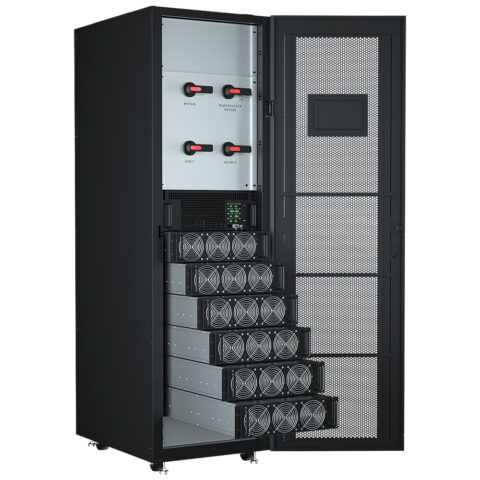
Unlike traditional “monolithic” UPS units with fixed capacity inside a single cabinet, modular UPS systems consist of independent power modules. Each module is typically 10–100 kVA. These are housed in a shared frame or rack. Hospitals can start with the exact capacity needed and add modules later without shutting down the system.
A typical architecture features:
- Rectifier and inverter modules
- Static bypass switch
- Battery system (lead-acid or lithium-ion)
- Centralized control and monitoring
Core Characteristics:
- Hot-swappable modules (no downtime during maintenance)
- Scalable capacity (add/remove modules as demand evolves)
- Redundancy support (N+1, N+X)
- Distributed architecture for fault isolation
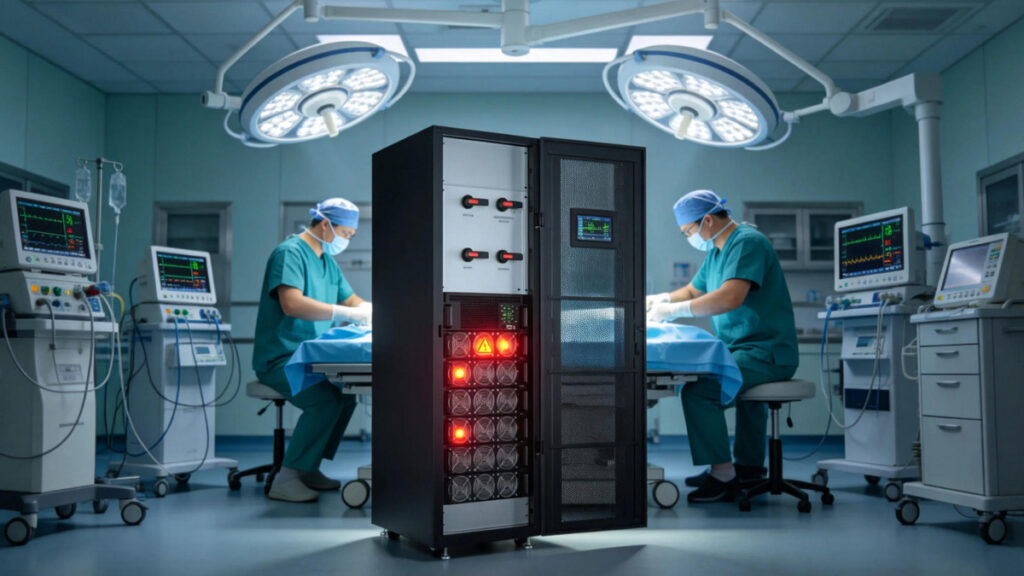
Modules operate in parallel using N+1 or N+X redundancy. If one module fails, the remaining units instantly assume the full load with zero interruption. This is a critical advantage in healthcare. Here, downtime is measured in lives, not dollars.
Why Hospitals Need Modular UPS Systems
1. Zero Downtime Requirement
Hospitals operate 24/7 with zero tolerance for outages. Modular UPS for hospitals ensure:
- Instant backup during grid failure
- Seamless transfer without switching delay
- Continuous operation of ICU, OT, and emergency systems
2. High Reliability with Redundancy
Modular UPS supports redundancy configurations such as:
- N+1 redundancy: One extra module ensures backup
- N+X redundancy: Multiple spare modules for critical zones
If one module fails, the others continue operating without disruption.
3. Scalability for Growing Infrastructure
Healthcare facilities expand continuously:
- New diagnostic equipment
- Additional wards or ICU units
- Digital transformation (EMR, PACS systems)
A modular UPS allows hospitals to scale power capacity without replacing the entire system, reducing CAPEX and operational disruption.
4. Maintenance Without Shutdown
Traditional UPS systems require full shutdown for maintenance. Modular UPS enables:
- Hot-swapping modules
- Reduced MTTR (Mean Time to Repair)
- No impact on critical loads
Benefits for Hospital Facilities
Reduced Downtime Risk
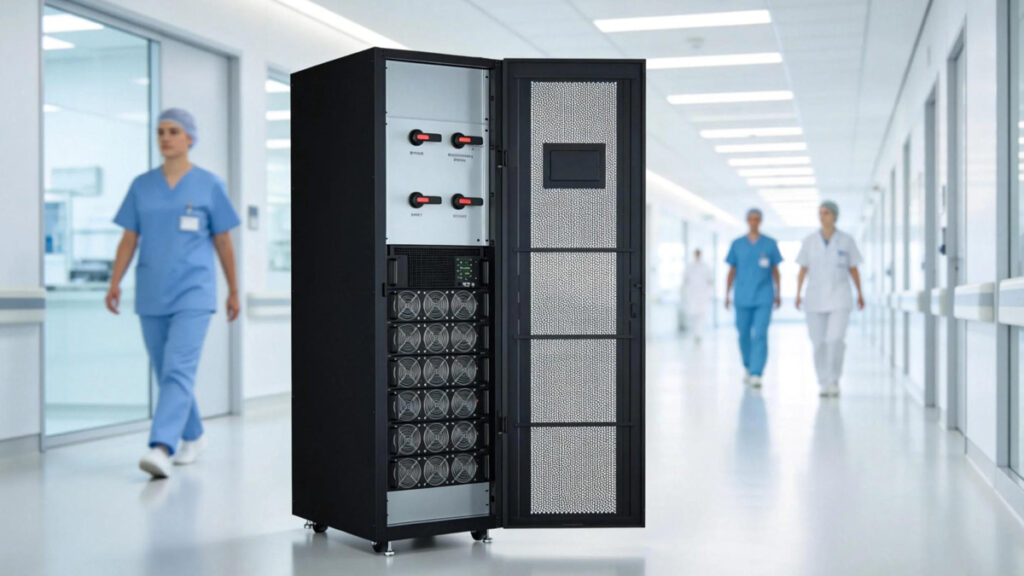
Replacing a module while the system is online allows maintenance to proceed without shutting down critical medical equipment. This is essential for MRI machines and cath labs, which can take hours to recalibrate after a cold start.
Space Optimization
Real estate in urban hospitals is scarce. Modular units offer a high power density (kW per square foot). This allows facilities to allocate more space to patient care rather than mechanical rooms.
Future-Proofing
As hospitals integrate more IoT (Internet of Things) devices and AI-driven diagnostic tools, their IT load grows. A modular architecture enables the power infrastructure to scale with technological advancement. It does so without requiring a costly “rip and replace” overhaul.
Key Applications of Modular UPS for Hospitals
Critical Medical Equipment
- Ventilators
- Dialysis machines
- Anesthesia systems
Diagnostic Systems
- MRI (Magnetic Resonance Imaging)
- CT scanners
- X-ray machines
IT & Data Centers
- Hospital Information Systems (HIS)
- Electronic Medical Records (EMR)
- Telemedicine platforms
Emergency Systems
- Operating rooms (OR)
- Intensive Care Units (ICU)
- Emergency lighting and alarms
Technical Advantages of Modular UPS for Healthcare
1. High Efficiency (Up to 96–98%)
Reduces energy consumption and operational costs, critical for large hospital facilities.
2. Advanced Load Adaptability
- Handles 100% unbalanced loads
- Suitable for mixed medical equipment with nonlinear characteristics
3. Integrated Monitoring & Smart Management
- Real-time diagnostics
- Remote monitoring via SNMP / RS485 / IoT platforms
- Predictive maintenance capabilities
4. Isolation Transformer Compatibility
Ensures:
- Electrical isolation
- Improved safety for sensitive medical devices
- Reduced harmonic distortion
Modular UPS vs Traditional UPS in Hospitals
| Feature | Modular UPS | Traditional UPS |
|---|---|---|
| Scalability | High (plug-and-play modules) | Limited |
| Maintenance | Hot-swappable | Requires shutdown |
| Reliability | High (distributed redundancy) | Lower |
| Initial Cost | Flexible investment | High upfront |
| Fault Isolation | Excellent | Limited |
How to Choose the Right Modular UPS for Hospitals
Define the protected loads
and record actual VA and watts for each.
Separate life‑critical loads (must never drop) from non‑critical loads.
Determine required runtime and availability
minutes/hours for extended outages).
Choose availability target and redundancy (common: N+1, N+2, or 2N for the most critical
systems).
Size capacity with growth and derating
Select modular UPS capacity in kVA that supports combined load at desired redundancy
(e.g., for N+1: choose total installed capacity = required load × (1 + 1/Nmodule) depending
on module size and count).
Select modular architecture & scalability
without downtime.
Confirm minimum and maximum module counts, and that performance (efficiency,
redundancy) scales predictably as modules are added.
Battery system and runtime options
Decide integrated battery cabinets vs external battery rooms; size battery bank for target
runtime and temperature‑compensated charging.
Verify battery maintenance, expected life, and replacement procedures without interrupting
loads.
Monitoring, controls & IT integration
predictive diagnostics, and integration with hospital BMS/DCIM.
Prefer solutions with secure remote access and role‑based user controls.
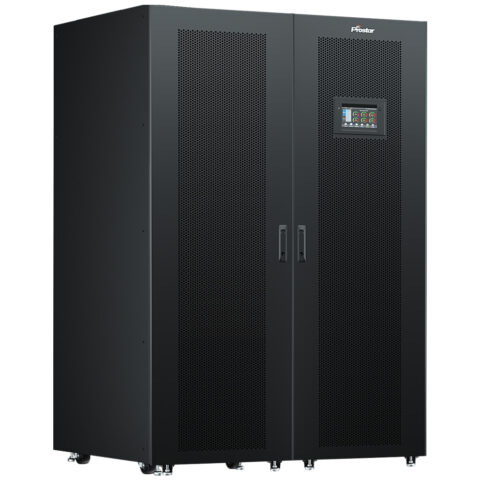
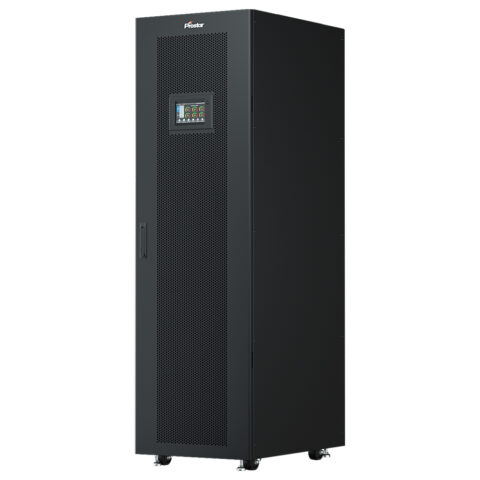
Typical Prostar Deployment in Hospitals
Critical Loads (ICU, Operating Room)
- Dedicated modular UPS with N+1 redundancy
- Separate battery bank
- Isolation transformer included
Diagnostic Equipment
- High-capacity modular UPS
- Stable voltage output
- Harmonic filtering
IT & Data Systems
- Modular UPS integrated with data center
- Scalable for future expansion
Related Modular UPS System
Future-Proofing Hospitals with Prostar UPS
Prostar solutions are aligned with next-generation hospital infrastructure:
- Smart hospital integration (IoT + BMS)
- Renewable energy compatibility (solar + storage)
- AI-based predictive maintenance
- Modular expansion without downtime
Frequently Asked Questions (FAQ)
How long can a modular UPS power hospital equipment?
Can modular UPS systems support older medical equipment?
Why is redundancy important in hospital UPS systems?
How often should hospital UPS be tested?
Which battery is better for medical UPS system?
The Articles You may Like
- Understanding How Scalable Modular UPS Systems Work
- Stand-alone power system – Wikipedia
- Modular UPS System for Data Centers & IT Infrastructure
- How Long Should the Durable Online UPS Systems Last
- Choosing the Best Uninterruptible Power Supply UPS for Home Use
- How to Choose 3 Phase Online UPS for Laser Cutting Machine