
As power infrastructure evolves, more businesses are replacing traditional lead-acid batteries with advanced lithium battery UPS systems. From data centers and hospitals to telecom sites and industrial automation, lithium UPS battery technology is rapidly becoming the preferred solution for high-efficiency, long-life backup power. In a lithium UPS, energy is stored in lithium-based battery packs—either integrated within or external to the UPS unit. Lithium battery for UPS is quickly becoming the gold standard for businesses and homeowners alike, offering unmatched efficiency, longevity, and reliability.
But can you simply swap out your old battery? What safety requirements must you meet? This guide covers everything you need to know—including compatibility, safety electronics, and proper sizing.
Why Pick a Lithium Battery for UPS?
One of the most common questions we hear from customers is: Why choose a lithium battery for UPS instead of lead-acid?
The answer lies in performance, lifecycle cost, and operational efficiency.
Key Advantages of Lithium UPS Batteries
1. Longer Service Life
Lithium batteries can deliver:
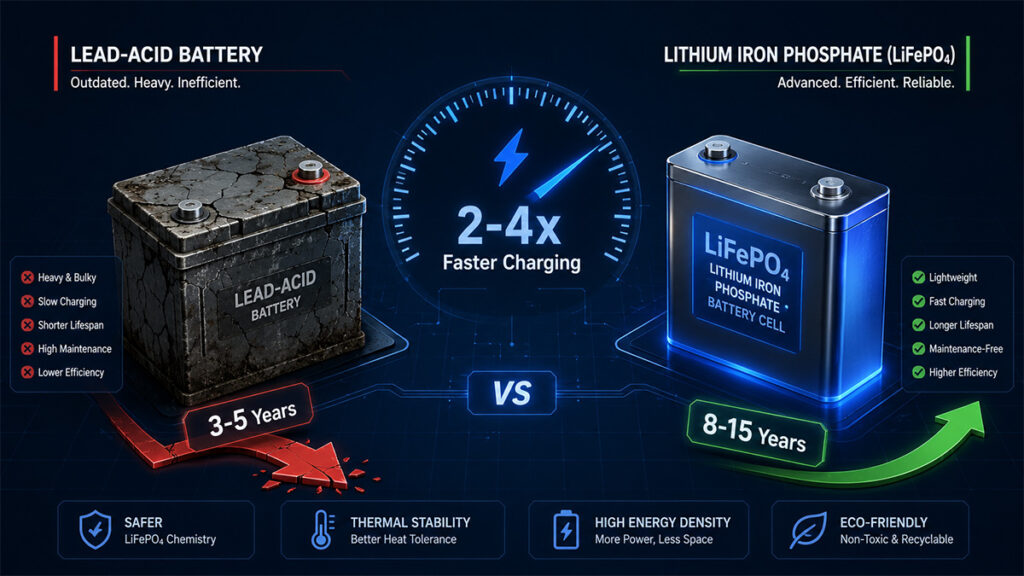
- 8–15 years of design life
- 3,000–6,000 charge cycles
- Significantly lower replacement frequency
Compared with traditional lead-acid batteries—which often require replacement every 3–5 years—lithium batteries dramatically reduce both maintenance and replacement costs over the system’s lifetime.
2. Faster Charging Speed
Lithium UPS batteries recharge much faster after a power outage, making them ideal for unstable grid environments.
The main benefits include:
- 2–4× faster recharge than lead-acid
- Higher charging efficiency
- Better readiness for repeated outages
In Prostar lithium single phase UPS, 1kVA – 2kVA charging current is adjustable from 1A to 20A, and 3kVA is 1A to 30A.
3. Smaller Footprint & Lower Weight
Lithium batteries boast far higher energy density, which means:
- Reduced battery room space
- Easier transportation and installation
- Lower floor-loading requirements
For modern server rooms and telecom cabinets, compact battery systems are increasingly essential.
4. Higher Efficiency
Lithium battery for ups systems offer:
- Lower internal resistance
- Better discharge efficiency
- Reduced heat generation
All of which improve the overall efficiency of the UPS power system.
Why Does a Lithium Polymer Battery Need a BMS?
12V Lithium Iron Battery vs Lead Acid: Which is Better for Your System?
How 3 Phase Lithium UPS System Enhances Backup Power Performance
Is Your UPS Compatible with Lithium Battery?
Not every UPS is designed to work seamlessly with lithium technology. A lithium battery for ups must support specific charging profiles, voltage ranges, and communication protocols.
Modern UPS systems, such as Prostar lithium UPS solutions, are specifically engineered for lithium integration. These systems support both:
- Single-phase UPS from 1kVA to 3kVA
- Three-phase UPS systems that work with lithium battery configurations
Choosing a lithium battery for ups ensures optimal performance, safety, and battery lifespan.
A Lithium Battery Won’t Work in an Old UPS
One of the most common mistakes is assuming retrofitting is plug-and-play. A lithium battery will not work in legacy UPS systems without proper verification. Here’s why:
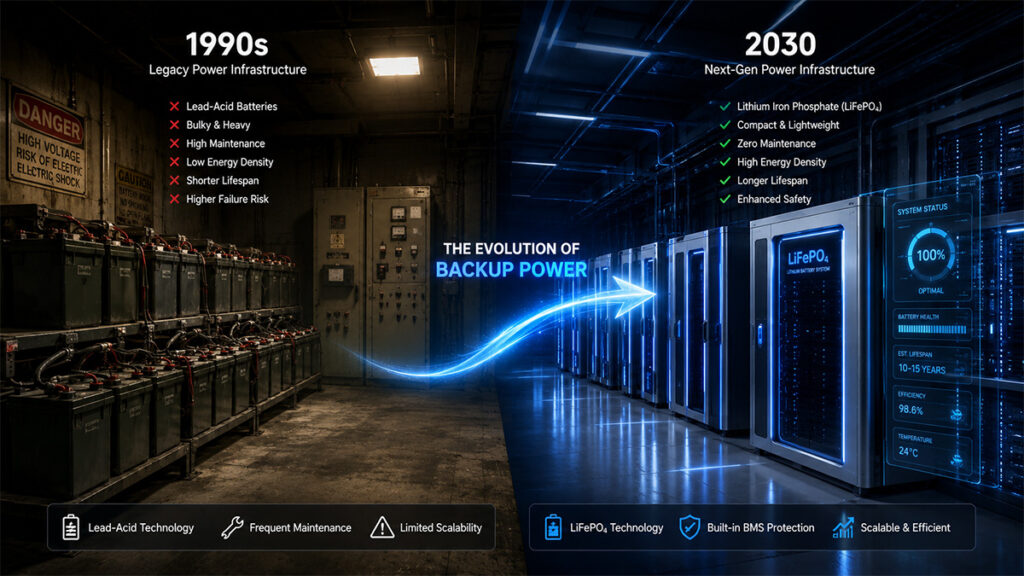
Old UPS units are designed with charging algorithms optimized for lead-acid batteries (typically float charging at 13.5V–13.8V). Lithium Iron Phosphate (LiFePO4), on the other hand, requires a Constant Current / Constant Voltage (CC/CV) charging profile with different absorption voltages.
If you connect a lithium battery to a old UPS:
| Risk | Consequence |
|---|---|
| The UPS may never fully charge the lithium pack | Inadequate backup runtime |
| The UPS may “trickle charge” continuously | Accelerated cell degradation |
| Warranty voiding | No manufacturer support |
| Uncontrolled charging | Fire and safety hazards |
Why Older UPS Systems May Fail with Lithium
The older UPS models often lack:
- Lithium charging algorithms
- Communication interfaces
- Proper float charging control
- BMS communication support
- Voltage parameter flexibility
This may lead to:
- Charging failure
- Battery alarms
- Reduced runtime
- Battery protection shutdown
- Safety risks
Therefore, retrofitting lithium batteries into legacy UPS systems requires careful engineering evaluation.
What Makes a UPS Compatible with Lithium Battery?
A professional lithium-compatible UPS should support:
| Feature | Purpose |
|---|---|
| Adjustable charging voltage | Match LiFePO4 CC/CV profile |
| Configurable charging current | Prevent overcurrent damage |
| Battery communication protocols | Enable BMS ↔ UPS dialogue |
| Smart battery management integration | Real-time monitoring & control |
| Temperature compensation logic | Adapt to ambient conditions |
| Advanced alarm & protection functions | Early fault detection |
Without these features, operational risks are unavoidable.
BMS Requirements for Lithium UPS Batteries
The BMS is the core safety and intelligence component of any lithium UPS battery solution. Understanding BMS requirements is essential for safe, reliable operation.
Essential BMS Functions
A lithium battery for ups BMS must include:
| Function | Description |
|---|---|
| Cell voltage balancing | Equalize charge across all cells |
| Overcharge protection | Prevent cell damage from overvoltage |
| Over-discharge protection | Avoid deep discharge damage |
| Over-current protection | Guard against excessive current draw |
| Short-circuit protection | Immediate fault isolation |
| Temperature monitoring | Thermal runaway prevention |
| SOC calculation | Accurate State of Charge tracking |
| SOH monitoring | Long-term health assessment |
| UPS communication | Seamless system integration |
Common Communication Protocols
| Protocol | Typical Use Case |
|---|---|
| RS485 | Serial communication, widely supported |
| CAN bus | High-speed, noise-resistant signaling |
| Modbus | Industrial standard, broad compatibility |
The UPS and BMS must communicate correctly to ensure stable, safe operation.
How to Size a Lithium Battery for UPS
Another important topic is how to size lithium battery for UPS applications.
UPS battery sizing depends on several technical factors.
Load Power
Calculate the actual load in:
- Watts (W)
- kVA
Example:
- 10kW server load
- 20kVA industrial load
UPS Battery Discharge Current
The discharge current of a UPS battery is not constant; it changes based on the load. The most accurate way to determine the maximum expected current is by using the following formula based on the UPS load and system efficiency.
Formula:
Discharge current (A) = UPS Power (W) / Battery Voltage (V)
LiFePO4 battery can handle higher discharge currents more efficiently than lead-acid and maintain a flatter voltage curve, making them superior for high-current applications.
Required Backup Time
Typical runtime about lithium battery for UPS requirements include:
- 5 minutes
- 10 minutes
- 15 minutes
- 30 minutes
- 1 hour or more
Calculate Running Time Formula:
Running time (Hours) = [Battery Voltage (Vbat) * Battery Capacity (Ah) * DoD * ηbat * ηups ] / Pload
Where:
- Vbat = nominal battery voltage (V) — e.g. 12.8V, 51.2 V.
- Ah = battery amp-hour rating (Ah).
- DoD = usable depth-of-discharge as a fraction (e.g. 0.8 for 80% usable).
- ηbat = battery efficiency (round-trip, ~0.95 typical; you can omit or set =1 if you want simpler).
- ηups = UPS inverter efficiency (use 0.80–0.95 depending on model).
- Pload = load power in watts (W).
Battery Voltage
Ensure the UPS DC bus voltage matches the LiFePO4 battery nominal voltage:
| UPS DC Input | Compatible LiFePO4 Battery |
| 12V | 12.8V |
| 24V | 25.6V |
| 36V | 35.2V or 38.4V |
| 48V | 51.2V |
| 72V | 76.8V |
| 96V | 102.4V |
| 192V | 204.8V |
| 240V, +/- 120V | 256V, +/- 128V |
| 360V | 358.4V |
| 384V, +/-192V | 409.6V, +/- 204.8V |
| 480V, +/-240V | 512V, +/- 256V |
| 600V | 614.4V |
Battery Capacity
Battery capacity is calculated in:
- Ah (Ampere-hour)
Convert aboved formula:
Battery Capacity (Ah) = [Pload * Running time (Hours)] / [Battery Voltage (Vbat) * DoD * ηbat * ηups ]
Worked examples
(1) Runtime:
Prostar 358.4V 100AH LiFePO4 Battery, DoD 80%, ET30K UPS, UPS Efficiency 93%, Full load:
Running time = [Battery Voltage (Vbat) * Battery Capacity (Ah) * DoD * ηbat * ηups ] / Pload
= 358.4 * 100 * 0.8 * 0.95 * 0.93 / 30000 = 0.844 hours = 50.6 minutes
(2) Battery Capacity:
ET30K UPS, UPS Efficiency 93%, Full load, Backup Time 30 minutes, DoD 80%
Battery Capacity = Pload * Running time (Hours) / Battery Voltage (Vbat) * DoD * ηbat * ηups
= 30000 * 0.5 / (358.4 * 0.8 * 0.95 * 0.93) = 59.21 ≈ 60AH
so, the battery capacity should be choose 358.4V 60AH. (Make sure this 60AH battery can accept this UPS discharge current about 83.71A)
Working with manufacturers like Prostar ensures accurate sizing and optimal system matching for both single-phase and three-phase applications.
Related Lithium Battery for UPS System
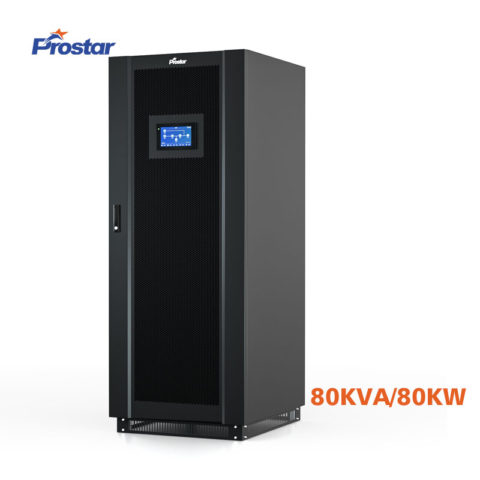
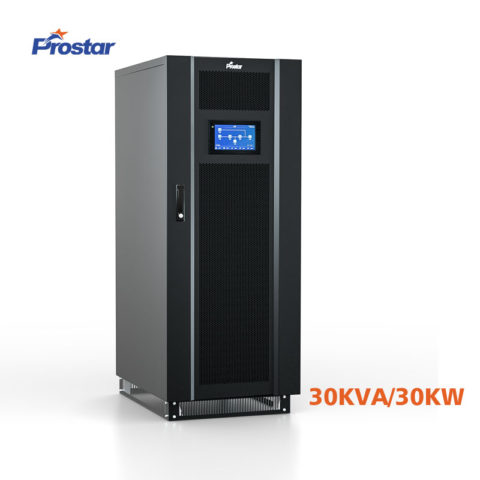
Prostar Lithium UPS: Built-In BMS Solutions
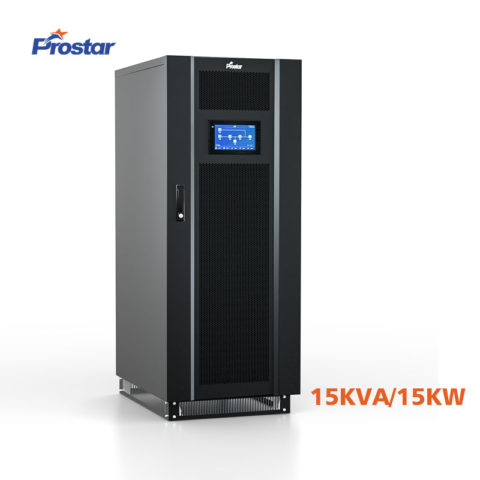
Enter Prostar, a leader in next-generation power backup. Prostar understands that complexity kills adoption. Their solution? A UPS is built-in BMS, meaning you don’t need “smart” batteries; you just need standard lithium cells managed by an intelligent UPS.
Single-Phase Solutions (1 kVA – 3 kVA)
For home offices, small servers, and network closets, Prostar’s single-phase 1–3 kVA lineup works seamlessly with lithium batteries. These units feature:
- Preset lithium charging algorithms
- Fanless, silent operation
- Hot-swappable battery modules
Three-Phase Solutions
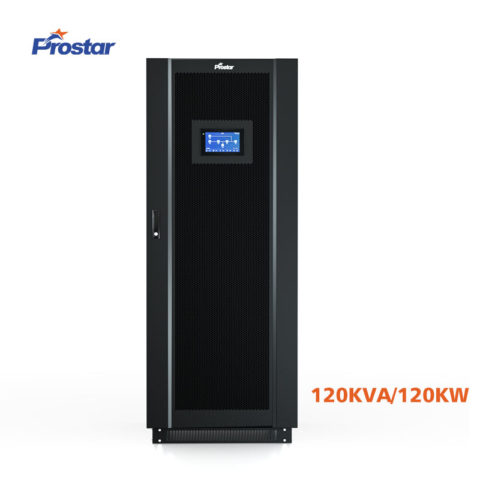
For industrial machinery and data centers, Prostar’s high-power three-phase UPS systems work with lithium batteries at 208V, 400V, or 480V inputs. These systems offer:
- Scalability up to several MW
- Advanced parallel redundancy
- Enterprise-grade reliability
These features make Prostar a strong choice for users seeking reliable and future-proof power backup solutions.
FAQ
What is a lithium battery for UPS?
Is every UPS compatible with lithium battery?
A lithium battery for ups should support:
– Adjustable charging voltage
– Configurable charging current
– BMS communication
– Smart charging algorithms
– Temperature protection
Using incompatible UPS systems may cause charging failures or battery alarms.
Can I replace lead-acid batteries with lithium batteries in my UPS?
Some modern UPS systems support lithium battery upgrades directly, while older models may require:
– Firmware updates
– Charger modifications
– External communication modules
– BMS integration
Always confirm with the UPS manufacturer before replacement.
What is the lifespan of a lithium UPS battery?
– 8–15 years design life
– 3000–6000 charge cycles
This is significantly longer than typical lead-acid batteries.
The Articles You may Like
- The Role of Industrial UPS for Oil and Gas Refineries
- Stand-alone power system – Wikipedia
- Modular UPS vs Traditional UPS: Which One is Better?
- What is Slew Rate in UPS System?A Complete Guide
- Choosing the Best Uninterruptible Power Supply UPS for Home Use
- How Does a Bidirectional Inverter Work