
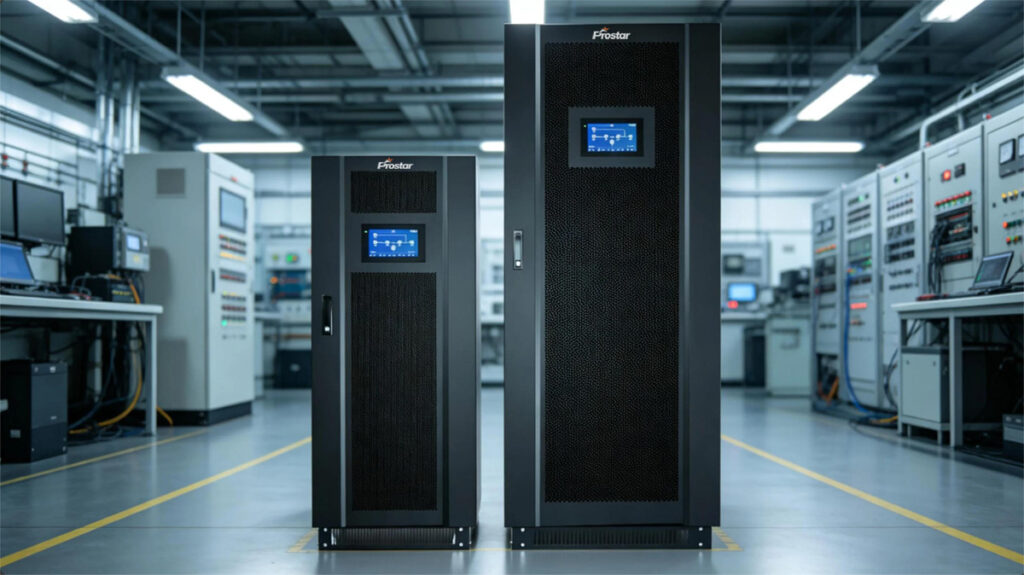
When selecting a UPS (Uninterruptible Power Supply) for industrial or critical applications, one key parameter is often overlooked. It is the slew rate. Unlike voltage, this parameter specifically refers to how quickly a UPS inverter can change its output frequency. It does this to match the input utility frequency. Proper understanding of slew rate is critical for smooth operation in systems that switch between utility (bypass) and inverter power.
What is Slew Rate?
Slew rate in the context of a UPS system, indicates how quickly the UPS inverter changes its output frequency. This change is necessary to synchronize with the input utility (bypass) frequency.
It is typically measured in Hertz per second (Hz/s).
During events such as transferring from mains power to battery or back, the UPS system must match its output frequency with the utility grid. This synchronization ensures stability. If the UPS synchronization is too slow, the UPS system may experience a phase mismatch. This can cause transients or even brief interruptions in the power supplied to sensitive equipment.
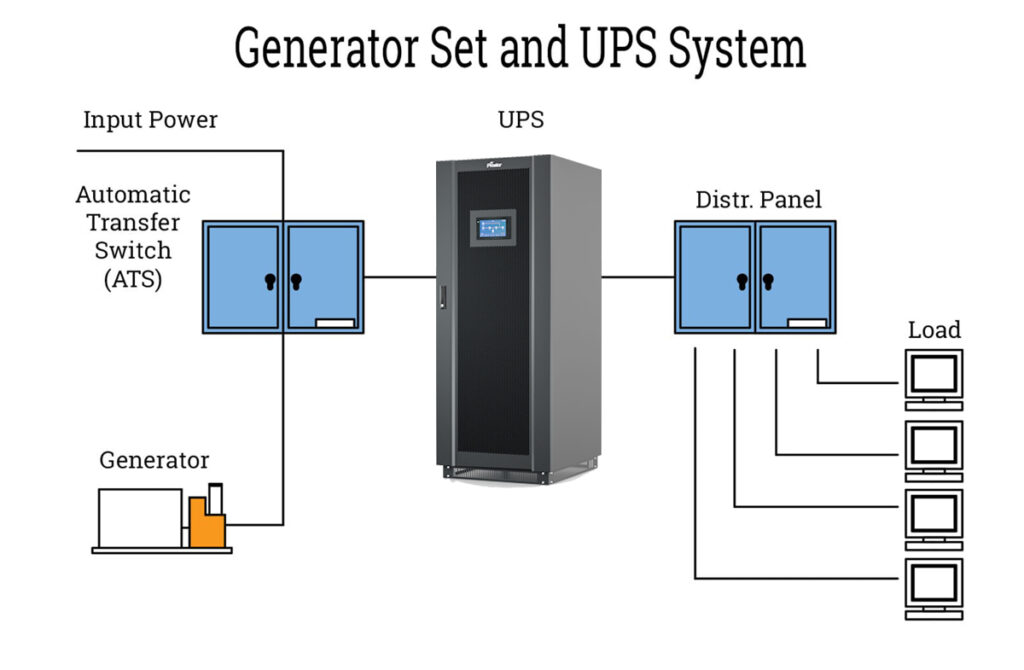
In practical UPS operation, slew rate is especially important when the UPS is connected to a generator. If the generator speed changes too quickly, the frequency may drift or overshoot. The UPS may interpret this as an unstable source.
A common example is a UPS that is set to tolerate a certain frequency-change limit, such as 1 Hz/s. If the input frequency changes faster than that, the UPS may stop synchronizing with the source. It will switch to its own internal frequency control instead.
Why Slew Rate Matters for UPS Performance
Prostar online (double-conversion) UPS systems continuously monitor input voltage, frequency, and slew rate. They use this information to decide whether to stay in normal mode. This involves passing conditioned utility or generator power. Alternatively, they may switch to battery backup.
Synchronization process
The UPS inverter phase-locks to the input frequency. If the input frequency changes too rapidly (high UPS frequency tracking rate), the UPS cannot maintain synchronization safely.
Generator compatibility
This is where UPS frequency tracking becomes most relevant. Generators experience sudden frequency drops or rises when large motors start, loads change, or the engine governor reacts. A high UPS frequency tracking rate (e.g., >1–2 Hz/s) signals instability, causing the UPS to reject the generator and transfer to battery—even if the generator is still running fine.
Without proper UPS output frequency adjustment handling, you risk:
- Frequent battery cycling (reducing battery life)
- Unnecessary alarms and downtime
- Overloading the generator or UPS bypass circuit
How it Works
When the input frequency changes, the UPS calculate as:
Slew Rate = ΔFrequency / ΔTime (in Hz/s)
For example:
- Frequency shifts from 60 Hz to 61 Hz in 1 second → 1 Hz/s.
- The same shift in 0.5 seconds → 2 Hz/s (faster, more unstable).
Most UPS systems allow you to configure:
- Maximum acceptable slew rate (before rejecting input)
- Static frequency tolerance (±% around nominal 50/60 Hz)
If the ups output frequency adjustment exceeds the set limit, the UPS:
- Stops tracking the input frequency
- Switches the load to inverter (battery) mode
- May trigger a “phase synchronization fault” or “bypass not available” alarm
This protects sensitive loads from distorted power but can cause issues in generator-backed setups.
Slew Rate vs. Other UPS Metrics
It is easy to confuse slew rate with other UPS specifications. Here is how they differ:
| Parameter | Definition | Why It’s Different |
|---|---|---|
| Slew Rate | Speed of change (frequency/voltage) | Focuses on dynamics and transient response. |
| THD | Total Harmonic Distortion | Focuses on steady-state waveform purity. |
| Transfer Time | Time to switch to battery | Focuses on static switching, not continuous adjustment. |
| Frequency Regulation | Steady-state accuracy | Focuses on maintaining a static value, not rate of change. |
What is a Good Slew Rate for a UPS?
The “ideal” slew rate depends on your application:
For Data Centers (IT Loads)
A lower ups output frequency adjustment (0.5 Hz/s to 1.0 Hz/s) is generally preferred to ensure stable operation of high-density server power supplies.
For Generator Applications
The medium to high ups output frequency adjustment (1.0 Hz/s to 2.0 Hz/s) is necessary to track the drifting frequency of diesel generators during startup and load changes.
For Industrial Motors
A very high voltage slew rate can cause insulation breakdown in motors. Industrial UPS systems often limit voltage output frequency adjustment to protect downstream inductive loads.
| Scenario | Recommended | Reasoning |
| Stable Utility Grid | 0.5Hz/s – 1.0Hz/s | Prioritizes load safety and smooth transitions. |
| Unstable Grid / Generator | 1.0 Hz/s – 2.0Hz/s | Maintains synchronization despite fluctuations. |
| High Sensitivity Lab Gear | < 0.2 Hz/s | Protects frequency-sensitive scientific instruments. |
Factory defaults are usually conservative (~2 Hz/s) for utility power. For generator applications, increase it to 1–2 Hz/s or higher to improve compatibility. However, test thoroughly. Higher values may allow more frequency variation to reach your loads.
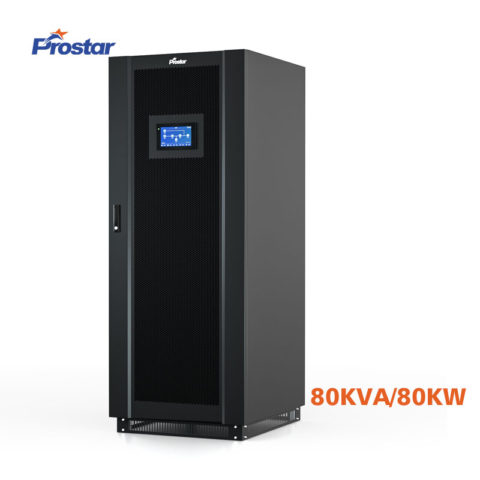
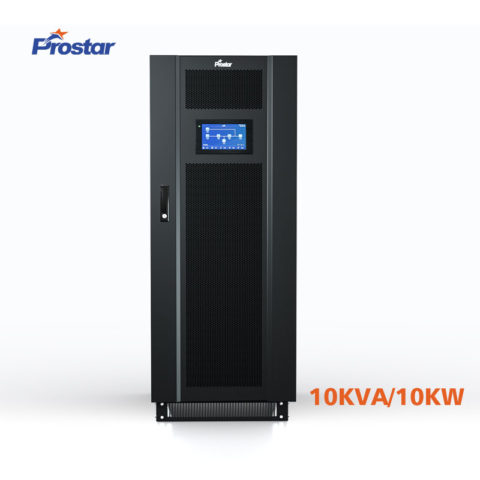
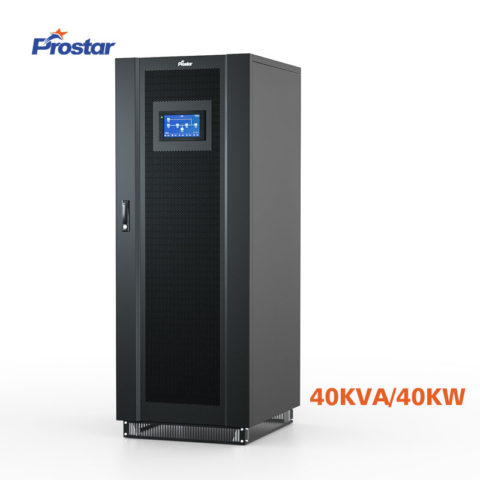
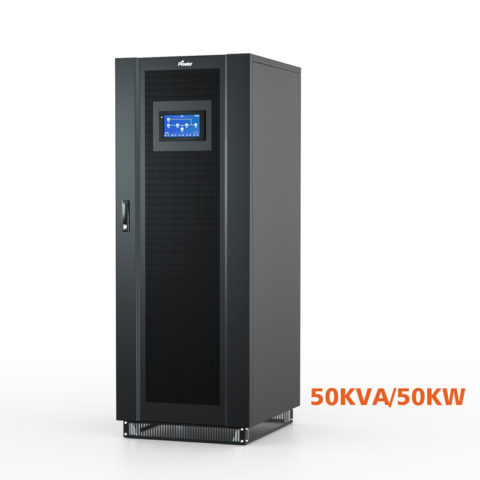
Related Industrial Online UPS
Common Issues with Slew Rate in UPS + Generator Setups
Issues:
- Frequent transfer to battery — Generator undersized or poor governor response.
- Synchronization faults — Slew rate setting too low for real-world generator behavior.
- Load flicker or instability — Setting slew rate too high on sensitive equipment.
- Alarm fatigue — Operators ignore real problems because of constant slew-rate warnings.
Solution:
- Oversize the generator (recommend 1–2× UPS rating for non-linear loads).
- Use inverter-type or electronically governed generators (lower inherent slew rate).
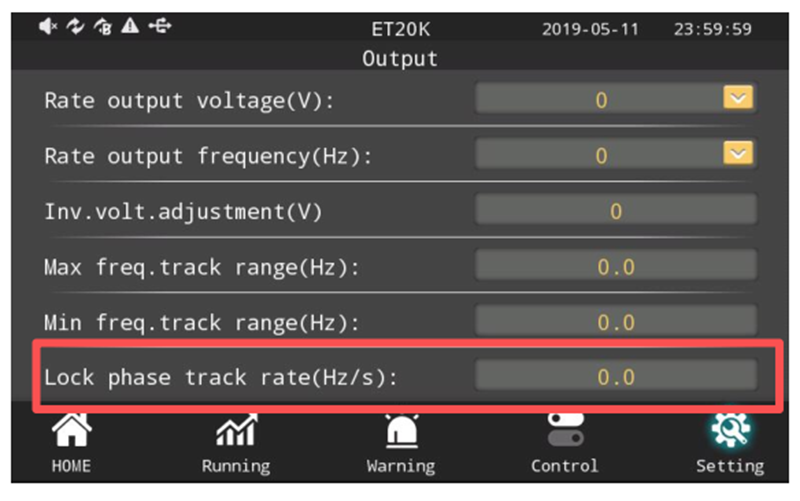
- Adjust UPS slew rate parameter via front panel or software.
- Add a UPS with wider slew rate tolerance or “generator mode” feature.
Optimizing UPS Performance
- Understand Your Load Sensitivity – Sensitive electronics prefer lower slew rates for smoother transitions.
- Parallel Configurations – Synchronize all units with the same slew rate to avoid circulating currents.
- Industrial Equipment – For motors and heavy machinery, using slightly higher slew rates (up to 2 Hz/s) enables faster adaptation. This ensures they adjust more quickly to supply changes.
- Factory Defaults – Prostar ET series 3 phase industrial UPS has a default of 2 Hz/s. This slew rate settings for UPS provides a reliable balance for most industrial and commercial applications.
FAQ
Is slew rate the same as voltage slew rate in power supplies?
Can I change slew rate on any UPS?
What happens if the slew rate is too high?
How do I know if my UPS is rejecting input due to slew rate?
The Articles You may Like
- Modular UPS vs Monolithic UPS: Key Differences
- Stand-alone power system – Wikipedia
- What is Slew Rate in relation to UPS Systems?
- Modular UPS for Hospitals: Reliable Power Backup Solutions
- Customizable UPS Solutions for Reliable Power Protection
- How to Choose Online UPS for Boiler System Backup Power